AD 2017-07-05
Applicability
| Type | Manufacturer | Model | Details |
|---|---|---|---|
| aircraft | Airbus | A300 | Airworthiness Directives; Airbus Airplanes |
Unsafe Condition
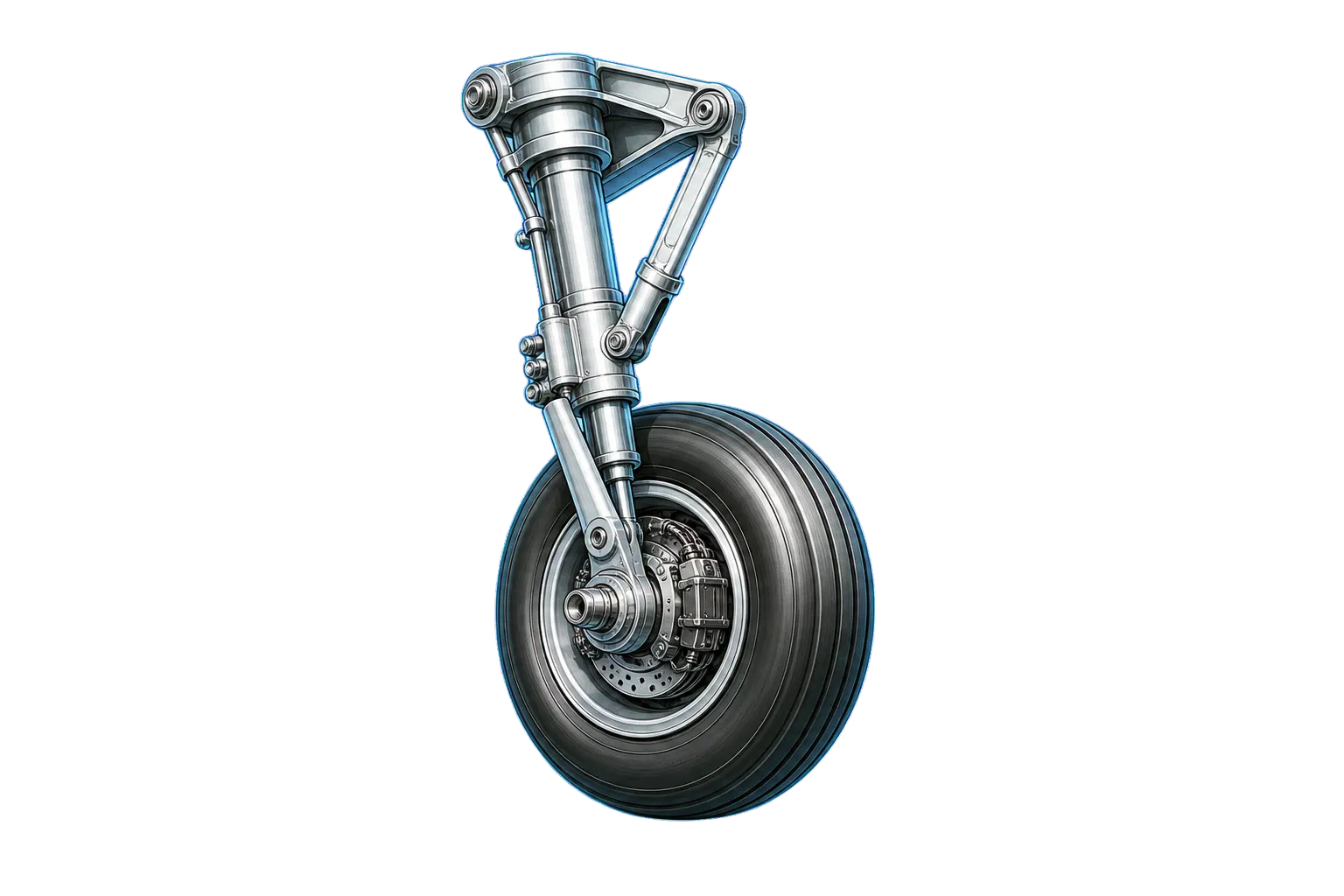
Cracks in main landing gear (MLG) leg components, specifically the MLG hinge arm/barrel pin, which could lead to MLG collapse, resulting in damage to the airplane and potential injury to occupants.
AI-generated summary from the source AD text. Verify against the official source before acting.
Required Actions
Detailed visual inspections of MLG leg components for cracks must be conducted. If cracked components are found, the MLG leg must be replaced.
AI-generated summary from the source AD text. Verify against the official source before acting.
Compliance Time
Within 100 flight cycles after the effective date of the AD.
AI-generated summary from the source AD text. Verify against the official source before acting.
Affected Aircraft
All Airbus Model A300 series airplanes, including Model A300 B4-600, B4-600R, F4-600R series airplanes, and Model A300 C4-605R Variant F airplanes (collectively called Model A300-600 series airplanes).
AI-generated summary from the source AD text. Verify against the official source before acting.
Federal Register Abstract
We are adopting a new airworthiness directive (AD) for all Airbus Model A300 series airplanes; and Model A300 B4-600, B4-600R, and F4-600R series airplanes, and Model A300 C4-605R Variant F airplanes (collectively called Model A300-600 series airplanes). This AD was prompted by reports of cracks in main landing gear (MLG) leg components. This AD requires detailed visual inspections of these MLG leg components and replacement of the MLG leg if cracked components are found. We are issuing this AD to address the unsafe condition on these products.
Applicability Source Text
Show captured applicability text from the source AD
(c) Applicability

    This AD applies to Airbus airplanes identified in paragraphs
(c)(1) through (c)(5) of this AD, certificated in any category, all
manufacturer serial numbers.
    (1) Model A300 B2-1A, B2-1C, B2K-3C, B2-203, B4-2C, B4-103, and
B4-203 airplanes.
    (2) Model A300 B4-601, B4-603, B4-620, and B4-622 airplanes.
    (3) Model A300 B4-605R and B4-622R airplanes.
    (4) Model A300 F4-605R and F4-622R airplanes.
    (5) Model A300 C4-605R Variant F airplanes.
Document Text
Show stored source text (verify against official source)
[Federal Register Volume 82, Number 62 (Monday, April 3, 2017)]
[Rules and Regulations]
[Pages 16101-16105]
From the Federal Register Online via the Government Publishing Office [<a href="http://www.gpo.gov">www.gpo.gov</a>]
[FR Doc No: 2017-06359]
=======================================================================
-----------------------------------------------------------------------
DEPARTMENT OF TRANSPORTATION
Federal Aviation Administration
14 CFR Part 39
[Docket No. FAA-2016-8184; Directorate Identifier 2016-NM-036-AD;
Amendment 39-18843; AD 2017-07-05]
RIN 2120-AA64
Airworthiness Directives; Airbus Airplanes
AGENCY: Federal Aviation Administration (FAA), Department of
Transportation (DOT).
ACTION: Final rule.
-----------------------------------------------------------------------
SUMMARY: We are adopting a new airworthiness directive (AD) for all
Airbus Model A300 series airplanes; and Model A300 B4-600, B4-600R, and
F4-600R series airplanes, and Model A300 C4-605R Variant F airplanes
(collectively called Model A300-600 series airplanes). This AD was
prompted by reports of cracks in main landing gear (MLG) leg
components. This AD requires detailed visual inspections of these MLG
leg components and replacement of the MLG leg if cracked components are
found. We are issuing this AD to address the unsafe condition on these
products.
DATES: This AD is effective May 8, 2017.
The Director of the Federal Register approved the incorporation by
reference of a certain publication listed in this AD as of May 8, 2017.
ADDRESSES: For service information identified in this final rule,
contact Airbus SAS, Airworthiness Office--EAW, 1 Rond Point Maurice
Bellonte, 31707 Blagnac Cedex, France; telephone +33 5 61 93 36 96; fax
+33 5 61 93 44 51; email <a href="/cdn-cgi/l/email-protection#a4c5c7c7cbd1cad08ac5cdd6d3cbd6d0cc89c1c5d7e4c5cdd6c6d1d78ac7cbc9"><span class="__cf_email__" data-cfemail="83e2e0e0ecf6edf7ade2eaf1f4ecf1f7ebaee6e2f0c3e2eaf1e1f6f0ade0ecee">[email protected]</span></a>; Internet
<a href="http://www.airbus.com">http://www.airbus.com</a>. You may view this referenced service information
at the FAA, Transport Airplane Directorate, 1601 Lind Avenue SW.,
Renton, WA. For information on the availability of this material at the
FAA, call 425-227-1221. It is also available on the Internet at <a href="http://www.regulations.gov">http://www.regulations.gov</a> by searching for and locating Docket No. FAA-2016-
8184.
Examining the AD Docket
You may examine the AD docket on the Internet at <a href="http://www.regulations.gov">http://www.regulations.gov</a> by searching for and locating Docket No. FAA-2016-
8184; or in person at the Docket Management Facility between 9 a.m. and
5 p.m., Monday through Friday, except Federal holidays. The AD docket
contains this AD, the regulatory evaluation, any comments received, and
other information. The street address for the Docket Office (telephone
800-647-5527) is Docket Management Facility, U.S. Department of
Transportation, Docket Operations, M-30, West Building Ground Floor,
Room W12-140, 1200 New Jersey Avenue SE., Washington, DC 20590.
FOR FURTHER INFORMATION CONTACT: Dan Rodina, Aerospace Engineer,
International Branch, ANM-116, Transport Airplane Directorate, FAA,
1601 Lind Avenue SW., Renton, WA 98057-3356; telephone: 425-227-2125;
fax: 425-227-1149.
SUPPLEMENTARY INFORMATION:
Discussion
We issued a notice of proposed rulemaking (NPRM) to amend 14 CFR
part 39 by adding an AD that would apply to all Airbus Model A300
series airplanes; and Model A300 B4-600, B4-600R, and F4-600R series
airplanes, and Model A300 C4-605R Variant F airplanes (collectively
called Model A300-600 series airplanes). The NPRM was prompted by
reports of cracks in
[[Page 16102]]
MLG leg components. The NPRM proposed to require repetitive detailed
visual inspections of certain MLG leg components for cracks, and
replacing the MLG leg if necessary. We are issuing this AD to detect
and correct cracking of certain components in the MLG leg, which could
result in a MLG collapse, and consequent damage to the airplane and
injury to the airplane occupants.
The NPRM published in the Federal Register on August 5, 2016 (81 FR
51818) (``the NPRM'').
The European Aviation Safety Agency (EASA), which is the Technical
Agent for the Member States of the European Union, has issued EASA AD
2016-0058, dated March 21, 2016 (referred to after this as ``the
MCAI''), to correct an unsafe condition for all Airbus Model A300
series airplanes; and Model A300 B4-600, B4-600R, and F4-600R series
airplanes, and Model A300 C4-605R Variant F airplanes (collectively
called Model A300-600 series airplanes). The MCAI states:
Two cases were reported of finding a cracked main landing gear
(MLG) hinge arm/barrel pin, one was discovered in service during a
maintenance task and the other one was identified during MLG
overhaul.
This condition, if not detected and corrected, could lead to MLG
collapse, resulting in damage to the aeroplane and potential injury
to occupants.
To address this potential unsafe condition, and awaiting a final
fix establishment, Airbus issued Alert Operators Transmission (AOT)
32W008-16 to provide instructions for detailed visual inspections
(DET) to detect through cracks.
For the reasons described above, this [EASA] AD requires
repetitive DET of the MLG hinge arm/barrel pin and, depending on
findings, replacement of the affected MLG leg.
You may examine the MCAI in the AD docket on the Internet at <a href="http://www.regulations.gov">http://www.regulations.gov</a> by searching for and locating Docket No. FAA-2016-
8184.
Comments
We gave the public the opportunity to participate in developing
this AD. The following presents the comments received on the NPRM and
the FAA's response to each comment.
Requests To Permit On-Wing Inspection/Pin Replacement
FedEx asked whether the airframe manufacturer and/or MLG
manufacturer have explored the possibility of inspecting the affected
MLG and replacing a cracked MLG hinge arm/barrel pin without removing
the MLG leg, as specified by Airbus Alert Operators Transmission (AOT)
A32W008-16, dated February 25, 2016, including Appendices 1 through 4.
FedEx stated that an on-wing inspection of the MLG leg would be
effective in determining if further structural damage has occurred.
United Parcel Service (UPS) requested that we revise the NPRM to
allow on-wing replacement of a cracked pin with part number C66441-(x)
instead of replacing the MLG leg. UPS stated that it has reviewed the
Airbus A300 Aircraft Maintenance Manual (AMM) and noted that the AMM
indicates that the pin can be replaced while the gear is installed on
the airplane.
We do not agree that an on-wing inspection of the MLG would be
effective in finding further structural damage. When a hinge arm/barrel
pin is cracked, damage to other MLG components cannot be excluded. This
damage cannot be detected by on-wing inspections. Airbus currently does
not have an approved method for on-wing inspections to detect all
possible damage to the MLG components. For these reasons, Airbus AOT
A32W008-16, dated February 25, 2016, including Appendices 1 through 4,
specifies removing the MLG for further inspections for damage.
We also do not agree that an on-wing replacement of the pin in the
MLG leg would be an adequate corrective action. As previously
explained, when a hinge arm/barrel pin is cracked, other MLG component
damage cannot be excluded. On-wing replacement of the pin would not
correct any other MLG component damage that might be present.
Under the provisions of paragraph (j)(1) of this AD, we will
consider requests for approval of an alternative on-wing inspection or
replacement method if sufficient data are submitted to substantiate
that the method would provide an acceptable level of safety. We have
not changed this AD in this regard.
Requests To Withdraw the NPRM or Increase the Interval Between
Inspections
UPS and FedEx requested that the 100 flight cycle inspection
interval be extended.
FedEx commented that, although it recognizes and appreciates the
airplane manufacturer's safety concerns about discovering a cracked MLG
hinge arm/barrel pin before complete failure, it would like to see the
analysis that resulted in determination of an inspection interval of
100 flight cycles to prevent in-service pin failures. FedEx asserted
that a 100 flight cycle interval may be unnecessarily conservative
based on the pre-discovery history of cracked pins in the MLG leg of
the airplane, which has had two cases of cracked MLG hinge arm/barrel
pins.
UPS requested that the FAA either withdraw the NPRM or change the
repetitive inspection interval from 100 flight cycles to 1,000 flight
cycles. UPS stated that the detailed visual inspection at intervals of
100 flight cycles for the internal diameter of each affected MLG hinge
arm/barrel pin specified by paragraph (g) of the proposed AD is too
restrictive and not supported by data. UPS stated that it believes the
cracking is associated with a specific operator's maintenance practices
rather than a design of the landing gear or pin. UPS stated that the
AMM and landing gear overhaul manual have defined inspection procedures
that have been used to properly maintain the landing gear without any
major findings for the past 30 years. UPS noted that its experience for
the past 16 years has not shown any findings. UPS provides the
following reasons for increasing the interval between inspections.
<bullet> The basis for issuance of the MCAI is findings of two
cracked pins. The first finding was discovered during gear overhaul
after the landing gear completed its gear overhaul life (8 years or
12,000 cycles). The second finding occurred after the unit accumulated
more than 3,500 flight cycles since overhaul and was also subjected to
a hard landing. Both pins had accumulated more than 25,000 flight
cycles and went to repeat overhauls before failure. This indicates that
the crack finding is associated with a specific operator maintenance
practice rather than an inherent design problem of the landing gear or
pin.
<bullet> Airbus Message 80187097/003, dated July 22, 2016, states
that Airbus is working with EASA to reduce the burden to operators.
<bullet> UPS has operated 52 Model A300 airplanes since
introduction of the model in the year 2000 with no findings. UPS's
fleet leader airplane has accumulated more than 21,000 flight cycles
with no similar finding. UPS has also reviewed all overhaul records
since the introduction of Model A300 airplanes and did not find any
cracked pins.
<bullet> UPS has accomplished the inspection specified in Airbus
AOT A32W008-16, dated February 25, 2016, including Appendices 1 through
4, every 100 flight cycles since February 2016. The 260 inspections
accomplished on 52 airplanes did not show any findings.
We do not agree to withdraw the NPRM or to increase the repetitive
interval between detailed visual inspections on the MLG leg. While the
[[Page 16103]]
MCAI cites two reports of cracked pins, Airbus has reports from the
past six years of 45 pins with damage on the outer diameter. Based on
the current reports and ongoing investigation, EASA is not able to
support an increased inspection interval. Therefore, we have determined
that the inspection interval recommended by the manufacturer and
required by EASA is appropriate based on the available data. However,
in the future, the data collected from the reporting requirement of
paragraph (i) of this AD may provide the necessary information to
justify an increase in the inspection interval. Additionally, if Airbus
develops an alternative method of compliance that reduces the burden on
operators, we will consider requests for its approval if sufficient
data is submitted to substantiate that the method would provide an
acceptable level of safety. We have not changed this AD in this regard.
Conclusion
We reviewed the relevant data, considered the comments received,
and determined that air safety and the public interest require adopting
this AD as proposed except for minor editorial changes. We have
determined that these minor changes:
<bullet> Are consistent with the intent that was proposed in the
NPRM for correcting the unsafe condition; and
<bullet> Do not add any additional burden upon the public than was
already proposed in the NPRM.
Related Service Information Under 1 CFR Part 51
We reviewed Airbus AOT A32W008-16, dated February 25, 2016,
including Appendices 1 through 4. This service information describes
procedures for a detailed visual inspection of the internal diameter of
each affected MLG hinge arm/barrel pin and replacement of the MLG leg
with a serviceable unit. This service information is reasonably
available because the interested parties have access to it through
their normal course of business or by the means identified in the
ADDRESSES section.
Costs of Compliance
We estimate that this AD affects 128 airplanes of U.S. registry.
We estimate the following costs to comply with this AD:
Estimated Costs
----------------------------------------------------------------------------------------------------------------
Cost on U.S.
Action Labor cost Parts cost Cost per product operators
----------------------------------------------------------------------------------------------------------------
Detailed visual inspection........ 1 work-hour x $85 0 $85 per inspection $10,880 per
per hour = $85 per cycle. inspection cycle.
inspection cycle.
Reporting......................... 1 work-hour x $85 0 $85................. $10,880.
per hour.
----------------------------------------------------------------------------------------------------------------
We estimate the following costs to do any necessary replacement
that would be required based on the results of the required inspection.
We have no way of determining the number of aircraft that might need
this replacement.
On-Condition Costs
----------------------------------------------------------------------------------------------------------------
Cost per
Action Labor cost Parts cost product
----------------------------------------------------------------------------------------------------------------
Remove and replace MLG Leg.................... 20 work-hours x $85 per hour = $3,400,000 $3,401,700
$1,700.
----------------------------------------------------------------------------------------------------------------
Paperwork Reduction Act
A federal agency may not conduct or sponsor, and a person is not
required to respond to, nor shall a person be subject to penalty for
failure to comply with a collection of information subject to the
requirements of the Paperwork Reduction Act unless that collection of
information displays a current valid OMB control number. The control
number for the collection of information required by this AD is 2120-
0056. The paperwork cost associated with this AD has been detailed in
the Costs of Compliance section of this document and includes time for
reviewing instructions, as well as completing and reviewing the
collection of information. Therefore, all reporting associated with
this AD is mandatory. Comments concerning the accuracy of this burden
and suggestions for reducing the burden should be directed to the FAA
at 800 Independence Ave. SW., Washington, DC 20591, ATTN: Information
Collection Clearance Officer, AES-200.
Authority for This Rulemaking
Title 49 of the United States Code specifies the FAA's authority to
issue rules on aviation safety. Subtitle I, section 106, describes the
authority of the FAA Administrator. ``Subtitle VII: Aviation
Programs,'' describes in more detail the scope of the Agency's
authority.
We are issuing this rulemaking under the authority described in
``Subtitle VII, Part A, Subpart III, Section 44701: General
requirements.'' Under that section, Congress charges the FAA with
promoting safe flight of civil aircraft in air commerce by prescribing
regulations for practices, methods, and procedures the Administrator
finds necessary for safety in air commerce. This regulation is within
the scope of that authority because it addresses an unsafe condition
that is likely to exist or develop on products identified in this
rulemaking action.
Regulatory Findings
We determined that this AD will not have federalism implications
under Executive Order 13132. This AD will not have a substantial direct
effect on the States, on the relationship between the national
government and the States, or on the distribution of power and
responsibilities among the various levels of government.
For the reasons discussed above, I certify that this AD:
1. Is not a ``significant regulatory action'' under Executive Order
12866;
2. Is not a ``significant rule'' under the DOT Regulatory Policies
and Procedures (44 FR 11034, February 26, 1979);
3. Will not affect intrastate aviation in Alaska; and
4.Will not have a significant economic impact, positive or
negative, on a substantial number of small entities
[[Page 16104]]
under the criteria of the Regulatory Flexibility Act.
List of Subjects in 14 CFR Part 39
Air transportation, Aircraft, Aviation safety, Incorporation by
reference, Safety.
Adoption of the Amendment
Accordingly, under the authority delegated to me by the
Administrator, the FAA amends 14 CFR part 39 as follows:
PART 39--AIRWORTHINESS DIRECTIVES
0
1. The authority citation for part 39 continues to read as follows:
Authority: 49 U.S.C. 106(g), 40113, 44701.
Sec. 39.13 [Amended]
0
2. The FAA amends Sec. 39.13 by adding the following new airworthiness
directive (AD):
2017-07-05 Airbus: Amendment 39-18843; Docket No. FAA-2016-8184;
Directorate Identifier 2016-NM-036-AD.
(a) Effective Date
This AD is effective May 8, 2017.
(b) Affected ADs
None.
(c) Applicability
This AD applies to Airbus airplanes identified in paragraphs
(c)(1) through (c)(5) of this AD, certificated in any category, all
manufacturer serial numbers.
(1) Model A300 B2-1A, B2-1C, B2K-3C, B2-203, B4-2C, B4-103, and
B4-203 airplanes.
(2) Model A300 B4-601, B4-603, B4-620, and B4-622 airplanes.
(3) Model A300 B4-605R and B4-622R airplanes.
(4) Model A300 F4-605R and F4-622R airplanes.
(5) Model A300 C4-605R Variant F airplanes.
(d) Subject
Air Transport Association (ATA) of America Code 32, Landing
Gear.
(e) Reason
This AD was prompted by reports of cracks in main landing gear
(MLG) leg components. We are issuing this AD to detect and correct
cracking of certain components in the MLG leg, which could result in
a MLG collapse, and consequent damage to the airplane and injury to
the airplane occupants.
(f) Compliance
Comply with this AD within the compliance times specified,
unless already done.
(g) Repetitive Detailed Visual Inspections
Within the compliance time specified in paragraphs (g)(1) and
(g)(2) of this AD, whichever occurs later, and thereafter at
intervals not to exceed 100 flight cycles: Accomplish a detailed
visual inspection of the internal diameter of each affected MLG
hinge arm/barrel pin, in accordance with the instructions of Airbus
Alert Operators Transmission (AOT) A32W008-16, dated February 25,
2016, including Appendices 1 through 4. The affected MLG hinge arm/
barrel pins are those with part number C66441-(x) and part number
C65543-(x), where the x represents a variable number.
(1) Within 30 months since the pin's first flight on an
airplane, or since the pin's first flight on an airplane after
overhaul, as applicable.
(2) Within 30 days after the effective date of this AD.
(h) Corrective Action for Cracked Pins
If any cracked pin is found during any inspection required by
paragraph (g) of this AD, before further flight, replace the MLG leg
with a serviceable unit, in accordance with the instructions of
Airbus AOT A32W008-16, dated February 25, 2016, including Appendices
1 through 4. Replacement of a MLG leg does not constitute
terminating action for the repetitive inspections required by
paragraph (g) of this AD.
(i) Reporting Requirement
At the applicable time specified in paragraph (i)(1) or (i)(2)
of this AD, report the results of the inspections required by
paragraph (g) of this AD to Airbus, in accordance with the
instructions of Airbus AOT A32W008-16, dated February 25, 2016,
including Appendices 1 through 4.
(1) If the inspection was done on or after the effective date of
this AD: Submit the report within 30 days after the inspection.
(2) If the inspection was done before the effective date of this
AD: Submit the report within 30 days after the effective date of
this AD.
(j) Other FAA AD Provisions
The following provisions also apply to this AD:
(1) Alternative Methods of Compliance (AMOCs): The Manager,
International Branch, ANM-116, Transport Airplane Directorate, FAA,
has the authority to approve AMOCs for this AD, if requested using
the procedures found in 14 CFR 39.19. In accordance with 14 CFR
39.19, send your request to your principal inspector or local Flight
Standards District Office, as appropriate. If sending information
directly to the International Branch, send it to ATTN: Dan Rodina,
Aerospace Engineer, International Branch, ANM-116, Transport
Airplane Directorate, FAA, 1601 Lind Avenue SW., Renton, WA 98057-
3356; telephone: 425-227-2125; fax: 425-227-1149. Information may be
emailed to: <a href="/cdn-cgi/l/email-protection#5b62761a1516766a6a6d761a16141876091e0a0e1e080f081b3d3a3a753c342d"><span class="__cf_email__" data-cfemail="546d79151a19796565627915191b17790611050111070007143235357a333b22">[email protected]</span></a>. Before using any
approved AMOC, notify your appropriate principal inspector, or
lacking a principal inspector, the manager of the local flight
standards district office/certificate holding district office. The
AMOC approval letter must specifically reference this AD.
(2) Contacting the Manufacturer: For any requirement in this AD
to obtain corrective actions from a manufacturer, the action must be
accomplished using a method approved by the Manager, International
Branch, ANM-116, Transport Airplane Directorate, FAA; or the
European Aviation Safety Agency (EASA); or Airbus's EASA Design
Organization Approval (DOA). If approved by the DOA, the approval
must include the DOA-authorized signature.
(3) Reporting Requirements: A federal agency may not conduct or
sponsor, and a person is not required to respond to, nor shall a
person be subject to a penalty for failure to comply with a
collection of information subject to the requirements of the
Paperwork Reduction Act unless that collection of information
displays a current valid OMB Control Number. The OMB Control Number
for this information collection is 2120-0056. Public reporting for
this collection of information is estimated to be approximately 5
minutes per response, including the time for reviewing instructions,
completing and reviewing the collection of information. All
responses to this collection of information are mandatory. Comments
concerning the accuracy of this burden and suggestions for reducing
the burden should be directed to the FAA at: 800 Independence Ave.
SW., Washington, DC 20591, Attn: Information Collection Clearance
Officer, AES-200.
(k) Related Information
Refer to Mandatory Continuing Airworthiness Information (MCAI)
EASA Airworthiness Directive 2016-0058, dated March 21, 2016, for
related information. This MCAI may be found in the AD docket on the
Internet at <a href="http://www.regulations.gov">http://www.regulations.gov</a> by searching for and locating
Docket No. FAA-2016-8184.
(l) Material Incorporated by Reference
(1) The Director of the Federal Register approved the
incorporation by reference (IBR) of the service information listed
in this paragraph under 5 U.S.C. 552(a) and 1 CFR part 51.
(2) You must use this service information as applicable to do
the actions required by this AD, unless this AD specifies otherwise.
(i) Airbus Alert Operations Transmission (AOT) A32W008-16, dated
February 25, 2016, including Appendices 1 through 4 of this AOT do
not contain the document date.
(ii) Reserved.
(3) For service information identified in this AD, contact
Airbus SAS, Airworthiness Office--EAW, 1 Rond Point Maurice
Bellonte, 31707 Blagnac Cedex, France; telephone +33 5 61 93 36 96;
fax +33 5 61 93 44 51; email <a href="/cdn-cgi/l/email-protection#fa9b9999958f948ed49b93888d95888e92d79f9b89ba9b9388988f89d4999597"><span class="__cf_email__" data-cfemail="741517171b011a005a151d06031b06001c5911150734151d061601075a171b19">[email protected]</span></a>;
Internet <a href="http://www.airbus.com">http://www.airbus.com</a>.
(4) You may view this service information at the FAA, Transport
Airplane Directorate, 1601 Lind Avenue SW., Renton, WA. For
information on the availability of this material at the FAA, call
425-227-1221.
(5) You may view this service information that is incorporated
by reference at the National Archives and Records Administration
(NARA). For information on the availability of this material at
NARA, call 202-741-6030, or go to: <a href="http://www.archives.gov/federal-register/cfr/ibr-locations.html">http://www.archives.gov/federal-register/cfr/ibr-locations.html</a>.
[[Page 16105]]
Issued in Renton, Washington, on March 22, 2017.
Michael Kaszycki,
Acting Manager, Transport Airplane Directorate, Aircraft Certification
Service.
[FR Doc. 2017-06359 Filed 3-31-17; 8:45 am]
BILLING CODE 4910-13-P
Source: Official FAA Source ↗
Retrieved: Apr 6, 2026
Rights: U.S. Government Public Domain
This site is not affiliated with or endorsed by the FAA. Always verify with official sources.
Related Airworthiness Directives
2025-23-02
final ruleAirworthiness Directives; Airbus SAS Airplanes
Unsafe Condition: The top stringer joints at rib 18 are an area of uniform stress distribution, which indicates that cracks may develop in adjacent stringer at the same time.

2025-19-09
final ruleAirworthiness Directives; Airbus SAS Airplanes
Unsafe Condition: Fatigue damage in principal structural elements.
2025-19-06 Recurring
final ruleAirworthiness Directives; Airbus SAS Airplanes
Unsafe Condition: cracks on the main deck cargo door (MDCD) actuator bearing fitting caused by fatigue
2025-18-07
final ruleAirworthiness Directives; Airbus SAS Airplanes
Unsafe Condition: The risks associated with the effects of aging on airplane systems, which could result in an increased potential for failure of certain life-limited parts, and reduced structural integrity or contr...