AD Amdt-39-12143
Unsafe Condition
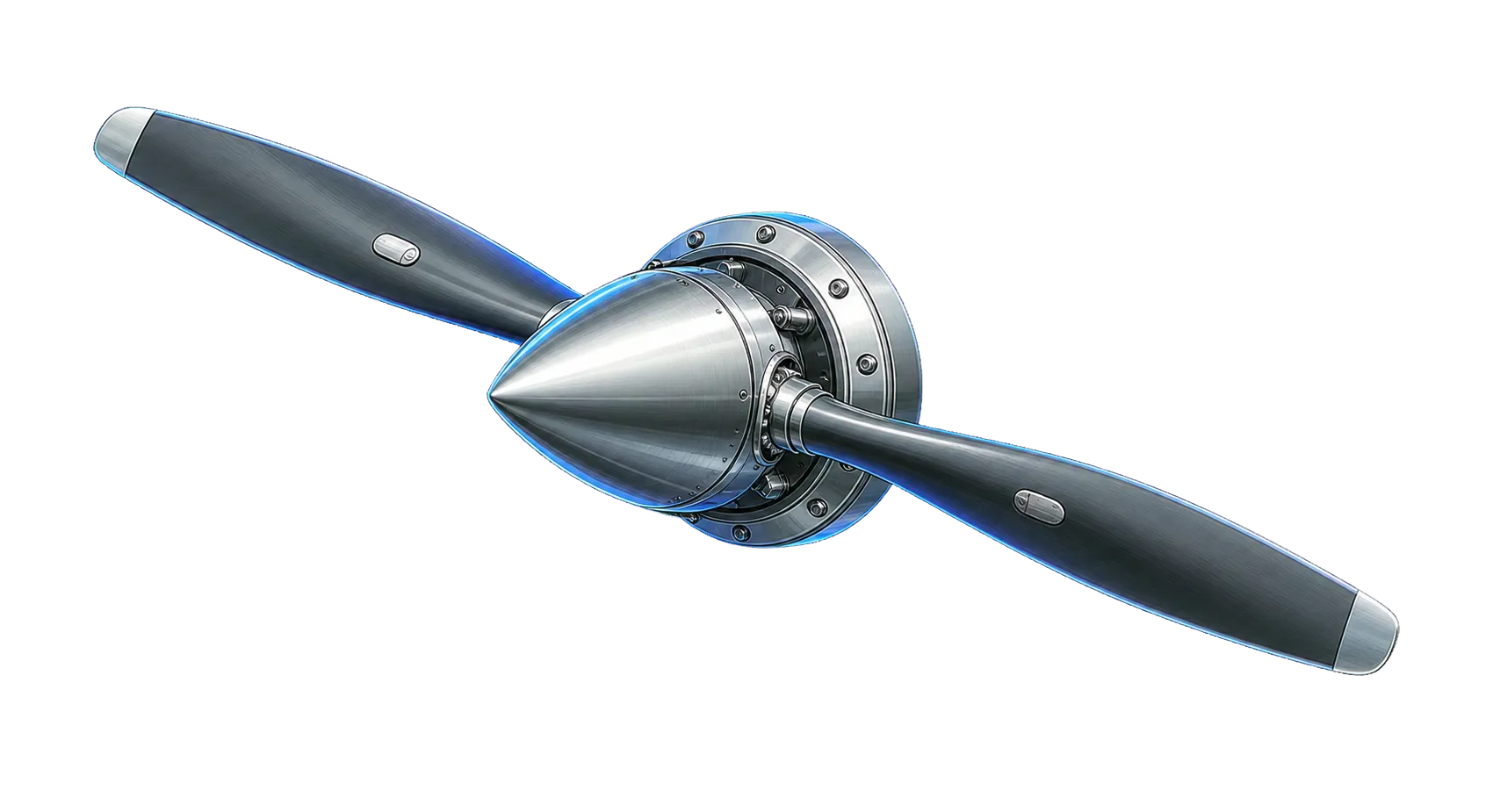
Propeller blade cracks across the camber face, which if not detected, could result in propeller blade separation and possible aircraft loss of control.
AI-generated summary from the source AD text. Verify against the official source before acting.
Required Actions
Perform initial and repetitive visual inspections of propeller blades for cracks across the camber face in accordance with Dowty Aerospace Propellers Service Bulletin S2000-61-75, Revision 4. Initially, conduct a visual inspection within 50 hours time-in-service after the effective date of this AD. Thereafter, inspect at intervals not to exceed 600 hours time-in-service since last inspection. Replace cracked propeller blades prior to further flight with serviceable blades.
AI-generated summary from the source AD text. Verify against the official source before acting.
Compliance Time
Within 50 hours time-in-service after the effective date of this AD.
AI-generated summary from the source AD text. Verify against the official source before acting.
Affected Aircraft
Dowty Aerospace Propellers Model R381/6-123-F/5 propellers, installed on but not limited to SAAB 2000 series airplanes.
AI-generated summary from the source AD text. Verify against the official source before acting.
Federal Register Abstract
This amendment revises an existing airworthiness directive (AD) that is applicable to Dowty Aerospace Propellers Model R381/6-123- F/5 propellers, that requires initial and repetitive visual and ultrasonic inspections of propeller blades for cracks across the camber face, and, if blades are found cracked, replacement with serviceable blades. This amendment is prompted by an engineering analysis of field service data and certification testing that indicate that the repetitive visual inspection interval can be safely increased and that the ultrasonic inspections can be eliminated. The actions specified in this proposed AD are intended to detect propeller blade cracks and propagation, which if not detected could result in propeller blade separation and possible aircraft loss of control.
Document Text
Show stored source text (verify against official source)
[Federal Register Volume 66, Number 51 (Thursday, March 15, 2001)]
[Rules and Regulations]
[Pages 15022-15024]
From the Federal Register Online via the Government Publishing Office [<a href="http://www.gpo.gov">www.gpo.gov</a>]
[FR Doc No: 01-5735]


-----------------------------------------------------------------------

DEPARTMENT OF TRANSPORTATION

Federal Aviation Administration

14 CFR Part 39

[Docket No. 99-NE-43-AD; Amendment 39-12143; AD 99-18-18 R1]
RIN 2120-AA64


Airworthiness Directives; Dowty Aerospace Propellers Model R381/
6-123-F/5 Propellers

AGENCY: Federal Aviation Administration, DOT.

ACTION: Final rule.

-----------------------------------------------------------------------

SUMMARY: This amendment revises an existing airworthiness directive
(AD) that is applicable to Dowty Aerospace Propellers Model R381/6-123-
F/5 propellers, that requires initial and repetitive visual and
ultrasonic inspections of propeller blades for cracks across the camber
face, and, if blades are found cracked, replacement with serviceable
blades. This amendment is prompted by an engineering analysis of field
service data and certification testing that indicate that the
repetitive visual inspection interval can be safely increased and that
the ultrasonic inspections can be eliminated. The actions specified in
this proposed AD are intended to detect propeller blade cracks and
propagation, which if not detected could result in propeller blade
separation and possible aircraft loss of control.

DATES: Effective April 19, 2001. The incorporation by reference of
certain publications listed in the regulations is approved by the
Director of the Federal Register as of April 19, 2001.

ADDRESSES: The service information referenced in this AD may be
obtained from Dowty Aerospace Propellers, Anson Business Park,
Cheltenham Road East, Gloucester GL29QN, England; telephone: 44 1452
716000, fax: 44 1452 716001. This information may be examined at the
FAA, New England Region, Office of the Regional Counsel, 12 New England
Executive Park, Burlington, MA, or at the Office of the Federal
Register, 800 North Capitol Street, NW, suite 700, Washington, DC.

FOR FURTHER INFORMATION CONTACT: Kirk Gustafson, Aerospace Engineer,
Boston Aircraft Certification Office, FAA, Engine and Propeller
Directorate, 12 New England Executive Park, Burlington, MA 01803-5299;
telephone: 781-238-7190, fax: 781-238-7199.

SUPPLEMENTARY INFORMATION: A proposal to amend part 39 of the Federal
Aviation Regulations (14 CFR part 39) by revising AD 99-18-18,
Amendment

[[Page 15023]]

39-11284 (64 FR 47661, September 1, 1999), which is applicable to Dowty
Aerospace Propellers Model R381/6-123-F/5 propellers, was published in
the Federal Register on August 21, 2000 (65 FR 50667). The action
proposed to increase the propeller blade crack inspection intervals.
For repetitive visual inspection intervals, the proposed increase was
from 50 to 300 hours time-in-service (TIS) since last inspection, and
for repetitive ultrasonic inspection intervals the proposed increase
was from 200 to 600 hours TIS.

Comment Received

    Interested persons have been afforded an opportunity to participate
in the making of this amendment. Due consideration has been given to
the comment received.

Eliminate Ultrasonic Inspection and Increase Inspection Interval

    A comment from the manufacturer recommends elimination of
ultrasonic inspections, based on analysis that concluded that initial
and repetitive visual inspection intervals are adequate. The
manufacturer states that the engineering analysis of field service data
did not reveal a specific root cause for the original cracked blade. It
is suspected that an unusual circumstance may have been involved, such
as an unreported impact with a ground vehicle. However, to ensure the
structural integrity of blades in service, initial and repetitive
visual inspections must be done, and, as a result of the analysis,
these inspections are being allowed at increased intervals as specified
in a new revision to the applicable service bulletin.
    The FAA agrees. The engineering data provided to the FAA by the
manufacturer indicates there are no specific structural concerns,
manufacturing quality issues, or fatigue mechanisms that would justify
the need for initial and repetitive ultrasonic inspections, and that an
increased repetitive visual inspection interval is appropriate. The
inspections were originally proposed by the manufacturer and mandated
by the FAA to address an unknown cause for a cracked blade found in
service. These inspections were based on a need for a conservative
control program as an interim action, while a detailed investigation
was performed. As a measure of conservatism, the extended repetitive
inspection interval is being retained. The inspection coincides with
existing propeller maintenance tasks so as not to create an undue
burden while providing additional margin against potential but
unanticipated causes for propeller blade cracks. This amendment has
been revised to eliminate the ultrasonic inspections, increase the
visual inspection intervals, and reference the newly revised service
bulletin.
    After careful review of the available data, including the comment
noted above, the FAA has determined that air safety and the public
interest require the adoption of the rule with the changes described
previously. The FAA has determined that these changes will neither
increase the economic burden on an operator nor increase the scope of
the AD.

Economic Analysis

    The FAA estimates that there are six propellers of the affected
design installed on aircraft of U.S. registry. The FAA also estimates
that it would take approximately four work hours per propeller to
accomplish a visual inspection, and that the average labor rate is $60
per work hour. A propeller will average three visual inspections per
year. Based on these figures for the six propellers, the yearly cost
impact for this AD is estimated to be $4,320.

Regulatory Impact

    The regulations adopted herein will not have a substantial direct
effect on the States, on the relationship between the national
Government and the States, or on the distribution of power and
responsibilities among the various levels of government. Therefore, it
is determined that this final rule does not have federalism
implications under Executive Order 13132.
    For the reasons discussed above, I certify that this action (1) is
not a ``significant regulatory action'' under Executive Order 12866;
(2) is not a ``significant rule'' under DOT Regulatory Policies and
Procedures (44 FR 11034, February 26, 1979); and (3) will not have a
significant economic impact, positive or negative, on a substantial
number of small entities under the criteria of the Regulatory
Flexibility Act. A final evaluation has been prepared for this action
and it is contained in the Rules Docket. A copy of it may be obtained
from the Rules Docket at the location provided under the caption
ADDRESSES.

List of Subjects in 14 CFR Part 39

    Air transportation, Aircraft, Aviation safety, Incorporation by
reference, Safety.

Adoption of the Amendment

    Accordingly, pursuant to the authority delegated to me by the
Administrator, the Federal Aviation Administration amends part 39 of
the Federal Aviation Regulations (14 CFR part 39) as follows:

PART 39--AIRWORTHINESS DIRECTIVES

    1. The authority citation for part 39 continues to read as follows:

    Authority: 49 U.S.C. 106(g), 40113, 44701.


Sec. 39.13  [Amended]

    2. Section 39.13 is amended by removing Amendment 39-11284 (64 FR
47661, September 1, 1999), and by adding a new airworthiness directive
(AD), and by adding a new airworthiness directive (AD), Amendment 39-
12143 to read as follows:

99-18-18  R1, Dowty Aerospace Propellers: Docket 99-NE-43-AD.
Revises AD 99-18-18, Amendment 39-11284.

    Applicability: Dowty Aerospace Propellers Model R381/6-123-F/5
propellers, installed on but not limited to SAAB 2000 series
airplanes.

    Note 1: This airworthiness directive (AD) applies to each
propeller identified in the preceding applicability provision,
regardless of whether it has been modified, altered, or repaired in
the area subject to the requirements of this AD. For propellers that
have been modified, altered, or repaired so that the performance of
the requirements of this AD is affected, the owner/operator must
request approval for an alternative method of compliance in
accordance with paragraph (c) of this AD. The request should include
an assessment of the effect of the modification, alteration, or
repair on the unsafe condition addressed by this AD; and, if the
unsafe condition has not been eliminated, the request should include
specific proposed actions to address it.

    Compliance: Required as indicated, unless accomplished
previously.
    To detect propeller blade cracks and propagation, which if not
detected could result in propeller blade separation and possible
aircraft loss of control, accomplish the following:

Visual Inspections

    (a) Perform initial and repetitive visual inspections of
propeller blades for cracks across the camber face in accordance
with the Accomplishment Instructions of Dowty Aerospace Propellers
Service Bulletin (SB) No. S2000-61-75, Revision 4, dated September
28, 2000, as follows:
    (1) Initially, conduct a visual inspection within 50 hours time-
in-service (TIS) after the effective date of this AD.
    (2) Thereafter, inspect at intervals not to exceed 600 hours TIS
since last inspection.
    (3) Replace cracked propeller blades prior to further flight
with serviceable blades.
    (b) [Reserved]

Alternative Method of Compliance

    (c) An alternative method of compliance or adjustment of the
compliance time that provides an acceptable level of safety may be

[[Page 15024]]

used if approved by the Manager, Boston Aircraft Certification
Office (ACO). Operators shall submit their requests through an
appropriate FAA Principal Maintenance Inspector, who may add
comments and then send it to the Manager, Boston ACO.

    Note 2: Information concerning the existence of approved
alternative methods of compliance with this airworthiness directive,
if any, may be obtained from the Boston ACO.

Special Flight Permits

    (d) Special flight permits may be issued in accordance with
Secs. 21.197 and 21.199 of the Federal Aviation Regulations (14 CFR
21.197 and 21.199) to operate the aircraft to a location where the
inspection requirements of this AD can be accomplished.

Incorporation by Reference

    (e) The actions required by this AD must be done in accordance
with the Accomplishment Instructions of Dowty Aerospace Propellers
Service Bulletin (SB) No. S2000-61-75, Revision 4, dated September
28, 2000. This incorporation by reference was approved by the
Director of the Federal Register in accordance with 5 U.S.C. 552(a)
and 1 CFR part 51. Copies may be obtained from Dowty Aerospace
Propellers, Anson Business Park, Cheltenham Road East, Gloucester
GL29QN, England; telephone: 44 1452 716000, fax: 44 1452 716001.
Copies may be inspected at the FAA, New England Region, Office of
the Regional Counsel, 12 New England Executive Park, Burlington, MA,
or at the Office of the Federal Register, 800 North Capitol Street,
NW, suite 700, Washington, DC.

Effective Date

    (f) This amendment becomes effective on April 19, 2001.

    Issued in Burlington, Massachusetts, on March 1, 2001.
David A. Downey,
Acting Manager, Engine and Propeller Directorate, Aircraft
Certification Service
[FR Doc. 01-5735 Filed 3-14-01; 8:45 am]
BILLING CODE 4910-13-P
Source: Official FAA Source ↗
Retrieved: Apr 6, 2026
Rights: U.S. Government Public Domain
This site is not affiliated with or endorsed by the FAA. Always verify with official sources.