AD Amdt-39-10247
Applicability
| Type | Manufacturer | Model | Details |
|---|---|---|---|
| aircraft | Boeing | 737-100 | Airworthiness Directives; Boeing Model 737-100, -200, -300, -400, and -500 Series Airplanes |
Unsafe Condition
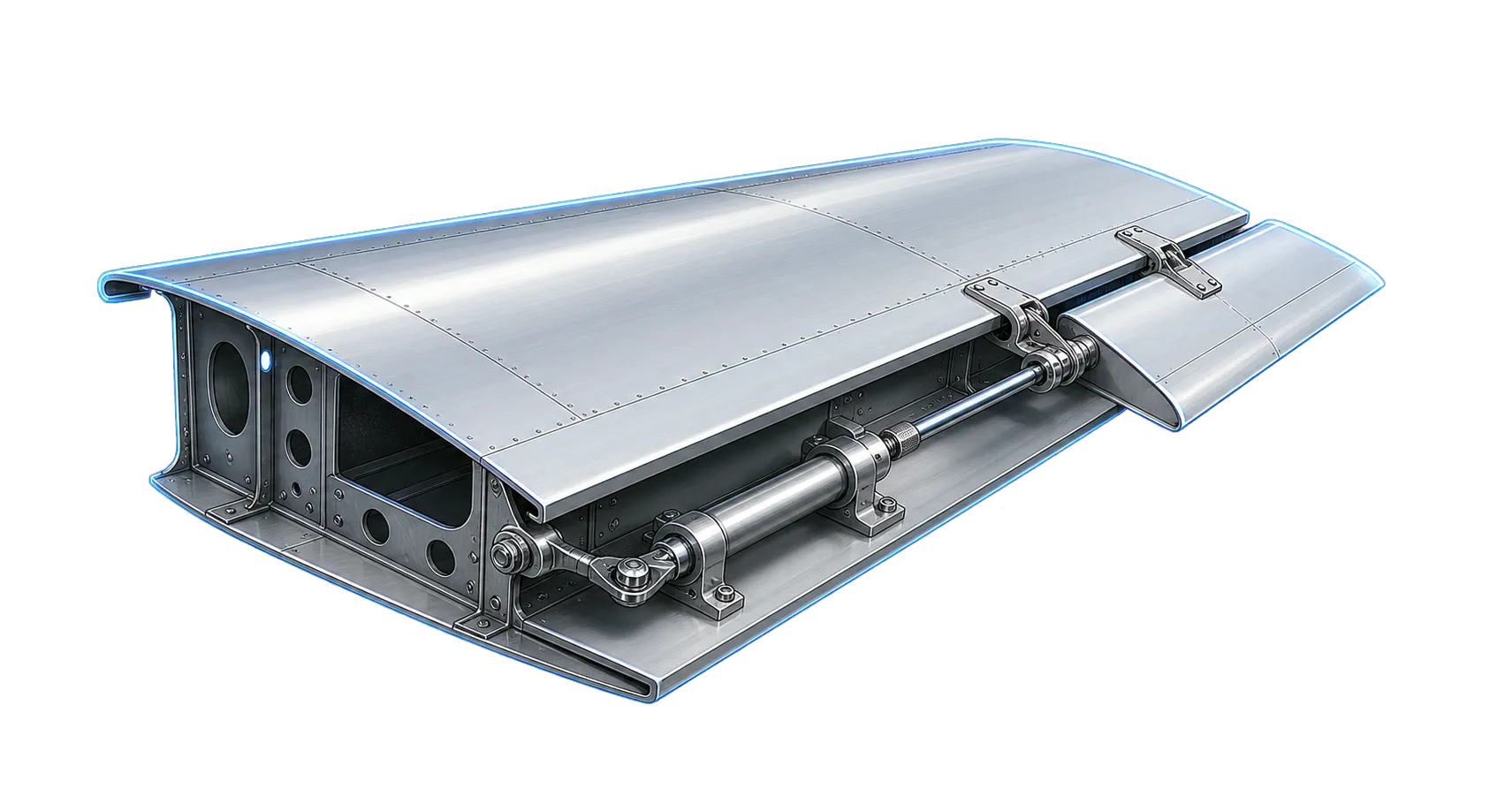
Failure of the aileron due to an inappropriate repair procedure resulting in inadequate adhesion between the skin and core of the aileron surface, which could cause in-flight separation and reduced controllability.
AI-generated summary from the source AD text. Verify against the official source before acting.
Required Actions
Perform a one-time visual inspection within 60 days after the effective date to check for affected aileron serial numbers. Remove and replace any defective ailerons prior to further flight, and submit a report within 10 days of inspection.
AI-generated summary from the source AD text. Verify against the official source before acting.
Compliance Time
Within 60 days after the effective date (December 30, 1997) for the inspection; prior to further flight for removal and replacement; within 10 days for submitting the report.
AI-generated summary from the source AD text. Verify against the official source before acting.
Affected Aircraft
Boeing Model 737-100, -200, -300, -400, and -500 series airplanes with ailerons repaired by BFGoodrich Aerospace (Tramco Inc.) having serial numbers BN23, BN49, BN56, BN59, BN167, BN180, BN206, BN236, 162, or 237.
AI-generated summary from the source AD text. Verify against the official source before acting.
Federal Register Abstract
This amendment adopts a new airworthiness directive (AD) that is applicable to all Boeing Model 737-100, -200, -300, -400, and -500 series airplanes. This amendment requires a one-time inspection to determine if certain ailerons are installed on the airplane. This amendment also requires removing any defective aileron, scrapping it, and replacing it with a new or serviceable aileron. This amendment is prompted by reports of failure of the aileron due to an inappropriate repair procedure. The actions specified in this AD are intended to detect and correct defective ailerons, which could result in in-flight separation of an aileron from the airplane and consequent reduced controllability of the airplane.
Document Text
Show stored source text (verify against official source)
[Federal Register Volume 62, Number 240 (Monday, December 15, 1997)]
[Rules and Regulations]
[Pages 65600-65601]
From the Federal Register Online via the Government Publishing Office [<a href="http://www.gpo.gov">www.gpo.gov</a>]
[FR Doc No: 97-32609]


-----------------------------------------------------------------------

DEPARTMENT OF TRANSPORTATION

Federal Aviation Administration

14 CFR Part 39

[Docket No. 97-NM-259-AD; Amendment 39-10247; AD 97-26-04]
RIN 2120-AA64


Airworthiness Directives; Boeing Model 737-100, -200, -300, -400,
and -500 Series Airplanes

AGENCY: Federal Aviation Administration, DOT.

ACTION: Final rule; request for comments.

-----------------------------------------------------------------------

SUMMARY: This amendment adopts a new airworthiness directive (AD) that
is applicable to all Boeing Model 737-100, -200, -300, -400, and -500
series airplanes. This amendment requires a one-time inspection to
determine if certain ailerons are installed on the airplane. This
amendment also requires removing any defective aileron, scrapping it,
and replacing it with a new or serviceable aileron. This amendment is
prompted by reports of failure of the aileron due to an inappropriate
repair procedure. The actions specified in this AD are intended to
detect and correct defective ailerons, which could result in in-flight
separation of an aileron from the airplane and consequent reduced
controllability of the airplane.

DATES: Effective December 30, 1997.
    Comments for inclusion in the Rules Docket must be received on or
before February 13, 1998.

ADDRESSES: Submit comments in triplicate to the Federal Aviation
Administration (FAA), Transport Airplane Directorate, ANM-103,
Attention: Rules Docket No. 97-NM-259-AD, 1601 Lind Avenue, SW.,
Renton, Washington 98055-4056.
    Information concerning this amendment may be obtained from or
examined at the FAA, Transport Airplane Directorate, 1601 Lind Avenue,
SW., Renton, Washington.

FOR FURTHER INFORMATION CONTACT: Greg Schneider or Nenita Odesa,
Aerospace Engineers, Airframe Branch, ANM-120S, FAA, Transport Airplane
Directorate, Seattle Aircraft Certification Office, 1601 Lind Avenue,
SW., Renton, Washington 98055-4056; telephone (425) 227-2028 or (425)
227-2557; fax (425) 227-1181.

SUPPLEMENTARY INFORMATION: The FAA has received two reports of failure
of the aileron on Boeing Model 737 series airplanes. In one incident, a
two-foot section of an aileron separated from the airplane during
descent, which resulted in vibration of the flight controls. In the
second incident, 30 percent of an aileron separated from the airplane
during climb. The flightcrew had to input a significant amount of trim
to straighten the wings to a level position prior to landing. This
airplane had accumulated 34 flight cycles since its ailerons were
rebuilt by Tramco Inc. (doing business as BFGoodrich (BFG) Aerospace,
Repair Station HN6R593N).
    Investigation revealed that the cause of these failures has been
attributed to an inappropriate repair procedure accomplished by BFG
Aerospace. During the process of rebuilding ailerons, part number 65-
46454-XX, for Boeing Model 737-100, -200, -300, -400, and -500 series
airplanes, BFG Aerospace did not use proper procedures in the
preparation of the aileron surface prior to the lay-up of the skin
panel. As a result, the contact surface between the skin and core did
not provide adequate adhesion properties for the bonded skin panel.
    BFG Aerospace has not located all of the defective ailerons and has
not provided documentation which verifies removal of the defective
ailerons from service.
    Defective ailerons that are installed on an airplane, if not
detected and corrected, could result in in-flight separation of an
aileron from the airplane, which could result in reduced
controllability of the airplane.

Explanation of the Requirements of the Rule

    Since an unsafe condition has been identified that is likely to
exist or develop on other Boeing Model 737-100, -200, -300, -400, and -
500 series airplanes of the same type design, this AD is being issued
to detect defective ailerons installed on an airplane, which could
result in in-flight separation of an aileron from the airplane and
consequent reduced controllability of the airplane. This AD requires a
one-time visual inspection to determine if certain ailerons are
installed on the airplane. This AD also requires removing any defective
aileron, scrapping it, replacing it with a new or serviceable aileron,
and submitting an inspection report to the FAA, if necessary.

Determination of Rule's Effective Date

    Since a situation exists that requires the immediate adoption of
this regulation, it is found that notice and opportunity for prior
public comment hereon are impracticable, and that good cause exists for
making this amendment effective in less than 30 days.

Comments Invited

    Although this action is in the form of a final rule that involves
requirements affecting flight safety and, thus, was not preceded by
notice and an opportunity for public comment, comments are invited on
this rule. Interested persons are invited to comment on this rule by
submitting such written data, views, or arguments as they may desire.
Communications shall identify the Rules Docket number and be submitted
in triplicate to the address specified under the caption ADDRESSES. All
communications received on or before the closing date for comments will
be considered, and this rule may be amended in light of the comments
received. Factual information that supports the commenter's ideas and
suggestions is extremely helpful in evaluating the effectiveness of the
AD action and determining whether additional rulemaking action would be
needed.
    Comments are specifically invited on the overall regulatory,
economic, environmental, and energy aspects of the rule that might
suggest a need to modify the rule. All comments submitted will be
available, both before and after the closing date for comments, in the
Rules Docket for examination by interested persons. A report that
summarizes each FAA-public contact concerned with the substance of this
AD will be filed in the Rules Docket.
    Commenters wishing the FAA to acknowledge receipt of their comments
submitted in response to this rule must submit a self-addressed,
stamped postcard on which the following statement is made: ``Comments
to

[[Page 65601]]

Docket Number 97-NM-259-AD.'' The postcard will be date stamped and
returned to the commenter.

Regulatory Impact

    The regulations adopted herein will not have substantial direct
effects on the States, on the relationship between the national
government and the States, or on the distribution of power and
responsibilities among the various levels of government. Therefore, in
accordance with Executive Order 12612, it is determined that this final
rule does not have sufficient federalism implications to warrant the
preparation of a Federalism Assessment.
    The FAA has determined that this regulation is an emergency
regulation that must be issued immediately to correct an unsafe
condition in aircraft, and that it is not a ``significant regulatory
action'' under Executive Order 12866. It has been determined further
that this action involves an emergency regulation under DOT Regulatory
Policies and Procedures (44 FR 11034, February 26, 1979). If it is
determined that this emergency regulation otherwise would be
significant under DOT Regulatory Policies and Procedures, a final
regulatory evaluation will be prepared and placed in the Rules Docket.
A copy of it, if filed, may be obtained from the Rules Docket at the
location provided under the caption ADDRESSES.

List of Subjects in 14 CFR Part 39

    Air transportation, Aircraft, Aviation safety, Safety.

Adoption of the Amendment

    Accordingly, pursuant to the authority delegated to me by the
Administrator, the Federal Aviation Administration amends part 39 of
the Federal Aviation Regulations (14 CFR part 39) as follows:

PART 39--AIRWORTHINESS DIRECTIVES

    1. The authority citation for part 39 continues to read as follows:

    Authority: 49 U.S.C. 106(g), 40113, 44701.


Sec. 39.13  [Amended]

    2. Section 39.13 is amended by adding the following new
airworthiness directive:

97-26-04  Boeing: Amendment 39-10247. Docket 97-NM-259-AD.

    Applicability: All Model 737-100, -200, -300, -400, and -500
series airplanes, certificated in any category.

    Note 1: This AD applies to each airplane identified in the
preceding applicability provision, regardless of whether it has been
modified, altered, or repaired in the area subject to the
requirements of this AD. For airplanes that have been modified,
altered, or repaired so that the performance of the requirements of
this AD is affected, the owner/operator must request approval for an
alternative method of compliance in accordance with paragraph (d) of
this AD. The request should include an assessment of the effect of
the modification, alteration, or repair on the unsafe condition
addressed by this AD; and, if the unsafe condition has not been
eliminated, the request should include specific proposed actions to
address it.

    Compliance: Required as indicated, unless accomplished
previously.
    To detect defective ailerons installed on an airplane, which
could result in in-flight separation of an aileron from the airplane
and consequent reduced controllability of the airplane, accomplish
the following:
    (a) Within 60 days after the effective date of this AD, perform
a one-time visual inspection to determine if an aileron repaired by
Tramco Inc. (doing business as BFGoodrich Aerospace, Repair Station
HN6R593N) having any of the following serial numbers is installed on
the airplane:

Affected Serial Numbers

BN23
BN49
BN56
BN59
BN167
BN180
BN206
BN236
162
237

    (b) If any aileron is found with an affected serial number
identified in paragraph (a) of this AD, accomplish paragraphs (b)(1)
and (b)(2) of this AD.
    (1) Prior to further flight, remove the defective aileron, and
replace it with a new or serviceable aileron. And
    (2) Within 10 days after accomplishing the inspection required
by paragraph (a) of this AD, submit a report of any findings of
ailerons specified in paragraph (a) of this AD to the Manager, FAA,
Transport Airplane Directorate, Seattle Aircraft Certification
Office (ACO), 1601 Lind Avenue, SW., Renton, Washington 98055-4056;
telephone (425) 227-2028; fax (425) 227-1181. Information collection
requirements contained in this regulation have been approved by the
Office of Management and Budget (OMB) under the provisions of the
Paperwork Reduction Act of 1980 (44 U.S.C. 3501 et seq.) and have
been assigned OMB Control Number 2120-0056.
    (c) As of the effective date of this AD, no person shall install
on any airplane an aileron having any serial number identified in
paragraph (a) of this AD.
    (d) An alternative method of compliance or adjustment of the
compliance time that provides an acceptable level of safety may be
used if approved by the Manager, Seattle ACO. Operators shall submit
their requests through an appropriate FAA Principal Maintenance
Inspector, who may add comments and then send it to the Manager,
Seattle ACO.

    Note 2: Information concerning the existence of approved
alternative methods of compliance with this AD, if any, may be
obtained from the Seattle ACO.

    (e) Special flight permits may be issued in accordance with
sections 21.197 and 21.199 of the Federal Aviation Regulations (14
CFR 21.197 and 21.199) to operate the airplane to a location where
the requirements of this AD can be accomplished.
    (f) This amendment becomes effective on December 30, 1997.

    Issued in Renton, Washington, on December 9, 1997.
John J. Hickey,
Acting Manager, Transport Airplane Directorate, Aircraft Certification
Service.
[FR Doc. 97-32609 Filed 12-12-97; 8:45 am]
BILLING CODE 4910-13-U
Source: Official FAA Source ↗
Retrieved: Apr 6, 2026
Rights: U.S. Government Public Domain
This site is not affiliated with or endorsed by the FAA. Always verify with official sources.
Related Airworthiness Directives
2025-02-02 Recurring
final ruleAirworthiness Directives; The Boeing Company Airplanes
Unsafe Condition: cracks in the frame inner chord and web at station (STA) 727 between S-11L and S-13L, which could result in the inability of a principal structural element to sustain limit load, and adversely affe...
2023-13-12 Recurring
final ruleAirworthiness Directives; The Boeing Company Airplanes
Unsafe Condition: premature aging of certain passenger chemical oxygen generators, which could fail to deliver oxygen during an emergency, possibly resulting in injury to the airplane occupants.
2023-12-13
final ruleAirworthiness Directives; The Boeing Company Airplanes
Unsafe Condition: Radio altimeters cannot be relied upon to perform their intended function if they experience interference from wireless broadband operations in the 5G C-Band. This interference can cause other airp...
2023-10-02
final ruleAirworthiness Directives; Transport and Commuter Category Airplanes
Unsafe Condition: Radio altimeter anomalies that are undetected by the automation or pilot, particularly close to the ground (e.g., landing flare), could lead to loss of continued safe flight and landing. Additional...