AD 2026-19-06
Applicability
| Type | Manufacturer | Model | Details |
|---|---|---|---|
| aircraft | Costruzioni | Aeronautiche Tecnam S.P.A. | Airworthiness Directives; Costruzioni Aeronautiche Tecnam S.P.A. Airplanes |
Unsafe Condition
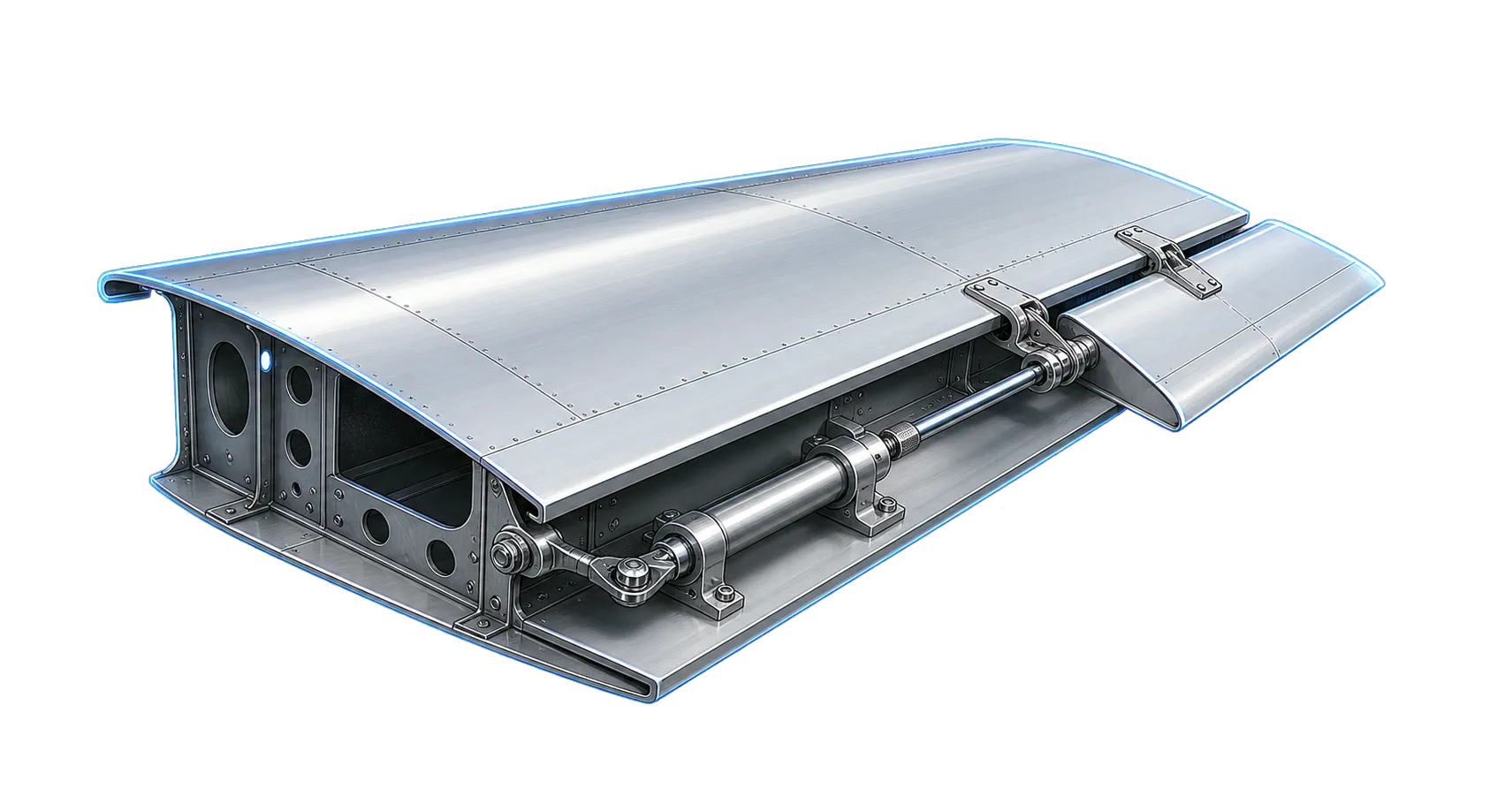
Partial detachment of the left aileron due to a missing hinge pin.
AI-generated summary from the source AD text. Verify against the official source before acting.
Required Actions
Conduct a one-time detailed visual inspection of the affected aileron hinges for damage (cracks, warping, scratched paint, missing/broken torque stripe) and cotter pins for improper installation. Take applicable corrective action if issues are found.
AI-generated summary from the source AD text. Verify against the official source before acting.
Affected Aircraft
Costruzioni Aeronautiche Tecnam S.p.A. Model P2006T airplanes subject to the AD.
AI-generated summary from the source AD text. Verify against the official source before acting.
Federal Register Abstract
The FAA is adopting a new airworthiness directive (AD) for certain Costruzioni Aeronautiche Tecnam S.p.A. (Tecnam) Model P2006T airplanes. This AD was prompted by a report of partial detachment of the left aileron due to a missing hinge pin. This AD requires a one- time detailed visual inspection of the affected aileron hinges for damage (cracks, warping of the hinges or hinge pin, scratched paint, missing or broken torque stripe, etc.) and cotter pins for improper installation and, depending on the findings, applicable corrective action. The FAA is issuing this AD to address the unsafe condition on these products.
Document Text
Show stored source text (verify against official source)
61120 Federal Register / Vol. 91, No. 186 / Monday, September 28, 2026 / Rules and Regulations government and the States, or on the distribution of power and responsibilities among the various levels of government. For the reasons discussed above, I certify that this AD: (1) Is not a ‘‘significant regulatory action’’ under Executive Order 12866, (2) Will not affect intrastate aviation in Alaska, and (3) Will not have a significant economic impact, positive or negative, on a substantial number of small entities under the criteria of the Regulatory Flexibility Act. List of Subjects in 14 CFR Part 39 Air transportation, Aircraft, Aviation safety, Incorporation by reference, Safety. The Amendment Accordingly, under the authority delegated to me by the Administrator, the FAA amends 14 CFR part 39 as follows: PART 39—AIRWORTHINESS DIRECTIVES ■ 1. The authority citation for part 39 continues to read as follows: Authority: 49 U.S.C. 106(g), 40113, 44701. § 39.13 [Amended] ■ 2. The FAA amends § 39.13 by adding the following new airworthiness directive: 2026–19–05 He ´licopte `res Guimbal: Amendment 39–23472; Docket No. FAA–2026–4630; Project Identifier MCAI–2025–01824–R. (a) Effective Date This airworthiness directive (AD) is effective November 2, 2026. (b) Affected ADs None. (c) Applicability This AD applies to He ´licopte `res Guimbal (HG) Model Cabri G2 helicopters having serial numbers (S/N) 1003 to 1389, except S/ N 1383 and 1388, certificated in any category. (d) Subject Joint Aircraft System Component (JASC) Code 2562, Emergency locator beacon. (e) Unsafe Condition This AD was prompted by a report of a potential malfunction of the helicopter emergency locator transmitter (ELT) and subsequent findings of weak ELT signals on 121.5 MHz and 406 MHz frequencies due to improper antenna installation (location). The FAA is issuing this AD to address the safety risk posed by weak ELT signal transmissions. The unsafe condition, if not addressed, could impair the ability to detect a distress signal during a helicopter emergency, which could delay the arrival of rescue services and timely medical assistance to injured occupants. (f) Compliance Comply with this AD within the compliance times specified, unless already done. (g) Required Actions Within 30 days after the effective date of this AD, revise the limitations section of the existing rotorcraft flight manual (RFM) for the helicopter by inserting the following text: ‘‘For Cabri G2 not equipped with the external ELT antenna: Operations conducted overwater under 14 CFR part 135 are prohibited pursuant to 14 CFR 135.168’’. (1) Inserting a copy of this AD into the limitation section of the RFM satisfies the requirements of paragraph (g) of this AD. (2) The owner/operator (pilot) holding at least a private pilot certificate may revise the existing RFM for the helicopter and must enter compliance into the helicopter maintenance records in accordance with 14 CFR 43.9(a) and 91.417(a)(2)(v). The record must be maintained as required by 14 CFR 91.417, 121.380, or 135.439. (h) Optional Terminating Action (1) For internal ELT antenna helicopters, as a terminating action, you may modify the ELT antenna and relocate and install a new VHF2 antenna (if installed) in accordance with section 2 ELT Antenna Installation through section 4 Engine Cowl Honeycomb Repair and section 6 Final Steps of Guimbal Mandatory Service Bulletin SB 25–006 B, dated December 12, 2025 (Guimbal SB 25– 006 B), except as provided in paragraphs (h)(1)(i) and (ii) of this AD. (i) Instead of discarding parts, you must remove those parts from service. (ii) Where Guimbal SB 25–006 B uses the term check, this AD requires doing an inspection. (2) Upon completion of paragraph (h)(1) of this AD, revise the RFM by removing the limitation identified in paragraph (g) of this AD. (i) Alternative Methods of Compliance (AMOCs) (1) The Manager, International Validation Branch, FAA, has the authority to approve AMOCs for this AD, if requested using the procedures found in 14 CFR 39.19. In accordance with 14 CFR 39.19, send your request to your principal inspector or local Flight Standards District Office, as appropriate. If sending information directly to the manager of the International Validation Branch, send it to the attention of the person identified in paragraph (j) of this AD and email to AMOC@faa.gov. (2) Before using any approved AMOC, notify your appropriate principal inspector, or lacking a principal inspector, the manager of the local flight standards district office/ certificate holding district office. (j) Additional Information For more information about this AD, contact David Enns, Aviation Safety Engineer, FAA, 1600 Stewart Avenue, Suite 410, Westbury, NY 11590; phone: (316) 946– 4147; email: david.enns@faa.gov. (k) Material Incorporated by Reference (1) The Director of the Federal Register approved the incorporation by reference of the material listed in this paragraph under 5 U.S.C. 552(a) and 1 CFR part 51. (2) You must use this material as applicable to do the actions required by this AD, unless the AD specifies otherwise. (i) Guimbal Mandatory Service Bulletin SB 25–006 B, dated December 12, 2025. (ii) [Reserved] (3) For Guimbal material identified in this AD, contact He ´licopte `res Guimbal, 1070, rue du Lieutenant Parayre, Ae ´rodrome d’Aix-en- Provence, 13290 Les Milles, France; phone: +33–4–42–39–10–88; email: support@ guimbal.com; website: guimbal.com. (4) You may view this material at the FAA, Airworthiness Products Section, Operational Safety Branch, 10101 Hillwood Parkway, Fort Worth, TX 76177. For information on the availability of this material at the FAA, call (817) 222–5110. (5) You may view this material at the National Archives and Records Administration (NARA). For information on the availability of this material at NARA, visit www.archives.gov/federal-register/cfr/ ibr-locations or email fr.inspection@nara.gov. Issued on September 17, 2026. Hollister B. Thorson, Acting Deputy Director, Compliance & Airworthiness Division, Aircraft Certification Service. [FR Doc. 2026–19761 Filed 9–25–26; 8:45 am] BILLING CODE 4910–13–P DEPARTMENT OF TRANSPORTATION Federal Aviation Administration 14 CFR Part 39 [Docket No. FAA–2026–11784; Project Identifier MCAI–2026–00700–A; Amendment 39–23473; AD 2026–19–06] RIN 2120–AA64 Airworthiness Directives; Costruzioni Aeronautiche Tecnam S.P.A. Airplanes AGENCY : Federal Aviation Administration (FAA), DOT. ACTION : Final rule; request for comments. SUMMARY : The FAA is adopting a new airworthiness directive (AD) for certain Costruzioni Aeronautiche Tecnam S.p.A. (Tecnam) Model P2006T airplanes. This AD was prompted by a report of partial detachment of the left aileron due to a missing hinge pin. This AD requires a one-time detailed visual inspection of the affected aileron hinges for damage (cracks, warping of the hinges or hinge pin, scratched paint, missing or broken torque stripe, etc.) and cotter pins for improper installation VerDate Sep<11>2014 15:47 Sep 25, 2026 Jkt 268001 PO 00000 Frm 00008 Fmt 4700 Sfmt 4700 E:\FR\FM\28SER1.SGM 28SER1 khammond on DSK9W7S144PROD with RULES

61121 Federal Register / Vol. 91, No. 186 / Monday, September 28, 2026 / Rules and Regulations and, depending on the findings, applicable corrective action. The FAA is issuing this AD to address the unsafe condition on these products. DATES : This AD is effective October 13, 2026. The Director of the Federal Register approved the incorporation by reference of a certain publication listed in this AD as of October 13, 2026. The FAA must receive comments on this AD by November 12, 2026. ADDRESSES : You may send comments, using the procedures found in 14 CFR 11.43 and 11.45, by any of the following methods: • Federal eRulemaking Portal: Go to regulations.gov . Follow the instructions for submitting comments. • Fax: (202) 493–2251. • Mail: U.S. Department of Transportation, Docket Operations, M– 30, West Building Ground Floor, Room W12–140, 1200 New Jersey Avenue SE, Washington, DC 20590. • Hand Delivery: Deliver to Mail address above between 9 a.m. and 5 p.m., Monday through Friday, except Federal holidays. AD Docket: You may examine the AD docket at regulations.gov under Docket No. FAA–2026–11784; or in person at Docket Operations between 9 a.m. and 5 p.m., Monday through Friday, except Federal holidays. The AD docket contains this final rule, the mandatory continuing airworthiness information (MCAI), any comments received, and other information. The street address for Docket Operations is listed above. Material Incorporated by Reference: • For Tecnam material identified in this AD, contact Tecnam, Via Maiorise, 81043 Capua CE, Italy; phone: +39 0823 997538; email: technical.support@ tecnam.com; website: tecnam.com . • You may view this material at the FAA, Airworthiness Products Section, Operational Safety Branch, 1100 Main, Kansas City, MO 64105. For information on the availability of this material at the FAA, call (817) 222–5110. It is also available at regulations.gov under Docket No. FAA–2026–11784. FOR FURTHER INFORMATION CONTACT : Anthony Kenward, Aviation Safety Engineer, FAA, 1600 Stewart Avenue, Suite 410, Westbury, NY 11590; phone: (817) 222–5152; email: anthony.b.kenward@faa.gov . SUPPLEMENTARY INFORMATION : Comments Invited The FAA invites you to send any written data, views, or arguments about this final rule. Send your comments using a method listed under the ADDRESSES section. Include ‘‘Docket No. FAA–2026–11784; Project Identifier MCAI–2026–00700–A’’ at the beginning of your comments. The most helpful comments reference a specific portion of the final rule, explain the reason for any recommended change, and include supporting data. The FAA will consider all comments received by the closing date and may amend this final rule because of those comments. Except for Confidential Business Information (CBI) as described in the following paragraph, and other information as described in 14 CFR 11.35, the FAA will post all comments received, without change, to regulations.gov, including any personal information you provide. The agency will also post a report summarizing each substantive verbal contact received about this final rule. Confidential Business Information CBI is commercial or financial information that is both customarily and actually treated as private by its owner. Under the Freedom of Information Act (FOIA) (5 U.S.C. 552), CBI is exempt from public disclosure. If your comments responsive to this AD contain commercial or financial information that is customarily treated as private, that you actually treat as private, and that is relevant or responsive to this AD, it is important that you clearly designate the submitted comments as CBI. Please mark each page of your submission containing CBI as ‘‘PROPIN.’’ The FAA will treat such marked submissions as confidential under the FOIA, and they will not be placed in the public docket of this AD. Submissions containing CBI should be sent to Anthony Kenward, Aviation Safety Engineer, FAA, 1600 Stewart Avenue, Suite 410, Westbury, NY 11590. Any commentary that the FAA receives which is not specifically designated as CBI will be placed in the public docket for this rulemaking. Background The European Union Aviation Safety Agency (EASA), which is the Technical Agent for the Member States of the European Union, has issued EASA AD 2026–0124, dated July 1, 2026 (also referred to as the MCAI), to correct an unsafe condition on certain Tecnam Model P2006T and P2006T NG airplanes. The MCAI states that an occurrence was reported of partial detachment of the left aileron of a Tecnam Model P2006T airplane. The initial investigation revealed that the hinge pin of the outboard hinge was missing, resulting in partial detachment of the aileron. Further investigation revealed that the hinge pin could have migrated out from the aileron hinge assembly due to a missing or broken cotter pin, which allowed the outboard aileron hinge halves to separate. Based on design, there should be a cotter pin installed on the ends of the hinge pins to secure their position. During further fleet inspections on two other airplanes, broken and improperly installed cotter pins were found, and cracks were discovered in some of the aileron hinges. This could result in a migrated hinge pin which, if not detected and corrected, could lead to detachment of an aileron, possibly resulting in loss of control of the airplane. The MCAI requires a one-time detailed visual inspection of the affected aileron hinges for cracks or damage and cotter pins for improper installation and, depending on the findings, applicable corrective action. You may examine the MCAI in the AD docket at regulations.gov under Docket No. FAA–2026–11784. Material Incorporated by Reference Under 1 CFR Part 51 The FAA reviewed Tecnam Service Bulletin No. SB 995–CS–Ed. 1 Rev. 2, dated September 18, 2026 (Tecnam SB 995–CS–Ed. 1 Rev. 2). This material specifies procedures for performing a one-time detailed visual inspection of the inboard and outboard aileron hinges and associated cotter pins to check the hinges for cracks or damage and the cotter pins for proper installation and integrity ( e.g., installed at both ends of each hinge pin, heads firmly seated with no evidence of looseness). This material also specifies procedures for replacing and securing discrepant cotter pins and contacting Tecnam for further instructions if cracked or damaged aileron hinges are found. This material is reasonably available because the interested parties have access to it through their normal course of business or by the means identified in the ADDRESSES section. FAA’s Determination These products have been approved by the civil aviation authority of another country and are approved for operation in the United States. Pursuant to the FAA’s bilateral agreement with this State of Design Authority, that authority has notified the FAA of the unsafe condition described in the MCAI and material referenced above. The FAA is issuing this AD after determining that the unsafe condition described previously is likely to exist or develop on other products of the same type design. AD Requirements This AD requires accomplishing the actions specified in the material already VerDate Sep<11>2014 15:47 Sep 25, 2026 Jkt 268001 PO 00000 Frm 00009 Fmt 4700 Sfmt 4700 E:\FR\FM\28SER1.SGM 28SER1 khammond on DSK9W7S144PROD with RULES

61122 Federal Register / Vol. 91, No. 186 / Monday, September 28, 2026 / Rules and Regulations described, except as discussed under ‘‘Differences Between this AD and the Referenced Material.’’ Differences Between This AD and the MCAI or Referenced Material The MCAI applies to Tecnam Model P2006T NG airplanes, but this AD does not because this model does not have an FAA type certificate. The MCAI and referenced material specify to contact the manufacturer for approved repair instructions if it is determined during an inspection that there is any discrepancy detected as described in the referenced service material. This AD instead requires doing repairs in accordance with a method approved by the FAA; EASA; or Tecnam’s EASA Design Organization Approval (DOA). If approved by the DOA, the approval must include the DOA-authorized signature. Although Tecnam SB 995–CS–Ed. 1 Rev. 2 specifies reporting certain information to the manufacturer, this AD does not require that reporting. Interim Action The FAA considers that this AD is an interim action. If final action is later identified, the FAA might consider further rulemaking. Justification for Immediate Adoption and Determination of the Effective Date Section 553(b) of the Administrative Procedure Act (APA) (5 U.S.C. 551 et seq. ) authorizes agencies to dispense with prior notice and comment procedures for rules when the agency, for ‘‘good cause,’’ finds that those procedures are ‘‘impracticable, unnecessary, or contrary to the public interest.’’ Under this section, an agency, upon finding good cause, may issue a final rule without providing notice and seeking comment prior to issuance. Further, section 553(d) of the APA authorizes agencies to make rules effective in less than thirty days, upon the finding of good cause. An unsafe condition exists that requires the immediate adoption of this AD without providing an opportunity for public comments prior to adoption. The FAA has found that the risk to the flying public justifies forgoing notice and comment prior to adoption of this rule. Missing aileron hinges or cotter pins, and cracked, damaged, or improperly installed aileron hinges or cotter pins can allow hinge pins to migrate out of the hinge assembly, which could result in detachment of the aileron. This represents a single-point failure with the potential for a catastrophic event, as detachment of a primary flight-control surface could result in loss of roll control, loss of airplane controllability, and loss of the airplane and occupants. Additionally, the compliance time in this AD is shorter than the time necessary for the public to comment before publication of the final rule. Accordingly, notice and opportunity for prior public comment are impracticable and contrary to the public interest pursuant to 5 U.S.C. 553(b). In addition, the FAA finds that good cause exists pursuant to 5 U.S.C. 553(d) for making this amendment effective in less than 30 days, for the same reasons the FAA found good cause to forgo notice and comment. Regulatory Flexibility Act The requirements of the Regulatory Flexibility Act (RFA) do not apply when an agency finds good cause pursuant to 5 U.S.C. 553 to adopt a rule without prior notice and comment. Because the FAA has determined that it has good cause to adopt this rule without prior notice and comment, RFA analysis is not required. Costs of Compliance The FAA estimates that this AD affects 102 airplanes of U.S. registry. The FAA estimates the following costs to comply with this AD: E STIMATED C OSTS Action Labor cost Parts cost Cost per product Cost on U.S. operators Detailed visual inspection of both inboard and outboard aileron hinges. 1 work-hour × $85 per hour = $85 ........................ $0 $85 $8,670 The FAA estimates the following costs to do any necessary replacement that would be required based on the results of the inspection. The agency has no way of determining the number of airplanes that might need this replacement: O N -C ONDITION C OSTS Action Labor cost Parts cost Cost per product Installation of cotter pin. ................ 1 work-hour × $85 per hour = $85 $1 per cotter pin ........................... $86 per affected cotter pin. The on-condition hinge repair that may be needed as a result of the inspection could vary from airplane to airplane. The FAA has received no data to determine the costs to accomplish the repair or the number of airplanes that may require hinge repair. Authority for This Rulemaking Title 49 of the United States Code specifies the FAA’s authority to issue rules on aviation safety. Subtitle I, section 106, describes the authority of the FAA Administrator. Subtitle VII: Aviation Programs describes in more detail the scope of the Agency’s authority. The FAA is issuing this rulemaking under the authority described in Subtitle VII, Part A, Subpart III, Section 44701: General requirements. Under that section, Congress charges the FAA with promoting safe flight of civil aircraft in air commerce by prescribing regulations for practices, methods, and procedures the Administrator finds necessary for safety in air commerce. This regulation is within the scope of that authority because it addresses an unsafe condition that is likely to exist or develop on products identified in this rulemaking action. Regulatory Findings This AD will not have federalism implications under Executive Order 13132. This AD will not have a substantial direct effect on the States, on the relationship between the national VerDate Sep<11>2014 15:47 Sep 25, 2026 Jkt 268001 PO 00000 Frm 00010 Fmt 4700 Sfmt 4700 E:\FR\FM\28SER1.SGM 28SER1 khammond on DSK9W7S144PROD with RULES

61123 Federal Register / Vol. 91, No. 186 / Monday, September 28, 2026 / Rules and Regulations government and the States, or on the distribution of power and responsibilities among the various levels of government. For the reasons discussed above, I certify that this AD: (1) Is not a ‘‘significant regulatory action’’ under Executive Order 12866, and (2) Will not affect intrastate aviation in Alaska. List of Subjects in 14 CFR Part 39 Air transportation, Aircraft, Aviation safety, Incorporation by reference, Safety. The Amendment Accordingly, under the authority delegated to me by the Administrator, the FAA amends 14 CFR part 39 as follows: PART 39—AIRWORTHINESS DIRECTIVES ■ 1. The authority citation for part 39 continues to read as follows: Authority: 49 U.S.C. 106(g), 40113, 44701. § 39.13 [Amended] ■ 2. The FAA amends § 39.13 by adding the following new airworthiness directive: 2026–19–06 Costruzioni Aeronautiche Tecnam S.P.A.: Amendment 39–23473; Docket No. FAA–2026–11784; Project Identifier MCAI–2026–00700–A. (a) Effective Date This airworthiness directive (AD) is effective October 13, 2026. (b) Affected ADs None. (c) Applicability This AD applies to Costruzioni Aeronautiche Tecnam S.P.A. (Tecnam) Model P2006T airplanes, certificated in any category, serial numbers (S/N) 001 through 434 and S/N 442. (d) Subject Joint Aircraft System Component (JASC) Code 2710, Aileron Control System. (e) Unsafe Condition This AD was prompted by a report of partial detachment of the left aileron due to a missing hinge pin. The FAA is issuing this AD to detect and address cracks, damage, or improper installation of the aileron hinges and cotter pins. The unsafe condition, if not addressed, could lead to detachment of an aileron, possibly resulting in loss of control of the airplane. (f) Compliance Comply with this AD within the compliance times specified, unless already done. (g) Required Actions (1) Within 25 flight hours or 30 days, whichever occurs first after the effective date of this AD, perform a one-time detailed visual inspection of the inboard and outboard aileron hinges of the left and right ailerons for damage (cracks, warping of the hinges or hinge pin, scratched paint, missing or broken torque stripe, etc.), and inspect the cotter pins installed at both ends of each hinge pin for improper installation and evidence of looseness, in accordance with steps N 4 and 5 of the Accomplishment Instructions in Tecnam Service Bulletin No. SB 995–CS-Ed. 1 Rev. 2, dated September 18, 2026 (Tecnam SB 995–CS-Ed. 1 Rev. 2). (2) If, during the inspection required by paragraph (g)(1) of this AD, no discrepancy affecting a cotter pin or crack or damage of an aileron hinge is found, no further action is required by this AD. (3) If, during the inspection required by paragraph (g)(1) of this AD, any discrepancy affecting a cotter pin is found, before further flight, replace and secure the cotter pin, in accordance with step N 6 of the Accomplishment Instructions in Tecnam SB 995–CS-Ed. 1 Rev. 2. (4) If, during the inspection required by paragraph (g)(1) of this AD, any crack or damage is found on an aileron hinge, before further flight, contact the Manager, International Validation Branch, FAA; or European Union Aviation Safety Agency (EASA); or Tecnam’s EASA Design Organization Approval (DOA) for approved corrective instructions. If approved by the DOA, the approval must include the DOA- authorized signature. Accomplish the approved corrective instructions accordingly. (h) No Reporting Requirement Although Tecnam SB 995–CS-Ed. 1 Rev. 2 specifies to submit information to the manufacturer, this AD does not require that action. (i) Credit for Previous Actions This paragraph provides credit for actions required by paragraph (g) of this AD, if those actions were performed before the effective date of this AD using Tecnam Service Bulletin No. SB 995–CS-Ed. 1 Rev. 0, dated April 21, 2026, or Tecnam Service Bulletin No. SB 995–CS-Ed. 1 Rev. 1, dated August 25, 2026. (j) Alternative Methods of Compliance (AMOCs) The Manager, International Validation Branch, FAA, has the authority to approve AMOCs for this AD, if requested using the procedures found in 14 CFR 39.19. In accordance with 14 CFR 39.19, send your request to your principal inspector or local Flight Standards District Office, as appropriate. If sending information directly to the manager of the International Validation Branch, send it to the attention of the person identified in paragraph (k)(1) of this AD and email to AMOC@faa.gov. Before using any approved AMOC, notify your appropriate principal inspector, or lacking a principal inspector, the manager of the local flight standards district office/certificate holding district office. (k) Additional Information (1) For more information about this AD, contact Anthony Kenward, Aviation Safety Engineer, FAA, 1600 Stewart Avenue, Suite 410, Westbury, NY 11590; phone: (817) 222– 5152; email: anthony.b.kenward@faa.gov. (2) Material identified in this AD that is not incorporated by reference is available at the address specified in paragraph (l)(3) of this AD. (l) Material Incorporated by Reference (1) The Director of the Federal Register approved the incorporation by reference of the material listed in this paragraph under 5 U.S.C. 552(a) and 1 CFR part 51. (2) You must use this material as applicable to do the actions required by this AD, unless the AD specifies otherwise. (i) Tecnam Service Bulletin No. SB 995– CS-Ed. 1 Rev. 2, dated September 18, 2026. (ii) [Reserved] (3) For Tecnam material identified in this AD, contact Costruzioni Aeronautiche Tecnam S.P.A., Via Maiorise, 81043 Capua CE, Italy; phone: +39 0823 997538; email: technical.support@tecnam.com; website: tecnam.com . (4) You may view this material at the FAA, Airworthiness Products Section, Operational Safety Branch, 1100 Main, Kansas City, MO 64105. For information on the availability of this material at the FAA, call (817) 222–5110. (5) You may view this material at the National Archives and Records Administration (NARA). For information on the availability of this material at NARA, visit www.archives.gov/federal-register/cfr/ ibr-locations or email fr.inspection@nara.gov . Issued on September 21, 2026. Hollister B. Thorson, Acting Deputy Director, Compliance & Airworthiness Division, Aircraft Certification Service. [FR Doc. 2026–19760 Filed 9–25–26; 8:45 am] BILLING CODE 4910–13–P DEPARTMENT OF TRANSPORTATION Federal Aviation Administration 14 CFR Part 39 [Docket No. FAA–2025–3991; Project Identifier MCAI–2025–00365–R; Amendment 39–23469; AD 2026–19–02] RIN 2120–AA64 Airworthiness Directives; Airbus Helicopters AGENCY : Federal Aviation Administration (FAA), DOT. ACTION : Final rule. SUMMARY : The FAA is adopting a new airworthiness directive (AD) for certain Airbus Helicopters Model EC 130 T2 helicopters. This AD was prompted by the determination that helicopter operators received main rotor blades (MRB) that are not certified to be VerDate Sep<11>2014 15:47 Sep 25, 2026 Jkt 268001 PO 00000 Frm 00011 Fmt 4700 Sfmt 4700 E:\FR\FM\28SER1.SGM 28SER1 khammond on DSK9W7S144PROD with RULES
Source: Official FAA Source ↗
Retrieved: Sep 26, 2026
Rights: U.S. Government Public Domain
This site is not affiliated with or endorsed by the FAA. Always verify with official sources.