AD 2026-15-11
Applicability
| Type | Manufacturer | Model | Details |
|---|---|---|---|
| aircraft | Boeing | Company | Airworthiness Directives; The Boeing Company Airplanes |
Unsafe Condition
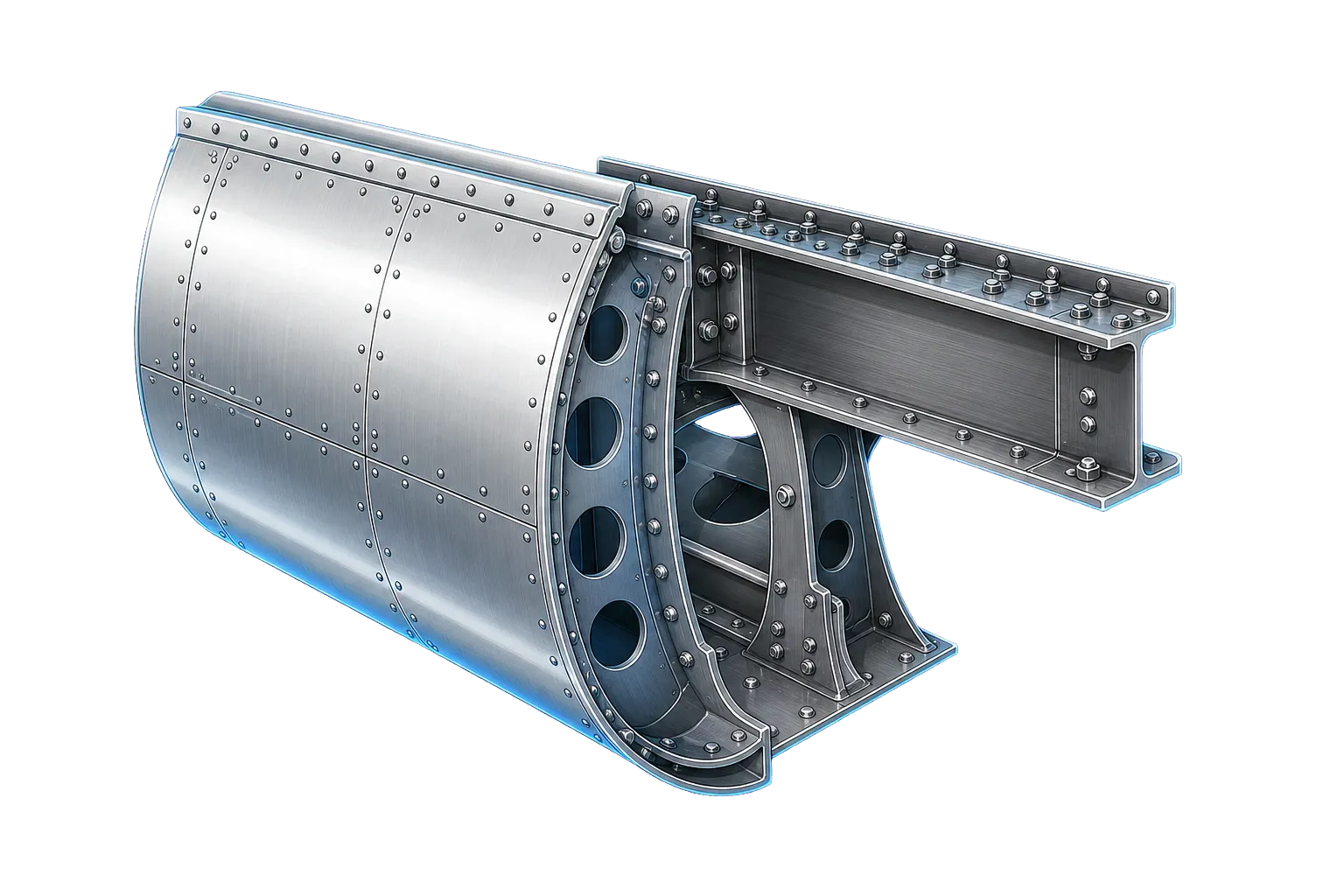
Cracks in the bear strap at the forward upper corner of the forward galley door cutout.
AI-generated summary from the source AD text. Verify against the official source before acting.
Required Actions
Inspect the fuselage skin for existing repairs and applicable on-condition actions.
AI-generated summary from the source AD text. Verify against the official source before acting.
Affected Aircraft
The Boeing Company Model 737-8, 737-9, and 737-8200 airplanes.
AI-generated summary from the source AD text. Verify against the official source before acting.
Federal Register Abstract
The FAA is adopting a new airworthiness directive (AD) for certain The Boeing Company Model 737-8, 737-9, and 737-8200 airplanes. This AD was prompted by reports of cracks in the bear strap at the forward upper corner of the forward galley door cutout. This AD requires an inspection of the fuselage skin for existing repairs and applicable on- condition actions. The FAA is issuing this AD to address the unsafe condition on these products.
Document Text
Show stored source text (verify against official source)
50698 Federal Register / Vol. 91, No. 150 / Thursday, August 6, 2026 / Rules and Regulations average lift cycles per hour TIS by following the instructions in paragraph (h)(2) of this AD. (iii) Once an MRS is determined to be an REL MRS, you no longer need to perform the 250-hour TIS moving average calculation, but you must continue to count and record the lift cycles and number of hours TIS. (iv) If an MRS is determined to be an REL MRS, it remains an REL MRS for the rest of its service life and is subject to the retirement times for an REL MRS. (3) Within 1,100 hours TIS after November 24, 2015 (the effective date of AD 2015–20– 12): (i) Conduct a Non-Destructive Inspection for a crack on each MRS. If there is a crack in an MRS, before further flight, replace it with an airworthy MRS. (ii) If an MRS is determined to be an REL MRS, identify it as an REL MRS by etching ‘‘REL’’ on the outside diameter of the MRS near the part S/N by following the Accomplishment Instructions, paragraph 3.C., of Sikorsky Alert Service Bulletin No. 61B–35–69, Revision A, dated October 10, 2023. (4) Replace each MRS with an airworthy MRS on or before reaching the revised retirement life as follows: (i) For an REL MRS that is not modified by following Sikorsky Customer Service Notice (CSN) No. 6135–10, dated March 18, 1987, and Sikorsky Service Bulletin (SB) No. 61B35–53, dated December 2, 1981 (unmodified REL MRS), the retirement life is 30,000 lift cycles or 1,500 hours TIS, whichever occurs first. (ii) For an REL MRS that is modified by following Sikorsky CSN No. 6135–10, dated March 18, 1987, and Sikorsky SB No. 61B35– 53 dated December 2, 1981; or Sikorsky CSN No. 6135–10A and Sikorsky SB No. 61B35– 53A, both Revision A, and both dated April 19, 2004 (modified REL MRS), the retirement life is 30,000 lift cycles or 5,000 hours TIS, whichever occurs first. (iii) For a Non-REL MRS, within 5 days after the effective date of this AD, revise the 13,000-hour TIS retirement life to 7,300 hours TIS by recording the new or revised retirement life on the MRS component history card or equivalent record. (A) If the hours TIS on the MRS are 7,300 hours TIS or greater as of the effective date of this AD, and the MRS is installed, at the next main gearbox overhaul, remove it from service. (B) If the hours TIS on the MRS are 7,300 hours TIS or greater as of the effective date of this AD, and the MRS is uninstalled or in overhaul, before further flight, remove it from service. (C) If the hours TIS on the MRS are less than 7,300 hours TIS as of the effective date of the AD, remove the MRS from service before exceeding 7,300 hours TIS. (5) Within 5 days after the effective date of this AD, establish or revise the retirement lives of the MRS as indicated in paragraphs (g)(4)(i) through (g)(4)(ii) of this AD by recording the new or revised retirement life on the MRS component history card or equivalent record. (6) Within 50 hours TIS after November 24, 2015 (the effective date of AD 2015–20–12), remove from service any MRS with oversized (0.8860 ″ or greater diameter) dowel pin bores. (h) Calculating Average Lift Cycles per Hour TIS (1) Calculating the first moving average of lift cycles per hour TIS. The first moving average calculation is performed on the MRS assembly when the external lift component history card record reflects that the MRS assembly has reached its first 250 hours TIS. To perform the calculation, divide the total number of lift cycles performed during the first 250 hours TIS by 250. The result will be the first moving average calculation of lift cycles per hour TIS. (2) Calculating subsequent moving average of lift cycles per hour TIS. Subsequent moving average calculations are performed on the MRS assembly at intervals of 50 hours TIS after the first moving average calculation. Subtract the total number of lift cycles performed during the first 50-hour TIS interval used in the previous moving average calculation from the total number of lift cycles performed on the MRS assembly during the previous 300 hours TIS. Divide this result by 250. The result will be the next or subsequent moving average calculation of lift cycles per hour TIS. (See Note 1 to paragraph (h)(2) of this AD for a sample calculation of subsequent 50-hour TIS intervals). Note 1 to paragraph (h)(2): Sample calculation for subsequent 50-hour TIS intervals. Assume the total number of lift cycles for the first 50-hour TIS interval used in the previous moving average calculation = 450 lift cycles and the total number of lift cycles for the previous 300 hours TIS = 2,700 lift cycles. The subsequent moving average of lift cycles per hour TIS = (2,700 ¥ 450) divided by 250 = 9 lift cycles per hour TIS. (i) Credit for Previous Actions This paragraph provides credit for the actions identified in paragraph (g)(3)(ii) of this AD if they were completed before the effective date of this AD using Sikorsky Alert Service Bulletin No. 61B35–69, dated April 19, 2004. (j) Alternative Methods of Compliance (AMOCs) (1) The Manager, East Certification Branch, FAA, has the authority to approve AMOCs for this AD, if requested using the procedures found in 14 CFR 39.19. In accordance with 14 CFR 39.19, send your request to your principal inspector or local Flight Standards District Office, as appropriate. If sending information directly to the manager of the East Certification Branch, send it to the attention of the person identified in paragraph (k)(1) of this AD and email to: AMOC@faa.gov. (2) Before using any approved AMOC, notify your appropriate principal inspector, or lacking a principal inspector, the manager of the local Flight Standards District Office/ certificate holding district office. (k) Additional Information (1) For more information about this AD, contact Isabel Saltzman, Aviation Safety Engineer, FAA, 1701 Columbia Avenue, College Park, GA 30337; phone: (781) 238– 7649; email: ecb-cos@faa.gov. (2) Material identified in this AD that is not incorporated by reference contains additional information about the subject of this AD and is available at the address specified in paragraph (l)(3) of this AD. (l) Material Incorporated by Reference (1) The Director of the Federal Register approved the incorporation by reference of the material listed in this paragraph under 5 U.S.C. 552(a) and 1 CFR part 51. (2) You must use this material as applicable to do the actions required by this AD, unless the AD specifies otherwise. (i) Sikorsky Alert Service Bulletin No. 61B–35–69, Revision A, dated October 10, 2023. (ii) [Reserved] (3) For Sikorsky material identified in this AD, contact a Sikorsky Field Representative or Sikorsky’s Service Engineering Group at Sikorsky Aircraft Corporation, Mailstop K100, 124 Quarry Road, Trumbull, CT 06611; phone: (800) 946–4337 (1–800–Winged–S); email: wcs _ cust _ service _ eng.gr-sik@ lmco.com; website: sikorsky360.com. (4) You may view this material at the FAA, Airworthiness Products Section, Operational Safety Branch, 10101 Hillwood Parkway, Fort Worth, TX 76177. For information on the availability of this material at the FAA, call (817) 222–5110. (5) You may view this material at the National Archives and Records Administration (NARA). For information on the availability of this material at NARA, visit www.archives.gov/federal-register/cfr/ ibr-locations or email fr.inspection@nara.gov. Issued on July 28, 2026. Steven W. Thompson, Acting Deputy Director, Compliance & Airworthiness Division, Aircraft Certification Service. [FR Doc. 2026–15978 Filed 8–5–26; 8:45 am] BILLING CODE 4910–13–P DEPARTMENT OF TRANSPORTATION Federal Aviation Administration 14 CFR Part 39 [Docket No. FAA–2025–3985; Project Identifier AD–2025–00493–T; Amendment 39–23423; AD 2026–15–11] RIN 2120–AA64 Airworthiness Directives; The Boeing Company Airplanes AGENCY : Federal Aviation Administration (FAA), DOT. ACTION : Final rule. SUMMARY : The FAA is adopting a new airworthiness directive (AD) for certain The Boeing Company Model 737–8, 737–9, and 737–8200 airplanes. This AD was prompted by reports of cracks in the bear strap at the forward upper VerDate Sep<11>2014 16:13 Aug 05, 2026 Jkt 268001 PO 00000 Frm 00038 Fmt 4700 Sfmt 4700 E:\FR\FM\06AUR1.SGM 06AUR1 lotter on DSK8BHNXB4PROD with RULES1

50699 Federal Register / Vol. 91, No. 150 / Thursday, August 6, 2026 / Rules and Regulations corner of the forward galley door cutout. This AD requires an inspection of the fuselage skin for existing repairs and applicable on-condition actions. The FAA is issuing this AD to address the unsafe condition on these products. DATES : This AD is effective September 10, 2026. The Director of the Federal Register approved the incorporation by reference of a certain publication listed in this AD as of September 10, 2026. ADDRESSES : AD Docket: You may examine the AD docket at regulations.gov under Docket No. FAA–2025–3985; or in person at Docket Operations between 9 a.m. and 5 p.m., Monday through Friday, except Federal holidays. The AD docket contains this final rule, any comments received, and other information. The address for Docket Operations is U.S. Department of Transportation, Docket Operations, M–30, West Building Ground Floor, Room W12–140, 1200 New Jersey Avenue SE, Washington, DC 20590. Material Incorporated by Reference: • For Boeing material identified in this AD, contact Boeing Commercial Airplanes, Attention: Contractual & Data Services (C&DS), 2600 Westminster Blvd., MC 110–SK57, Seal Beach, CA 90740–5600; telephone 562–797–1717; website myboeingfleet.com. • You may view this material at the FAA, Airworthiness Products Section, Operational Safety Branch, 2200 South 216th St., Des Moines, WA. For information on the availability of this material at the FAA, call 206–231–3195. It is also available at regulations.gov under Docket No. FAA–2025–3985. FOR FURTHER INFORMATION CONTACT : Luis Cortez-Muniz, Aviation Safety Engineer, FAA, 2200 South 216th St., Des Moines, WA 98198; phone: 206–231–3958; email: luis.a.cortez-muniz@faa.gov. SUPPLEMENTARY INFORMATION : Background The FAA issued a notice of proposed rulemaking (NPRM) to amend 14 CFR part 39 by adding an AD that would apply to certain The Boeing Company Model 737–8, 737–9, and 737–8200 airplanes. The NPRM was published in the Federal Register on November 25, 2025 (90 FR 53245). The NPRM was prompted by reports of cracks in the bear strap at the forward upper corner of the forward galley door cutout. In the NPRM, the FAA proposed to require an inspection of the fuselage skin for existing repairs and applicable on- condition actions. The FAA is issuing this AD to address cracks in the fuselage skin and bear strap, which may lead to the inability of the principal structural element to sustain limit loads and adversely affect the structural integrity of the airplane. Discussion of Final Airworthiness Directive Comments The FAA received comments from The Boeing Company who supported the NPRM without change. The FAA received additional comments from two commenters, including The Foundation for Aviation Safety and United Airlines (United). The following presents the comments received on the NPRM and the FAA’s response to each comment. Request To Explain How the Root Cause Is Addressed The Foundation for Aviation Safety asked what the FAA and Boeing are doing to address the root cause of the defect. The commenter also asked if a structural defect is important enough to immediately ground an airplane after it is detected, why is the inspection for defects not accomplished long before the proposed compliance time. The FAA is issuing this AD to address the unsafe condition on in-service airplanes. The required compliance times for the initial inspection and on- condition repetitive inspections and repair were established to ensure any crack is detected and repaired before the crack reaches critical length with multiple opportunities for detection. The rulemaking timeline was based on Boeing 737 fleet findings, supporting analysis, and the severity of the effect on the airplane ( i.e., safety consequences) if cracking propagates beyond a critical length. The FAA determined that the required actions and compliance times provide an acceptable level of safety. In addition, Boeing is introducing changes to the manufacturing process that address the root cause of the unsafe condition on in- production airplanes. Request To Clarify Whether Certain Repairs Apply to Condition 1 United stated that Table 1, Condition 1 of the Accomplishment Instructions of Boeing Alert Requirements Bulletin 737–53A1408 RB, dated December 20, 2024, specifies to contact Boeing for alternative inspection instructions for any repair found during the general visual inspection of the fuselage skin. The commenter noted that Boeing Alert Service Bulletin 737–53A1408, dated December 20, 2024, does not provide guidance for repairs accomplished per the structural repair manual (SRM) limits in 737–8 and 737–9 SRM 53–00– 01, for fuselage skin blend out and bear strap blend out repair. United requested clarification on whether repairs performed within allowable damage limits should be considered ‘‘repairs found’’ for the purposes of Table 1, or if such repairs may be treated as unrepaired areas, ‘‘no repair found.’’ The FAA notes that Condition 1 applies to any repair, which includes blend out repairs accomplished per the SRM within the allowable damage limits. Such blend out repairs need to be evaluated to determine whether the repetitive inspection interval specified in the service information provides an acceptable level of safety for those repairs. Depending on findings, it may be necessary to reduce the inspection interval. The FAA has not changed this AD in response to this comment. Conclusion The FAA reviewed the relevant data, considered any comments received, and determined that air safety requires adopting this AD as proposed. Accordingly, the FAA is issuing this AD to address the unsafe condition on these products. Except for minor editorial changes, and any other changes described previously, this AD is adopted as proposed in the NPRM. None of the changes will increase the economic burden on any operator. Material Incorporated by Reference Under 1 CFR Part 51 The FAA reviewed Boeing Alert Requirements Bulletin 737–53A1408 RB, dated December 20, 2024. This material specifies procedures for an external general visual inspection of the fuselage skin for any repair and applicable on-condition actions. On- condition actions include repetitive detailed inspection for cracking of the fuselage skin; repetitive external surface high frequency eddy current (HFEC) inspections of the fuselage skin at certain fastener locations and the fuselage skin and bear strap along the edge of door corner radius for cracking; repetitive external subsurface low frequency eddy current (LFEC) inspection of the bear strap at certain fastener locations for cracking; and obtaining instructions from Boeing for alternative inspections or for crack repair. This material is reasonably available because the interested parties have access to it through their normal course of business or by the means identified in the ADDRESSES section. Costs of Compliance The FAA estimates that this AD affects 471 airplanes of U.S. registry. VerDate Sep<11>2014 16:13 Aug 05, 2026 Jkt 268001 PO 00000 Frm 00039 Fmt 4700 Sfmt 4700 E:\FR\FM\06AUR1.SGM 06AUR1 lotter on DSK8BHNXB4PROD with RULES1

50700 Federal Register / Vol. 91, No. 150 / Thursday, August 6, 2026 / Rules and Regulations The FAA estimates the following costs to comply with this AD: E STIMATED C OSTS Action Labor cost Parts cost Cost per product Cost on U.S. operators External general visual inspection for re- pairs. 1 work-hour × $85 per hour = $85 .............. $0 $85 ............... $40,035. External detailed and eddy current inspec- tions for cracks. Up to 4 work-hours × $85 per hour = $340 per inspection cycle. 0 Up to $340 ... Up to $160,140 per inspection cycle. The FAA has received no definitive data on which to base the cost estimates for the on-condition repairs or for the alternative inspections specified in this AD. Authority for This Rulemaking Title 49 of the United States Code specifies the FAA’s authority to issue rules on aviation safety. Subtitle I, section 106, describes the authority of the FAA Administrator. Subtitle VII: Aviation Programs, describes in more detail the scope of the Agency’s authority. The FAA is issuing this rulemaking under the authority described in Subtitle VII, Part A, Subpart III, Section 44701: General requirements. Under that section, Congress charges the FAA with promoting safe flight of civil aircraft in air commerce by prescribing regulations for practices, methods, and procedures the Administrator finds necessary for safety in air commerce. This regulation is within the scope of that authority because it addresses an unsafe condition that is likely to exist or develop on products identified in this rulemaking action. Regulatory Findings This AD will not have federalism implications under Executive Order 13132. This AD will not have a substantial direct effect on the States, on the relationship between the national government and the States, or on the distribution of power and responsibilities among the various levels of government. For the reasons discussed above, I certify that this AD: (1) Is not a ‘‘significant regulatory action’’ under Executive Order 12866, (2) Will not affect intrastate aviation in Alaska, and (3) Will not have a significant economic impact, positive or negative, on a substantial number of small entities under the criteria of the Regulatory Flexibility Act. List of Subjects in 14 CFR Part 39 Air transportation, Aircraft, Aviation safety, Incorporation by reference, Safety. The Amendment Accordingly, under the authority delegated to me by the Administrator, the FAA amends 14 CFR part 39 as follows: PART 39—AIRWORTHINESS DIRECTIVES ■ 1. The authority citation for part 39 continues to read as follows: Authority: 49 U.S.C. 106(g), 40113, 44701. § 39.13 [Amended] ■ 2. The FAA amends § 39.13 by adding the following new airworthiness directive: 2026–15–11 The Boeing Company: Amendment 39–23423; Docket No. FAA–2025–3985; Project Identifier AD– 2025–00493–T. (a) Effective Date This airworthiness directive (AD) is effective September 10, 2026. (b) Affected ADs None. (c) Applicability This AD applies to The Boeing Company Model 737–8, 737–9, and 737–8200 airplanes, certificated in any category, as identified in Boeing Alert Requirements Bulletin 737–53A1408 RB, dated December 20, 2024. (d) Subject Air Transport Association (ATA) of America Code 53, Fuselage. (e) Unsafe Condition This AD was prompted by reports of cracks in the bear strap at the forward upper corner of the forward galley door cutout. The FAA is issuing this AD to address cracks in the fuselage skin and bear strap, which may lead to the inability of the principal structural element to sustain limit loads and adversely affect the structural integrity of the airplane. (f) Compliance Comply with this AD within the compliance times specified, unless already done. (g) Required Actions Except as specified by paragraph (h) of this AD: At the applicable times specified in the ‘‘Compliance’’ paragraph of Boeing Alert Requirements Bulletin 737–53A1408 RB, dated December 20, 2024, do all applicable actions identified in, and in accordance with, the Accomplishment Instructions of Boeing Alert Requirements Bulletin 737–53A1408 RB, dated December 20, 2024. Note 1 to paragraph (g): Guidance for accomplishing the actions required by this AD can be found in Boeing Alert Service Bulletin 737–53A1408, dated December 20, 2024, which is referred to in Boeing Alert Requirements Bulletin 737–53A1408 RB, dated December 20, 2024. (h) Exceptions to Requirements Bulletin Specifications (1) Where Compliance Time columns of the tables in the ‘‘Compliance’’ paragraph of Boeing Alert Requirements Bulletin 737– 53A1408 RB, dated December 20, 2024, refer to the original issue date of Requirements Bulletin 737–53A1408 RB, this AD requires using the effective date of this AD. (2) Where Boeing Alert Requirements Bulletin 737–53A1408 RB, dated December 20, 2024, specifies contacting Boeing for repair instructions or for alternative inspections, this AD requires doing the repair, or doing the alternative inspections and applicable on-condition actions, using a method approved in accordance with the procedures specified in paragraph (i) of this AD. (i) Alternative Methods of Compliance (AMOCs) (1) The Manager, AIR–520, Continued Operational Safety Branch, FAA, has the authority to approve AMOCs for this AD, if requested using the procedures found in 14 CFR 39.19. In accordance with 14 CFR 39.19, send your request to your principal inspector or responsible Flight Standards Office, as appropriate. If sending information directly to the manager of the Continued Operational Safety Branch, send it to the attention of the person identified in paragraph (j)(1) of this AD. Information may be emailed to: AMOC@ faa.gov. Before using any approved AMOC, notify your appropriate principal inspector, or lacking a principal inspector, the manager of the responsible Flight Standards Office. VerDate Sep<11>2014 16:13 Aug 05, 2026 Jkt 268001 PO 00000 Frm 00040 Fmt 4700 Sfmt 4700 E:\FR\FM\06AUR1.SGM 06AUR1 lotter on DSK8BHNXB4PROD with RULES1

50701 Federal Register / Vol. 91, No. 150 / Thursday, August 6, 2026 / Rules and Regulations (2) An AMOC that provides an acceptable level of safety may be used for any repair, modification, or alteration required by this AD if it is approved by The Boeing Company Organization Designation Authorization (ODA) that has been authorized by the Manager, AIR–520, Continued Operational Safety Branch, FAA, to make those findings. To be approved, the repair method, modification deviation, or alteration deviation must meet the certification basis of the airplane, and the approval must specifically refer to this AD. (j) Additional Information (1) For more information about this AD, contact Luis Cortez-Muniz, Aviation Safety Engineer, FAA, 2200 South 216th St., Des Moines, WA 98198; phone: 206–231–3958; email: luis.a.cortez-muniz@faa.gov. (2) Material identified in this AD that is not incorporated by reference is available at the address specified in paragraph (k)(3) of this AD. (k) Material Incorporated by Reference (1) The Director of the Federal Register approved the incorporation by reference of the material listed in this paragraph under 5 U.S.C. 552(a) and 1 CFR part 51. (2) You must use this material as applicable to do the actions required by this AD, unless the AD specifies otherwise. (i) Boeing Alert Requirements Bulletin 737–53A1408 RB, dated December 20, 2024. (ii) [Reserved] (3) For Boeing material identified in this AD, contact Boeing Commercial Airplanes, Attention: Contractual & Data Services (C&DS), 2600 Westminster Blvd., MC 110– SK57, Seal Beach, CA 90740–5600; telephone 562–797–1717; website myboeingfleet.com. (4) You may view this material at the FAA, Airworthiness Products Section, Operational Safety Branch, 2200 South 216th St., Des Moines, WA. For information on the availability of this material at the FAA, call 206–231–3195. (5) You may view this material at the National Archives and Records Administration (NARA). For information on the availability of this material at NARA, visit www.archives.gov/federal-register/cfr/ ibr-locations or email fr.inspection@nara.gov. Issued on August 3, 2026. Brian Knaup, Acting Deputy Director, Integrated Certificate Management Division, Aircraft Certification Service. [FR Doc. 2026–15936 Filed 8–5–26; 8:45 am] BILLING CODE 4910–13–P DEPARTMENT OF COMMERCE Bureau of Industry and Security 15 CFR 700 [Docket No. 260804–0143] 0694–AK51 DPAS Directive Allocation Order and Additional Requirements for Recoverable Critical Minerals and Materials AGENCY : Bureau of Industry and Security, Department of Commerce. ACTION : Temporary final rule; Request for comments. SUMMARY : The Bureau of Industry and Security (‘‘BIS’’) is publishing this temporary final rule to restrict the exportation of black mass and tungsten waste and scrap without a license. Specifically, as of August 27, 2026, U.S. persons engaged in the sale of black mass and tungsten waste and scrap must allocate 100 percent of monthly sales to U.S. persons, unless an adjustment or exception is obtained in advance from BIS. This action is taken pursuant to section 101 of the Defense Production Act of 1950, as amended (‘‘DPA’’ or the ‘‘Act’’), the Defense Priorities and Allocations System (15 CFR part 700) and Presidential Determination Pursuant to Section 101 of the Defense Production Act of 1950, as Amended, on Recoverable Critical Minerals and Materials, dated July 30, 2026 (‘‘DPA Determination on Recoverable CMMs’’), in which the President authorized the Department of Commerce (‘‘Commerce’’) to address the scarcity of recoverable critical minerals and materials (‘‘CMMs’’). BIS invites the public to submit comments on whether any additional sales requirements are necessary or appropriate to promote the national defense. DATES : Directive Allocation Order Effective date: August 27, 2026 through August 27, 2027. Request for Adjustment and Exceptions date: Requests may be submitted on a rolling basis beginning August 6, 2026 through August 27, 2027. Comments: Comments must be received by November 4, 2026. ADDRESSES : Requests for an adjustment or exception may be submitted to the Department of Commerce, Bureau of Industry and Security, Office of Strategic Industries and Economic Security via DPASAllocations@ bis.doc.gov. Comments regarding this temporary final rule may be submitted to the Federal rulemaking portal at: https:// www.regulations.gov. The regulations.gov ID for this notice is BIS– 2026–0364. Please refer to RIN 0694– AK51 in all comments. All filers using the portal should use the name of the person or entity submitting the comments as the name of their files, in accordance with the instructions below. Anyone submitting business confidential information should clearly identify the business confidential portion at the time of submission, file a statement justifying nondisclosure and referring to the specific legal authority claimed, and provide a non-confidential version of the submission. For comments submitted electronically containing business confidential information, the file name of the business confidential version should begin with the characters ‘‘BC.’’ Any page containing business confidential information must be clearly marked ‘‘BUSINESS CONFIDENTIAL’’ on the top of that page. The corresponding non-confidential version of those comments must be clearly marked ‘‘PUBLIC.’’ The file name of the non-confidential version should begin with the character ‘‘P.’’ Any submissions with file names that do not begin with either a ‘‘BC’’ or a ‘‘P’’ will be assumed to be public and will be made publicly available at: https:// www.regulations.gov. Commenters submitting business confidential information are encouraged to scan a hard copy of the non-confidential version to create an image of the file, rather than submitting a digital copy with redactions applied, to avoid inadvertent redaction errors which could enable the public to read business confidential information. FOR FURTHER INFORMATION CONTACT : Emily Noel, Office of Strategic Industries and Economic Security, Bureau of Industry and Security, Department of Commerce, Telephone: 202–482–3634; email: DPASAllocations@bis.doc.gov. SUPPLEMENTARY INFORMATION : The preamble to this temporary final rule consists of four sections: I. Legal Authorities II. Provisions of the Temporary Final Rule III. Request for Comment IV. Rulemaking Requirements I. Legal Authorities BIS administers the DPAS regulation which implements the priorities and allocations authority under Title I of the DPA (50 U.S.C. 4501, et seq. ), with respect to all materials, services, and facilities, including construction materials, not delegated to other VerDate Sep<11>2014 16:13 Aug 05, 2026 Jkt 268001 PO 00000 Frm 00041 Fmt 4700 Sfmt 4700 E:\FR\FM\06AUR1.SGM 06AUR1 lotter on DSK8BHNXB4PROD with RULES1
Source: Official FAA Source ↗
Retrieved: Aug 7, 2026
Rights: U.S. Government Public Domain
This site is not affiliated with or endorsed by the FAA. Always verify with official sources.
Related Airworthiness Directives
2026-20-10 Recurring
final ruleAirworthiness Directives; The Boeing Company Airplanes
Unsafe Condition: unsafe condition.
2026-20-04 Recurring
final ruleAirworthiness Directives; The Boeing Company Airplanes
Unsafe Condition: Cracks in the upper frames around the uppermost fastener common to the fail-safe chord at the fuselage frame splices may not be detected due to insufficient inspection opportunities in existing MPD...
2026-20-01
final ruleAirworthiness Directives; The Boeing Company Airplanes
Unsafe Condition: The absence of cargo liner joint sealing tape could allow a fire to propagate into the cabin.
2026-19-04
final ruleAirworthiness Directives; The Boeing Company Airplanes
Unsafe Condition: Overheating of alternating current motor pump (ACMP) with a certain part number can cause a fire in the main landing gear (MLG) wheel well.