AD 2019-12-07
Applicability
| Type | Manufacturer | Model | Details |
|---|---|---|---|
| aircraft | Airbus | Various | Airworthiness Directives; Airbus SAS Airplanes |
Unsafe Condition
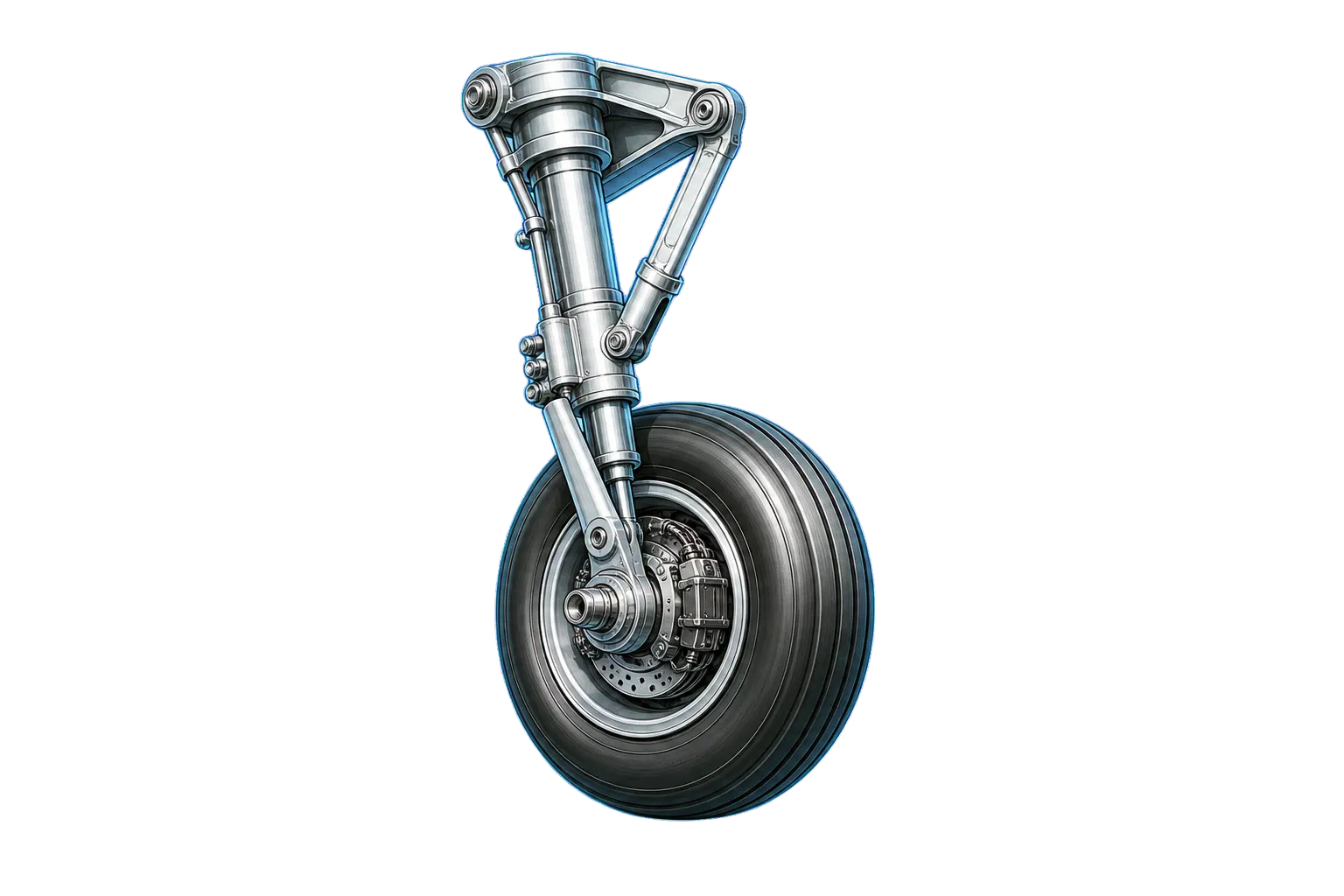
Cracks were found in the main landing gear (MLG) sliding tubes due to certain manufacturing defects that might not be identified using the current on-wing scheduled inspections. The cracks may have developed due to metallic inclusion during production and abnormal grinding operation during overhaul, or burrs that could have been present since manufacture. This condition, if not detected and corrected, could lead to sliding tube failure, possibly resulting in MLG collapse, damage to the airplane, and injury to occupants.
AI-generated summary from the source AD text. Verify against the official source before acting.
Required Actions
Perform repetitive inspections of the affected MLG sliding tubes for cracking, and depending on findings, accomplishment of applicable corrective action(s) (replacement of a cracked MLG sliding tube with a serviceable MLG sliding tube).
AI-generated summary from the source AD text. Verify against the official source before acting.
Compliance Time
Within 50 flight hours
AI-generated summary from the source AD text. Verify against the official source before acting.
Affected Aircraft
Airbus SAS Model A318 and A319 series airplanes; Model A320-211, -212, -214, -231, -232, and -233 airplanes; and Model A321 series airplanes.
AI-generated summary from the source AD text. Verify against the official source before acting.
Federal Register Abstract
The FAA is superseding Airworthiness Directive (AD) 2007-11-11 and AD 2017-01-11, which applied to all Airbus SAS Model A318 and Model A319 series airplanes; Model A320-211, -212, -214, -231, -232, and -233 airplanes; and Model A321 series airplanes. AD 2007-11-11 required an inspection to determine the serial number of both main landing gear (MLG) sliding tubes, repetitive inspections for cracking of the affected MLG sliding tubes and corrective actions if necessary, and eventual replacement of both MLG shock absorbers. AD 2017-01-11 required identification of the part number and serial number of the MLG sliding tubes; inspection of affected chromium plates and sliding tube axles for damage; and replacement of the sliding tube if necessary. This AD retains certain requirements of AD 2007-11-11 and AD 2017-01-11. This AD also requires repetitive inspections of affected MLG sliding tubes for cracking, replacement of cracked MLG sliding tubes, and eventual replacement of each affected MLG sliding tube. This AD was prompted by cracks found in the MLG sliding tubes due to certain manufacturing defects that might not be identified using the current on-wing scheduled inspections. The FAA is issuing this AD to address the unsafe condition on these products.
Applicability Source Text
Show captured applicability text from the source AD
(c) Applicability

    This AD applies to the Airbus SAS airplanes identified in
paragraphs (c)(1) through (c)(4) of this AD, certificated in any
category, all manufacturer serial numbers (MSNs).
    (1) Model A318-111, -112, -121, and -122 airplanes.
    (2) Model A319-111, -112, -113, -114, -115, -131, -132, and -133
airplanes.
    (3) Model A320-211, -212, -214, -216, -231, -232, and -233
airplanes.
    (4) Model A321-111, -112, -131, -211, -212, -213, -231, and -232
airplanes.
Document Text
Show stored source text (verify against official source)
[Federal Register Volume 84, Number 124 (Thursday, June 27, 2019)]
[Rules and Regulations]
[Pages 30579-30588]
From the Federal Register Online via the Government Publishing Office [<a href="http://www.gpo.gov">www.gpo.gov</a>]
[FR Doc No: 2019-13545]
-----------------------------------------------------------------------
DEPARTMENT OF TRANSPORTATION
Federal Aviation Administration
14 CFR Part 39
[Docket No. FAA-2019-0017; Product Identifier 2018-NM-112-AD; Amendment
39-19662; AD 2019-12-07]
RIN 2120-AA64
Airworthiness Directives; Airbus SAS Airplanes
AGENCY: Federal Aviation Administration (FAA), Department of
Transportation (DOT).
ACTION: Final rule.
-----------------------------------------------------------------------
SUMMARY: The FAA is superseding Airworthiness Directive (AD) 2007-11-11
and AD 2017-01-11, which applied to all Airbus SAS Model A318 and Model
A319 series airplanes; Model A320-211, -212, -214, -231, -232, and -233
airplanes; and Model A321 series airplanes. AD 2007-11-11 required an
inspection to determine the serial number of both main landing gear
(MLG) sliding tubes, repetitive inspections for cracking of the
affected MLG sliding tubes and corrective actions if necessary, and
eventual replacement of both MLG shock absorbers. AD 2017-01-11
required identification of the part number and serial number of the MLG
sliding tubes; inspection of affected chromium plates and sliding tube
axles for damage; and replacement of the sliding tube if
[[Page 30580]]
necessary. This AD retains certain requirements of AD 2007-11-11 and AD
2017-01-11. This AD also requires repetitive inspections of affected
MLG sliding tubes for cracking, replacement of cracked MLG sliding
tubes, and eventual replacement of each affected MLG sliding tube. This
AD was prompted by cracks found in the MLG sliding tubes due to certain
manufacturing defects that might not be identified using the current
on-wing scheduled inspections. The FAA is issuing this AD to address
the unsafe condition on these products.
DATES: This AD is effective August 1, 2019.
The Director of the Federal Register approved the incorporation by
reference of certain publications listed in this AD as of August 1,
2019.
The Director of the Federal Register approved the incorporation by
reference of a certain other publication listed in this AD as of
February 22, 2017 (82 FR 5362, January 18, 2017).
The Director of the Federal Register approved the incorporation by
reference of a certain other publication listed in this AD as of June
29, 2007 (72 FR 29241, May 25, 2007).
ADDRESSES: For Airbus service information identified in this final
rule, contact Airbus SAS, Airworthiness Office--EIAS, Rond-Point Emile
Dewoitine No: 2, 31700 Blagnac Cedex, France; telephone +33 5 61 93 36
96; fax +33 5 61 93 44 51; email <a href="/cdn-cgi/l/email-protection#9dfcfefef2e8f3e9b3fcf4efeaf2efe9f5b0f8fceeddfcf4efffe8eeb3fef2f0"><span class="__cf_email__" data-cfemail="dbbab8b8b4aeb5aff5bab2a9acb4a9afb3f6bebaa89bbab2a9b9aea8f5b8b4b6">[email protected]</span></a>;
internet <a href="http://www.airbus.com">http://www.airbus.com</a>.
For Safran and Messier-Dowty service information identified in this
final rule, contact Safran Landing Systems, One Carbon Way, Walton, KY
41094; telephone (859) 525-8583; fax (859) 485-8827; internet <a href="https://www.safran-landing-systems.com">https://www.safran-landing-systems.com</a>.
You may view this referenced service information at the FAA,
Transport Standards Branch, 2200 South 216th St., Des Moines, WA. For
information on the availability of this material at the FAA, call 206-
231-3195. It is also available on the internet at <a href="http://www.regulations.gov">http://www.regulations.gov</a> by searching for and locating Docket No. FAA-2019-
0017.
Examining the AD Docket
You may examine the AD docket on the internet at <a href="http://www.regulations.gov">http://www.regulations.gov</a> by searching for and locating Docket No. FAA-2019-
0017; or in person at Docket Operations between 9 a.m. and 5 p.m.,
Monday through Friday, except Federal holidays. The AD docket contains
this final rule, the regulatory evaluation, any comments received, and
other information. The address for Docket Operations is U.S. Department
of Transportation, Docket Operations, M-30, West Building Ground Floor,
Room W12-140, 1200 New Jersey Avenue SE, Washington, DC 20590.
FOR FURTHER INFORMATION CONTACT: Sanjay Ralhan, Aerospace Engineer,
International Section, Transport Standards Branch, FAA, 2200 South
216th St., Des Moines, WA 98198; telephone and fax 206-231-3223.
SUPPLEMENTARY INFORMATION:
Discussion
The FAA issued a notice of proposed rulemaking (NPRM) to amend 14
CFR part 39 to supersede AD 2007-11-11, Amendment 39-15068 (72 FR
29241, May 25, 2007) (``AD 2007-11-11''), and AD 2017-01-11, Amendment
39-18778 (82 FR 5362, January 18, 2017) (``AD 2017-01-11''). AD 2007-
11-11 applied to all Airbus SAS Model A318 and Model A319 series
airplanes; Model A320-211, -212, -214, -231, -232, and -233 airplanes;
and Model A321 series airplanes. AD 2017-01-11 applied to all Airbus
SAS Model A318 and Model A319 series airplanes; Model A320-211, -212, -
214, -231, -232, and -233 airplanes; and Model A321 series airplanes.
The NPRM published in the Federal Register on February 25, 2019 (84
FR 5960). The NPRM was prompted by a determination that cracks were
found in the MLG sliding tubes due to certain manufacturing defects
that might not be identified using the current on-wing scheduled
inspections. The NPRM proposed to retain certain requirements of AD
2007-11-11 and AD 2017-01-11. The NPRM also proposed to require
repetitive inspections of affected MLG sliding tubes for cracking,
replacement of cracked MLG sliding tubes, and eventual replacement of
each affected MLG sliding tube. The FAA is issuing this AD to address
cracking in an MLG sliding tube, which could lead to failure of an MLG
sliding tube resulting in MLG collapse, damage to the airplane, and
injury to passengers.
The European Aviation Safety Agency (EASA), which is the Technical
Agent for the Member States of the European Union, has issued EASA AD
2018-0135, dated June 26, 2018 (referred to after this as the Mandatory
Continuing Airworthiness Information, or ``the MCAI''), to correct an
unsafe condition for all Airbus SAS Model A318 and A319 series
airplanes; Model A320-211, -212, -214, -216, -231, -232, and -233
airplanes; and Model A321-111, -112, -131, -211, -212, -213, -231, and
-232 airplanes. The MCAI states:
Cracks were reported on [main landing gear] MLG sliding tubes
and the investigations determined metallic inclusion during
production and abnormal grinding operation during overhaul as cause
of these cracks. Prompted by these reports, respectively, [Direction
Generale de l'Aviation Civile] DGAC France issued [French] AD F-
2005-115 (EASA approval 2005-6032) [which corresponds to FAA AD
2007-11-11] and EASA issued AD 2014-0058 [which corresponds to FAA
AD 2017-01-11], both requiring inspections and replacement of
certain MLG sliding tubes.
More recently, during overhaul, cracks were found in the lower
slave link bracket lug holes on two MLG sliding tubes. Subsequent
investigations determined that these cracks may have developed due
to burrs, which could have been present since manufacture. Based on
the fact that the sliding tube is certified as a safe life part,
this is considered to be a non-compliance with the requirements of
[Joint Aviation Requirements] JAR 25.571(c). Cracks in the affected
sliding tubes may not be found during the existing on-wing scheduled
inspections.
This condition, if not detected and corrected, could lead to
sliding tube failure, possibly resulting in MLG collapse, damage to
the aeroplane and injury to occupants.
Prompted by these findings, Safran Landing Systems, the MLG
manufacturer (formerly Messier-Dowty, Messier-Bugatti-Dowty, and
hereafter referred to as ``Safran'' in this AD), introduced
additional quality steps to eliminate burrs in the manufacturing
process. To address this potential unsafe condition on delivered MLG
sliding tubes, Airbus issued SB [service bulletin] A320-32-1441,
providing instructions for on-wing repetitive inspections, and
Safran issued SB 200-32-321 and SB 201-32-68, as applicable to MLG
configuration, providing instructions for inspection in shop.
For the reason described above, this [EASA] AD partially retains
the requirements of DGAC France AD F-2005-115 (EASA approval 2005-
6032) and EASA AD 2014-0058, which are superseded, requires
repetitive inspections of the affected MLG sliding tubes [for
cracking] and, depending on findings, accomplishment of applicable
corrective action(s) [replacement of a cracked MLG sliding tube with
a serviceable MLG sliding tube]. This [EASA] AD also defines
criteria for installation on an aeroplane of an affected MLG sliding
tube.
You may examine the MCAI in the AD docket on the internet at <a href="http://www.regulations.gov">http://www.regulations.gov</a> by searching for and locating Docket No. FAA-2019-
0017.
Comments
The FAA gave the public the opportunity to participate in
developing this final rule. The following presents the comments
received on the NPRM and the FAA's response to each comment.
[[Page 30581]]
Support for the NPRM
Air Line Pilots Association, International (ALPA) supported the
intent of the NPRM.
Request To Remove Functional Testing From ``Required for Compliance
(RC)'' Requirements
Delta Air Lines (DAL) requested that the functional testing
requirement be removed from the required for compliance ``RC''
procedures identified in the Accomplishment Instructions of Airbus
Service Bulletin A320-32-1441, Revision 01, dated December 14, 2017.
The commenter explained that paragraph 3.D. of the Accomplishment
Instructions of Airbus Service Bulletin A320-32-1441, Revision 01,
dated December 14, 2017, describes post-modification testing, which
results in functional testing of the brake and wheel installation
functionality. The commenter noted that these tests do not require any
special equipment for testing or require the operation of equipment.
The commenter stated that it would prefer to use the airplane
maintenance manual (AMM) procedures instead of a functional test.
The FAA disagrees with the commenter's request. Functional testing
is required by EASA, the state of design authority for the Model A318
and Model A319 series airplanes; Model A320-211, -212, -214, -231, -
232, and -233 airplanes; and Model A321 series airplanes; to restore
the airplane to its type design requirements. In addition, the
functional test procedure described in the above mentioned Airbus
service information refers to the procedures in AMM task 32-41-11-400-
006, ``Installation of the MLG Wheels,'' to perform the functional
test, which is what the commenter requested. The functional test is
required for compliance to ensure that risk has been mitigated and the
airplane can be returned to service per the type design requirements.
The FAA has not changed this AD in regard to this issue.
Request for Clarification of Definition
DAL observed that paragraph (n)(1) of the proposed AD defined
affected MLG shock absorbers as those having a part number and serial
number identified in Messier-Dowty Service Bulletin 200-32-286,
Revision 3, dated October 3, 2008, for Model A318, A319, and A320
series airplanes; and Messier-Dowty Service Bulletin 201-32-43,
Revision 3, dated October 3, 2008, for Model A321 series airplanes. DAL
noted that, upon review of this service information, it determined that
there are no specific part number and serial number combinations for
the MLG shock absorbers listed, and that the service information
identified serial numbers for only the MLG sliding tubes.
From these statements, the FAA infers that DAL was requesting
clarification of the definition of an affected MLG shock absorber. The
FAA agrees to clarify this definition. An affected MLG shock absorber
assembly contains an affected MLG sliding tube subassembly. The intent
of paragraph (n) of this AD is to assist operators in identification of
the discrepant MLG sliding tube part numbers. Furthermore, this
definition matches what was provided in the corresponding MCAI AD
issued by EASA. The FAA has not revised this AD in regard to this
issue.
Request for Clarification of Parts Installation Prohibition
DAL requested that paragraph (r)(1) of the proposed AD be revised
to state that, as of the effective date of the AD, no person may
install an affected MLG sliding tube on any airplane. The commenter
noted that paragraph (r)(1) of the proposed AD stated that, as of the
effective date of this AD, no person may install on any airplane an
affected MLG shock absorber. The commenter stated that its request is
supported by the fact that the proposed AD only described inspections
and actions based on the MLG sliding tubes, not the remainder of the
MLG shock absorber. The commenter further explained that it is feasible
that non-sliding tube components of the MLG shock absorber assemblies
may be perfectly fit for operation beyond the AD replacement times. The
commenter observed that this change would allow operators to use any
existing stock of MLG shock absorber related components (other than the
affected MLG sliding tubes). The commenter stated that its position is
further supported by the statements in the ``Proposed Requirements of
this NPRM'' paragraph, because no mention of an MLG shock absorber
replacement is discussed. The commenter also explained that it would be
difficult to comply with the proposed requirement specified in
paragraph (r)(1) of the proposed AD, since paragraph (n)(2) of the
proposed AD does not list specific MLG shock absorber part number and
serial number combinations.
The FAA agrees with the intent of the commenter's request. The
affected MLG shock absorber assembly contains an MLG sliding tube
subassembly. The intent of paragraph (r)(1) of this AD is to prohibit
the installation of an MLG shock absorber assembly containing a
discrepant MLG sliding tube subassembly part number. The FAA has
revised paragraph (r)(1) of this AD to prohibit, as of the effective
date of this AD, the installation of an MLG shock absorber assembly
containing a discrepant MLG sliding tube part number.
Request To Allow the Use of Future Revisions of Service Information
DAL requested that the proposed AD be revised to allow the use of
future revisions of the service information. The commenter noted that
the EASA AD allows the use of future revisions of service information.
The FAA disagrees with the commenter's request. The FAA may not
refer to any document that does not yet exist. In general terms, the
FAA is required by Office of the Federal Register (OFR) regulations for
approval of materials incorporated by reference, as specified in 1 CFR
51.1(f), to either publish the service document contents as part of the
actual AD language; or submit the service document to the OFR for
approval as referenced material, in which case the FAA may only refer
to such material in the text of an AD. The AD may refer to the service
document only if the OFR approved it for incorporation by reference.
See 1 CFR part 51. To allow operators to use later revisions of the
referenced document (issued after publication of the AD), either the
FAA must revise the AD to reference specific later revisions, or
operators must request approval to use later revisions as an
alternative method of compliance with this AD under the provisions of
paragraph (w)(1) of this AD. The FAA has not revised this AD regarding
this issue.
Conclusion
The FAA reviewed the relevant data, considered the comments
received, and determined that air safety and the public interest
require adopting this final rule with the changes described previously
and minor editorial changes. The FAA has determined that these minor
changes:
<bullet> Are consistent with the intent that was proposed in the
NPRM for addressing the unsafe condition; and
<bullet> Do not add any additional burden upon the public than was
already proposed in the NPRM.
The FAA also determined that these changes will not increase the
economic burden on any operator or increase the scope of this final
rule.
Related Service Information Under 1 CFR Part 51
Airbus has issued the following service information.
[[Page 30582]]
<bullet> Service Bulletin A320-32-1441, Revision 01, dated December
14, 2017. This service information describes procedures for inspections
of the MLG sliding tubes for cracking and corrective actions (which
includes replacing the MLG sliding tubes).
<bullet> Service Bulletin A320-32A1273, Revision 02, dated May 26,
2005. This service information specifies the serial numbers of the MLG
sliding tubes that must be replaced.
Safran Landing Systems has issued the following service
information. These documents are distinct since they apply to different
airplane models.
<bullet> Safran Service Bulletin 200-32-321, Revision 2, dated
October 3, 2017; and Service Bulletin 201-32-68, Revision 2, dated
October 3, 2017. These documents specify the part numbers and serial
numbers of the affected MLG sliding tubes.
<bullet> Messier-Dowty Service Bulletin 200-32-286, Revision 3,
dated October 3, 2008; and Service Bulletin 201-32-43, Revision 3,
dated October 3, 2008. These documents specify the part numbers and
serial numbers of the affected MLG shock absorbers.
This AD also requires Airbus Service Bulletin A320-32-1416,
including Appendix 01, dated March 10, 2014, which the Director of the
Federal Register approved for incorporation by reference as of February
22, 2017 (82 FR 5362, January 18, 2017).
This AD also requires Airbus Service Bulletin A320-32A1273,
Revision 02, including Appendix 01, dated May 26, 2005, which the
Director of the Federal Register approved for incorporation by
reference as of June 29, 2007 (72 FR 29241, May 25, 2007).
This service information is reasonably available because the
interested parties have access to it through their normal course of
business or by the means identified in the ADDRESSES section.
Costs of Compliance
The FAA estimates that this AD affects 1,186 airplanes of U.S.
registry. The FAA estimates the following costs to comply with this AD:
Estimated Costs for Required Actions
--------------------------------------------------------------------------------------------------------------------------------------------------------
Action Labor cost Parts cost Cost per product Cost on U.S. operators
--------------------------------------------------------------------------------------------------------------------------------------------------------
Retained actions from AD 2007-11-11 8 work-hours x $85 per Up to $45,310.............. Up to $46,670............. Up to $13,659,030.*
(297 airplanes) *. hour = $680.
Retained actions from AD 2017-01-11. 18 work-hours x $85 per $0......................... $1,530.................... $1,814,580.
hour = $1,530.
New actions......................... 13 work-hours x $85 per (**)....................... $1,105 **................. $1,310,530.**
hour = $1,105.
--------------------------------------------------------------------------------------------------------------------------------------------------------
* Operators should note that, although all U.S.-registered airplanes are subject to the requirements of AD 2007-11-11, there are only 297 possible
affected MLG sliding tubes in the worldwide fleet. The FAA has no way of knowing how many affected MLG sliding tubes, if any, are installed in U.S.-
registered airplanes.
** The FAA has received no definitive data for the parts costs for the replacements.
The FAA estimates the following costs to do any necessary on-
condition action that would be required based on the results of any
required actions. The FAA has no way of determining the number of
aircraft that might need this on-condition action:
Estimated Costs of On-Condition Action
------------------------------------------------------------------------
Cost per
Labor cost Parts cost product
------------------------------------------------------------------------
6 work-hours x $85 per hour = $510.... (*) * $510
------------------------------------------------------------------------
* The FAA has received no definitive data for the parts costs for the on-
condition actions.
Authority for This Rulemaking
Title 49 of the United States Code specifies the FAA's authority to
issue rules on aviation safety. Subtitle I, section 106, describes the
authority of the FAA Administrator. Subtitle VII: Aviation Programs,
describes in more detail the scope of the Agency's authority.
The FAA is issuing this rulemaking under the authority described in
Subtitle VII, Part A, Subpart III, Section 44701: ``General
requirements.'' Under that section, Congress charges the FAA with
promoting safe flight of civil aircraft in air commerce by prescribing
regulations for practices, methods, and procedures the Administrator
finds necessary for safety in air commerce. This regulation is within
the scope of that authority because it addresses an unsafe condition
that is likely to exist or develop on products identified in this
rulemaking action.
This AD is issued in accordance with authority delegated by the
Executive Director, Aircraft Certification Service, as authorized by
FAA Order 8000.51C. In accordance with that order, issuance of ADs is
normally a function of the Compliance and Airworthiness Division, but
during this transition period, the Executive Director has delegated the
authority to issue ADs applicable to transport category airplanes and
associated appliances to the Director of the System Oversight Division.
Regulatory Findings
The FAA determined that this AD will not have federalism
implications under Executive Order 13132. This AD will not have a
substantial direct effect on the States, on the relationship between
the national government and the States, or on the distribution of power
and responsibilities among the various levels of government.
For the reasons discussed above, I certify that this AD:
1. Is not a ``significant regulatory action'' under Executive Order
12866;
2. Will not affect intrastate aviation in Alaska; and
3. Will not have a significant economic impact, positive or
negative, on a substantial number of small entities under the criteria
of the Regulatory Flexibility Act.
List of Subjects in 14 CFR Part 39
Air transportation, Aircraft, Aviation safety, Incorporation by
reference, Safety.
[[Page 30583]]
Adoption of the Amendment
Accordingly, under the authority delegated to me by the
Administrator, the FAA amends 14 CFR part 39 as follows:
PART 39--AIRWORTHINESS DIRECTIVES
0
1. The authority citation for part 39 continues to read as follows:
Authority: 49 U.S.C. 106(g), 40113, 44701.
Sec. 39.13 [Amended]
0
2. The FAA amends Sec. 39.13 by:
0
a. Removing Airworthiness Directive (AD) 2007-11-11, Amendment 39-15068
(72 FR 29241, May 25, 2007); and AD 2017-01-11, Amendment 39-18778 (82
FR 5362, January 18, 2017);
0
b. Adding the following new AD:
2019-12-07 Airbus SAS: Amendment 39-19662; Docket No. FAA-2019-0017;
Product Identifier 2018-NM-112-AD.
(a) Effective Date
This AD is effective August 1, 2019.
(b) Affected ADs
This AD replaces the following ADs.
(1) AD 2007-11-11, Amendment 39-15068 (72 FR 29241, May 25,
2007) (``AD 2007-11-11'').
(2) AD 2017-01-11, Amendment 39-18778 (82 FR 5362, January 18,
2017) (``AD 2017-01-11'').
(c) Applicability
This AD applies to the Airbus SAS airplanes identified in
paragraphs (c)(1) through (c)(4) of this AD, certificated in any
category, all manufacturer serial numbers (MSNs).
(1) Model A318-111, -112, -121, and -122 airplanes.
(2) Model A319-111, -112, -113, -114, -115, -131, -132, and -133
airplanes.
(3) Model A320-211, -212, -214, -216, -231, -232, and -233
airplanes.
(4) Model A321-111, -112, -131, -211, -212, -213, -231, and -232
airplanes.
(d) Subject
Air Transport Association (ATA) of America Code 32, Landing
gear.
(e) Reason
This AD was prompted by a determination that cracks were found
in the main landing gear (MLG) sliding tubes due to certain
manufacturing defects that might not be identified using the current
on-wing scheduled inspections. The FAA is issuing this AD to address
cracking in an MLG sliding tube, which could lead to failure of an
MLG sliding tube resulting in MLG collapse, damage to the airplane,
and injury to passengers.
(f) Compliance
Comply with this AD within the compliance times specified,
unless already done.
(g) Retained Replacement of AD 2007-11-11, With Updated References to
Service Information and Specific Delegation Approval Language
This paragraph restates the requirements of paragraph (i) of AD
2007-11-11, with updated references to service information and
specific delegation approval language. Within 41 months after June
29, 2007 (the effective date of AD 2007-11-11), replace all MLG
shock absorbers equipped with MLG sliding tubes having serial
numbers listed in Airbus All Operators Telex (AOT) A320-32A1273,
Revision 01, dated May 6, 2004; or the Accomplishment Instructions
of Airbus Service Bulletin A320-32A1273, Revision 02, including
Appendix 01, dated May 26, 2005; with new or serviceable MLG shock
absorbers equipped with MLG sliding tubes having serial numbers not
listed in Airbus AOT A320-32A1273, Revision 01, dated May 6, 2004;
or the Accomplishment Instructions of Airbus Service Bulletin A320-
32A1273, Revision 02, including Appendix 01, dated May 26, 2005;
using a method approved by the Manager, International Section,
Transport Standards Branch, FAA; or the European Aviation Safety
Agency (EASA); or Airbus SAS's EASA Design Organization Approval
(DOA). If approved by the DOA, the approval must include the DOA-
authorized signature. As of June 29, 2007, only Airbus Service
Bulletin A320-32A1273, Revision 02, including Appendix 01, dated May
26, 2005, may be used to determine the affected MLG sliding tubes.
Note 1 to paragraph (g): Guidance on the replacement specified
in paragraph (g) of this AD can be found in Airbus A318/A319/A320/
A321 Aircraft Maintenance Manual Chapter 32-11-13, page block 401.
(h) Retained MLG Sliding Tube Part Number and Serial Number
Identification of AD 2017-01-11, With No Changes
This paragraph restates the requirements of paragraph (g) of AD
2017-01-11, with no changes. Within three months after February 22,
2017 (the effective date of AD 2017-01-11): Do an inspection to
identify the part number and serial number of the MLG sliding tubes
installed on the airplane. A review of airplane maintenance records
is acceptable in lieu of this inspection if the part number and
serial number of the MLG sliding tubes can be conclusively
determined from that review.
(i) Retained Identification of Airplanes of AD 2017-01-11, With No
Changes
This paragraph restates the identification specified in
paragraph (h) of AD 2017-01-11, with no changes. An airplane with a
MSN not listed in figure 1 to paragraph (i) of this AD is not
affected by the requirements of paragraph (j) of this AD, provided
it can be determined that no MLG sliding tube having a part number
and serial number listed in table 1 to paragraphs (i), (j), (l)(1),
(l)(2), (m)(1), and (m)(2) of this AD has been installed on that
airplane since first flight of the airplane.
BILLING CODE 4910-13-P
[[Page 30584]]
[GRAPHIC] [TIFF OMITTED] TR27JN19.000
[GRAPHIC] [TIFF OMITTED] TR27JN19.001
[[Page 30585]]
[GRAPHIC] [TIFF OMITTED] TR27JN19.002
[[Page 30586]]
[GRAPHIC] [TIFF OMITTED] TR27JN19.003
BILLING CODE 4910-13-C
(j) Retained Inspections of AD 2017-01-11, With No Changes
This paragraph restates the requirements of paragraph (i) of AD
2017-01-11, with no changes. For each MLG sliding tube identified as
required by paragraph (h) of this AD, having a part number and
serial number listed in table 1 to paragraphs (i), (j), (l)(1),
(l)(2), (m)(1), and (m)(2) of this AD: Within 3 months after
February 22, 2017 (the effective date of AD 2017-01-11) inspect
affected MLG axles and brake flanges by doing a detailed visual
inspection of the chromium plates for damage, and a Barkhausen noise
inspection of the MLG sliding tube axles for damage, in accordance
with the Accomplishment Instructions of Airbus Service Bulletin
A320-32-1416, including Appendix 01, dated March 10, 2014. For Model
A318 series airplanes, use the procedures specified for Model A319
series airplanes in Airbus Service Bulletin A320-32-1416, including
Appendix 01, dated March 10, 2014.
(k) Retained Corrective Action of AD 2017-01-11, With No Changes
This paragraph restates the requirements of paragraph (j) of AD
2017-01-11, with no changes. If, during any inspection required by
paragraph (j) of this AD, any damage is detected: Before further
flight, replace the MLG sliding tube with a serviceable MLG sliding
tube, in accordance with the Accomplishment Instructions of Airbus
Service Bulletin A320-32-1416, including Appendix 01, dated March
10, 2014. For Model A318 series airplanes, use the procedures
specified for Model A319 series airplanes in Airbus Service Bulletin
A320-32-1416, including Appendix 01, dated March 10, 2014.
(l) Retained Definition of Serviceable MLG Sliding Tube of AD 2017-01-
11, With No Changes
This paragraph restates the definition specified in paragraph
(k) of AD 2017-01-11, with no changes. For the purpose of paragraph
(k) of this AD, a serviceable MLG sliding tube is defined as an MLG
sliding tube that meets the criterion in either paragraph (l)(1) or
(l)(2) of this AD.
(1) An MLG sliding tube having a part number and serial number
not listed in table 1 to paragraphs (i), (j), (l)(1), (l)(2),
(m)(1), and (m)(2) of this AD.
(2) An MLG sliding tube having a part number and serial number
listed in table 1 to paragraphs (i), (j), (l)(1), (l)(2), (m)(1),
and (m)(2) of this AD that has passed the inspections required by
paragraph (j) of this AD.
(m) Retained Parts Installation Prohibition of AD 2017-01-11, With No
Changes
This paragraph restates the requirements of paragraph (l) of AD
2017-01-11, with no changes.
(1) For airplanes that have an MLG sliding tube installed that
has a part number and serial number listed in table 1 to paragraphs
(i), (j), (l)(1), (l)(2), (m)(1), and (m)(2) of this AD: After an
airplane is returned to service following accomplishment of the
actions required by paragraphs (h), (i), and (j) of this AD, no
person may install on any airplane an MLG sliding tube having a part
number and serial number listed in table 1 to paragraphs (i), (j),
(l)(1), (l)(2), (m)(1), and (m)(2) of this AD, unless that MLG
sliding tube has passed the inspection required by paragraph (j) of
this AD.
(2) For airplanes that, as of February 22, 2017 (the effective
date of AD 2017-01-11), do not have an MLG sliding tube installed
that has a part number and serial number listed in table 1 to
paragraphs (i), (j), (l)(1), (l)(2), (m)(1), and (m)(2) of this AD:
No person may install, on any airplane, an MLG sliding tube having a
part number and serial number listed in table 1 to paragraphs (i),
(j), (l)(1), (l)(2), (m)(1), and (m)(2) of this AD unless that MLG
sliding tube has passed the inspection required by paragraph (j) of
this AD.
(n) New Definitions
For the purpose of paragraphs (o), (p), (q), (r), and (s) of
this AD the following definitions apply.
(1) Affected MLG shock absorber: An MLG shock absorber having a
part number and serial number as identified in Messier-Dowty Service
Bulletin 200-32-286, Revision 3, dated October 3, 2008, for Model
A318, A319, and A320 series airplanes; and Messier-Dowty Service
Bulletin 201-32-43, Revision 3, dated October 3, 2008, for Model
A321 series airplanes.
(2) Affected MLG sliding tube: An MLG sliding tube having a part
number and serial number as identified in Appendix B of Safran
Service Bulletin 200-32-321, Revision 2, dated October 3, 2017, for
Model A318, A319, and A320 series airplanes; or Safran Service
Bulletin 201-32-68, Revision 2, dated October 3, 2017, for Model
A321 series
[[Page 30587]]
airplanes, except those parts that passed an inspection as specified
in Safran Service Bulletin 200-32-321; or Safran Service Bulletin
201-32-68; as applicable; and those parts that, after that
inspection, have been repaired, using instructions approved by the
Manager, International Section, Transport Standards Branch, FAA; or
EASA; or Airbus SAS's EASA DOA. If approved by the DOA, the approval
must include the DOA-authorized signature.
(3) Serviceable MLG sliding tube: An MLG sliding tube that is
not affected, or an affected MLG sliding tube, that has not exceeded
10,000 flight cycle since first installation on an airplane, or an
affected MLG sliding tube that, within the last 5,000 flight cycles
before installation on an airplane, passed an inspection specified
in Airbus Service Bulletin A320-32-1441.
(o) New Requirement of This AD: Repetitive Inspections
At the compliance time specified in figure 2 to paragraph (o) of
this AD, and thereafter at intervals not to exceed 5,000 flight
cycles: Do a detailed inspection of each affected MLG sliding tube,
in accordance with the Accomplishment Instructions of Airbus Service
Bulletin A320-32-1441, Revision 01, dated December 14, 2017.
[GRAPHIC] [TIFF OMITTED] TR27JN19.004
Note 2 to paragraph (o): If no reliable data regarding the
number of flight cycles accumulated by the MLG sliding tube are
available, operators may refer to the guidance specified in Chapter
5.2, ``Traceability'', of Section 1, of Part 1 of the Airbus A318/
A319/A320/A321 Airworthiness Limitations Section.
(p) New Requirement of This AD: Corrective Actions
(1) If, during any inspection required by paragraph (o) of this
AD, any crack is detected on an MLG sliding tube: Before further
flight, replace that MLG sliding tube with a serviceable MLG sliding
tube, in accordance with the Accomplishment Instructions of Airbus
Service Bulletin A320-32-1441, Revision 01, dated December 14, 2017.
(2) Replacement of an MLG on an airplane with an MLG having a
serviceable MLG sliding tube installed is an acceptable method to
comply with the requirements of paragraph (p)(1) of this AD for that
airplane.
(q) New Requirement of This AD: Part Replacement
(1) Within 10 years after the effective date of this AD: Replace
each affected MLG sliding tube with an MLG sliding tube that is not
affected. Installation of an MLG sliding tube that is not affected
on an airplane constitutes terminating action for the repetitive
inspections required by paragraph (o) of this AD for that airplane.
(2) Replacement of an MLG on an airplane with an MLG that does
not have an affected MLG sliding tube installed is an acceptable
method to comply with the requirement of paragraph (q)(1) of this AD
for that airplane.
(r) New Requirement of This AD: Parts Installation Limitation
(1) As of the effective date of this AD no person may install on
any airplane an affected MLG shock absorber assembly containing a
discrepant MLG sliding tube part number.
(2) Do not install an affected MLG sliding tube on any airplane
as specified in paragraph (r)(2)(i) or (r)(2)(ii) of this AD, as
applicable.
(i) For an airplane with an affected MLG sliding tube installed
as of the effective date of this AD: After replacement of each
affected MLG sliding tube as required by paragraph (q) of this AD.
(ii) For an airplane that does not have an affected MLG sliding
tube installed as of the effective date of this AD: As of the
effective date of this AD.
(s) Identification of Airplanes Not Affected by Certain Requirements of
This AD
An airplane on which Airbus Modification 161202 or Modification
161346 has been installed in production is not affected by the
requirements of paragraphs (g), (h), (j), (o), and (q), of this AD,
provided it has been verified that no affected MLG sliding tube is
installed on that airplane.
(t) Credit for Previous Actions
(1) This paragraph provides credit for the actions required by
paragraph (g) of this AD, if those actions were performed before
June 29, 2007, using Airbus AOT A320-32A1273, Revision 01, dated May
6, 2004. This document was incorporated by reference in AD 2004-11-
13, Amendment 39-13659 (69 FR 31867, June 8, 2004).
(2) This paragraph provides credit for the initial inspection
and applicable corrective actions required by paragraphs (o) and (p)
of this AD if those actions were performed before the effective date
of this AD, using the Accomplishment Instructions in Airbus Service
Bulletin A320-32-1441, dated December 28, 2016.
(u) Service Information Exceptions
The service information specified in paragraph (g) of this AD
has instructions to send any cracked part to Messier-Dowty. This AD
does not include such a requirement, in accordance with the
procedures specified in paragraph (w)(2) of this AD.
(v) No Reporting Requirement
Although Airbus Service Bulletin A320-32-1441, Revision 01,
dated December 14, 2017, specifies to submit certain information to
the manufacturer, and specifies that action as ``RC,'' (required for
compliance) this AD does not include that requirement.
(w) Other FAA AD Provisions
(1) Alternative Methods of Compliance (AMOCs): The Manager,
International Section, Transport Standards Branch, FAA, has the
authority to approve AMOCs for this AD, if requested using the
procedures found in 14 CFR 39.19. In accordance with 14 CFR 39.19,
send your request to your principal inspector or local Flight
Standards District Office, as appropriate. If sending information
directly to the International Section, send it to the attention of
the person identified in paragraph (x)(2) of this AD. Information
may be emailed to: <a href="/cdn-cgi/l/email-protection#4871650906056579797e650905070b651a0d191d0d1b1c1b082e2929662f273e"><span class="__cf_email__" data-cfemail="bc8591fdf2f1918d8d8a91fdf1f3ff91eef9ede9f9efe8effcdadddd92dbd3ca">[email protected]</span></a>.
(i) Before using any approved AMOC, notify your appropriate
principal inspector, or lacking a principal inspector, the manager
of the local flight standards district office/certificate holding
district office.
(ii) AMOCs approved previously for AD 2007-11-11 are approved as
AMOCs for the corresponding provisions of paragraph (g) of this AD.
(iii) AMOCs approved previously for AD 2017-01-11 are approved
as AMOCs for the corresponding provisions of paragraphs (h), (i),
(j), (k), (l), and (m) of this AD.
(2) Contacting the Manufacturer: As of the effective date of
this AD, for any requirement in this AD to obtain corrective actions
from a manufacturer, the action must be accomplished using a method
approved by the Manager, International Section, Transport Standards
Branch, FAA; or EASA; or Airbus SAS's EASA DOA. If approved by the
DOA, the approval must include the DOA-authorized signature.
(3) Required for Compliance (RC): Except as required by
paragraphs (u) and (v) of this AD: If any service information
contains
[[Page 30588]]
procedures or tests that are identified as RC, those procedures and
tests must be done to comply with this AD; any procedures or tests
that are not identified as RC are recommended. Those procedures and
tests that are not identified as RC may be deviated from using
accepted methods in accordance with the operator's maintenance or
inspection program without obtaining approval of an AMOC, provided
the procedures and tests identified as RC can be done and the
airplane can be put back in an airworthy condition. Any
substitutions or changes to procedures or tests identified as RC
require approval of an AMOC.
(x) Related Information
(1) Refer to Mandatory Continuing Airworthiness Information
(MCAI) EASA AD 2018-0135, dated June 26, 2018, for related
information. This MCAI may be found in the AD docket on the internet
at <a href="http://www.regulations.gov">http://www.regulations.gov</a> by searching for and locating Docket
No. FAA-2019-0017.
(2) For more information about this AD, contact Sanjay Ralhan,
Aerospace Engineer, International Section, Transport Standards
Branch, FAA, 2200 South 216th St., Des Moines, WA 98198; telephone
and fax 206-231-3223.
(3) Service information identified in this AD that is not
incorporated by reference is available at the addresses specified in
paragraphs (y)(6), (y)(7), and (y)(8) of this AD.
(y) Material Incorporated by Reference
(1) The Director of the Federal Register approved the
incorporation by reference (IBR) of the service information listed
in this paragraph under 5 U.S.C. 552(a) and 1 CFR part 51.
(2) You must use this service information as applicable to do
the actions required by this AD, unless this AD specifies otherwise.
(3) The following service information was approved for IBR on
August 1, 2019.
(i) Airbus Service Bulletin A320-32-1441, Revision 01, dated
December 14, 2017.
(ii) Messier-Dowty Service Bulletin 200-32-286, Revision 3,
dated October 3, 2008.
(iii) Messier-Dowty Service Bulletin 201-32-43, Revision 3,
dated October 3, 2008.
(iv) Safran Service Bulletin 200-32-321, Revision 2, dated
October 3, 2017.
(v) Safran Service Bulletin 201-32-68, Revision 2, dated October
3, 2017.
(4) The following service information was approved for IBR on
February 22, 2017 (82 FR 5362, January 18, 2017).
(i) Airbus Service Bulletin A320-32-1416, including Appendix 01,
dated March 10, 2014.
(ii) [Reserved]
(5) The following service information was approved for IBR on
June 29, 2007 (72 FR 29241, May 25, 2007).
(i) Airbus Service Bulletin A320-32A1273, Revision 02, including
Appendix 01, dated May 26, 2005.
(ii) [Reserved]
(6) For Airbus service information identified in this AD,
contact Airbus SAS, Airworthiness Office--EIAS, Rond-Point Emile
Dewoitine No: 2, 31700 Blagnac Cedex, France; telephone +33 5 61 93
36 96; fax +33 5 61 93 44 51; email <a href="/cdn-cgi/l/email-protection#d7b6b4b4b8a2b9a3f9b6bea5a0b8a5a3bffab2b6a497b6bea5b5a2a4f9b4b8ba"><span class="__cf_email__" data-cfemail="ed8c8e8e82988399c38c849f9a829f9985c0888c9ead8c849f8f989ec38e8280">[email protected]</span></a>;
internet <a href="http://www.airbus.com">http://www.airbus.com</a>.
(7) For Safran and Messier-Dowty service information identified
in this AD, contact Safran Landing Systems, One Carbon Way, Walton,
KY 41094; telephone (859) 525-8583; fax (859) 485-8827; internet
<a href="https://www.safran-landing-systems.com">https://www.safran-landing-systems.com</a>.
(8) You may view this service information at the FAA, Transport
Standards Branch, 2200 South 216th St., Des Moines, WA. For
information on the availability of this material at the FAA, call
206-231-3195.
(9) You may view this service information that is incorporated
by reference at the National Archives and Records Administration
(NARA). For information on the availability of this material at
NARA, call 202-741-6030, or go to: <a href="http://www.archives.gov/federal-register/cfr/ibr-locations.html">http://www.archives.gov/federal-register/cfr/ibr-locations.html</a>.
Issued in Des Moines, Washington, on June 19, 2019.
Michael Kaszycki,
Acting Director, System Oversight Division, Aircraft Certification
Service.
[FR Doc. 2019-13545 Filed 6-26-19; 8:45 am]
BILLING CODE 4910-13-P
Source: Official FAA Source ↗
Retrieved: Apr 4, 2026
Rights: U.S. Government Public Domain
This site is not affiliated with or endorsed by the FAA. Always verify with official sources.