AD 2015-18-05
Applicability
| Type | Manufacturer | Model | Details |
|---|---|---|---|
| aircraft | Airbus SAS | A320-211 | Airworthiness Directives; Airbus Airplanes |
| aircraft | Airbus SAS | A320-231 | Airworthiness Directives; Airbus Airplanes |
Unsafe Condition
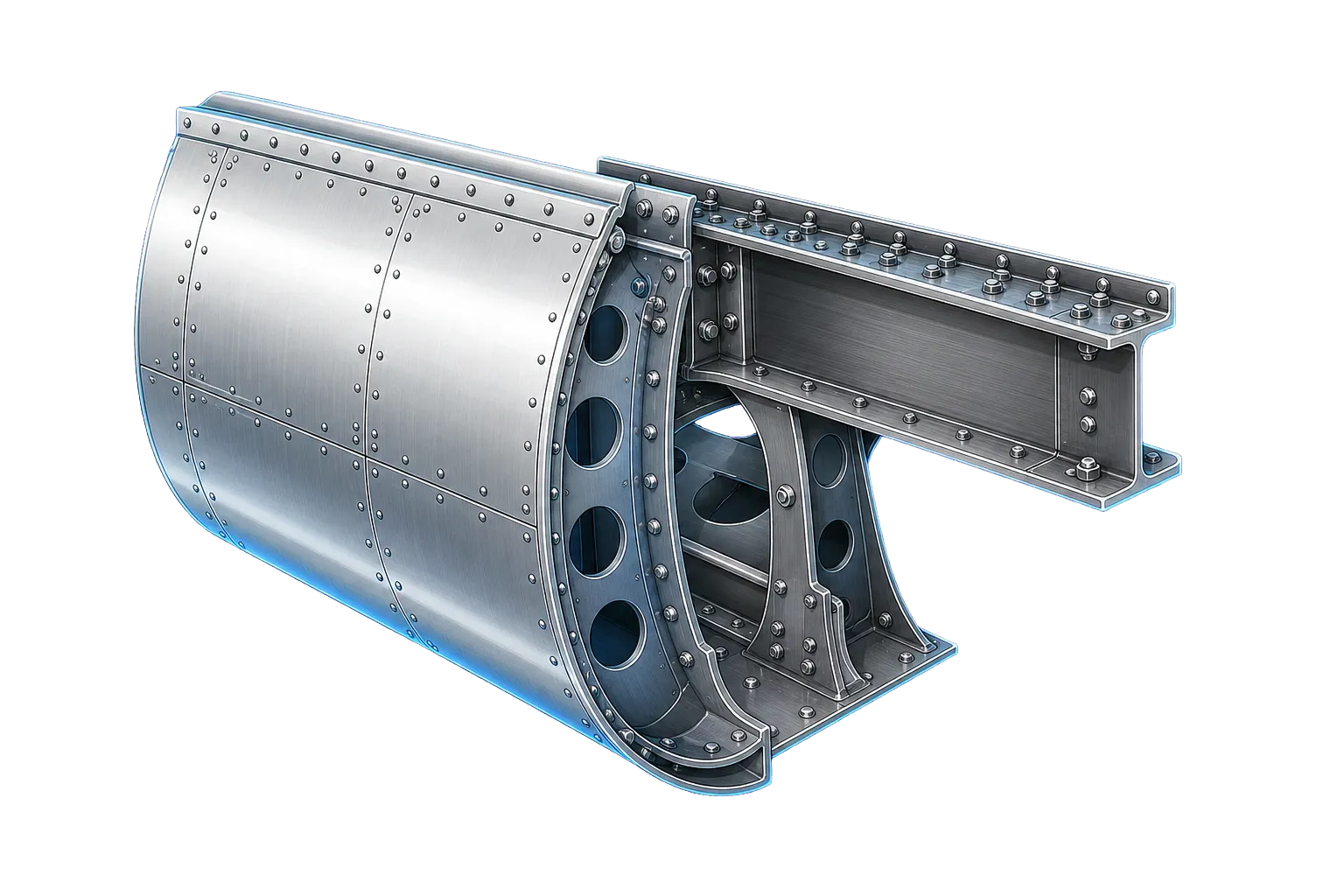
Fatigue cracking on the rib flange area of the front spar of the wing center section, which can reduce the structural integrity of fuselage frame 36 and the wing center section.
AI-generated summary from the source AD text. Verify against the official source before acting.
Required Actions
Modify the rib flange on the front spar of the wing center section by installing shims and new fasteners to reinforce pressure floor fittings. Perform repetitive high frequency eddy current inspections for cracking of the radius of the rib flanges and vertical stiffener at frame 36. Conduct a rototest inspection for cracking of the fastener holes of the rib flanges. Repair if needed.
AI-generated summary from the source AD text. Verify against the official source before acting.
Compliance Time
Within 12 months of effective date
AI-generated summary from the source AD text. Verify against the official source before acting.
Affected Aircraft
Airbus Model A320-111, -211, and -231 airplanes with manufacturer serial numbers up to MSN 0084 inclusive, and additional airplanes having MSNs 001, 009, and 015.
AI-generated summary from the source AD text. Verify against the official source before acting.
Federal Register Abstract
We are superseding Airworthiness Directive (AD) 97-07-14, for certain Airbus Model A320-111, -211, and -231 airplanes. AD 97-07-14 required modification of an area on the front spar of the wing center section by installing shims and new fasteners to reinforce pressure floor fittings. This new AD continues to require modifying the rib flange on the front spar of the wing center section by installing shims and new fasteners to reinforce pressure floor fittings; and requires repetitive high frequency eddy current inspections for cracking of the radius of the rib flanges and vertical stiffener at frame 36, a rototest inspection for cracking of the fastener holes of the rib flanges, repair if needed, and adding additional airplanes to the applicability. This AD was prompted by the need for repetitive inspections on airplanes on which the modification of the rib flange on the front spar of the wing center section has been done. We are issuing this AD to prevent fatigue cracking on the rib flange area of the front spar of the wing center section, which can reduce the structural integrity of fuselage frame 36 and the wing center section.
Applicability Source Text
Show captured applicability text from the source AD
(c) Applicability

    This AD applies to Airbus Model A320-211 and -231 airplanes,
certificated in any category, all manufacturer serial numbers (MSN)
up to MSN 0084 inclusive.
Document Text
Show stored source text (verify against official source)
[Federal Register Volume 80, Number 178 (Tuesday, September 15, 2015)]
[Rules and Regulations]
[Pages 55229-55232]
From the Federal Register Online via the Government Publishing Office [<a href="http://www.gpo.gov">www.gpo.gov</a>]
[FR Doc No: 2015-22924]
-----------------------------------------------------------------------
DEPARTMENT OF TRANSPORTATION
Federal Aviation Administration
14 CFR Part 39
[Docket No. FAA-2015-0926; Directorate Identifier 2014-NM-121-AD;
Amendment 39-18263; AD 2015-18-05]
RIN 2120-AA64
Airworthiness Directives; Airbus Airplanes
AGENCY: Federal Aviation Administration (FAA), Department of
Transportation (DOT).
ACTION: Final rule.
-----------------------------------------------------------------------
SUMMARY: We are superseding Airworthiness Directive (AD) 97-07-14, for
certain Airbus Model A320-111, -211, and -231 airplanes. AD 97-07-14
required modification of an area on the front spar of the wing center
section by installing shims and new fasteners to reinforce pressure
floor fittings. This new AD continues to require modifying the rib
flange on the front spar of the wing center section by installing shims
and new fasteners to reinforce pressure floor fittings; and requires
repetitive high frequency eddy current inspections for cracking of the
radius of the rib flanges and vertical stiffener at frame 36, a
rototest inspection for cracking of the fastener holes of the rib
flanges, repair if needed, and adding additional airplanes to the
applicability. This AD was prompted by the need for repetitive
inspections on airplanes on which the modification of the rib flange on
the front spar of the wing center section has been done. We are issuing
this AD to prevent fatigue cracking on the rib flange area of the front
spar of the wing center section, which can reduce the structural
integrity of fuselage frame 36 and the wing center section.
DATES: This AD becomes effective October 20, 2015.
The Director of the Federal Register approved the incorporation by
reference of a certain publication listed in this AD as of October 20,
2015.
The Director of the Federal Register approved the incorporation by
reference
[[Page 55230]]
of a certain other publication listed in this AD as of May 12, 1997 (62
FR 16473, April 7, 1997).
ADDRESSES: You may examine the AD docket on the Internet at <a href="http://www.regulations.gov/#!docketDetail">http://www.regulations.gov/#!docketDetail</a>;D=FAA-2015-0926; or in person at the
Docket Management Facility, U.S. Department of Transportation, Docket
Operations, M-30, West Building Ground Floor, Room W12-140, 1200 New
Jersey Avenue SE., Washington, DC.
For service information identified in this AD, contact Airbus,
Airworthiness Office--EIAS, 1 Rond Point Maurice Bellonte, 31707
Blagnac Cedex, France; telephone +33 5 61 93 36 96; fax +33 5 61 93 44
51; email <a href="/cdn-cgi/l/email-protection#8beae8e8e4fee5ffa5eae2f9fce4f9ffe3a6eeeaf8cbeae2f9e9fef8a5e8e4e6"><span class="__cf_email__" data-cfemail="82e3e1e1edf7ecf6ace3ebf0f5edf0f6eaafe7e3f1c2e3ebf0e0f7f1ace1edef">[email protected]</span></a>; Internet <a href="http://www.airbus.com">http://www.airbus.com</a>. You may view this referenced service information at the
FAA, Transport Airplane Directorate, 1601 Lind Avenue SW., Renton, WA.
For information on the availability of this material at the FAA, call
425-227-1221. It is also available on the Internet at <a href="http://www.regulations.gov">http://www.regulations.gov</a> by searching for and locating Docket No. FAA-2015-
0926.
FOR FURTHER INFORMATION CONTACT: Sanjay Ralhan, Aerospace Engineer,
International Branch, ANM-116, Transport Airplane Directorate, FAA,
1601 Lind Avenue SW., Renton, WA 98057-3356; telephone 425-227-1405;
fax 425-227-1149.
SUPPLEMENTARY INFORMATION:
Discussion
We issued a notice of proposed rulemaking (NPRM) to amend 14 CFR
part 39 to supersede AD 97-07-14, Amendment 39-9988 (62 FR 16473, April
7, 1997). AD 97-07-14 applied to certain Airbus Model A320-111, -211,
and -231 airplanes. The NPRM published in the Federal Register on April
24, 2015 (80 FR 22943).
Since we issued AD 97-07-14, Amendment 39-9988 (62 FR 16473, April
7, 1997), we have determined the need for repetitive inspections on
airplanes on which Airbus Modification 20976 (modification of the rib
flange on the front spar of the wing center section) was done in
production, or was done using Airbus Service Bulletin A320-57-1013,
dated April 12, 1989; or Airbus Service Bulletin A320-57-1013, Revision
1, dated September 29, 1992.
The European Aviation Safety Agency (EASA), which is the Technical
Agent for the Member States of the European Union, has issued EASA
Airworthiness Directive 2014-0053, dated March 7, 2014 (referred to
after this as the Mandatory Continuing Airworthiness Information, or
``the MCAI''), to correct an unsafe condition on certain Airbus Model
A320-211 and -231 airplanes. The MCAI states:
During full scale fatigue tests on the Airbus A320 test
specimen, cracks were found in the rib flange on the front spar side
perpendicular to vertical posts at frame (FR) 36. It was determined
that similar cracks could develop on certain in-service aeroplanes.
This condition, if not detected and corrected, could affect the
wing structural integrity.
To reduce the risk of crack initiation, two modifications for
aeroplanes in production and one modification for in-service
aeroplanes were developed by Airbus: Prior to [manufacturer serial
number] MSN 0085, the adaptation modification (Mod) 20976 was
applied in production, consisting in installing shims under the
fasteners linking the rib flange, the lower corner, the front spar
and its vertical stiffener; from MSN 0085 onwards, the serial Mod
20908 was applied in production, consisting in installing reinforced
lower surface rib flanges at front spar level.
Airbus issued Service Bulletin (SB) A320-57-1013 for affected
in-service aeroplanes, and [Directorate General for Civil Aviation]
DGAC France issued AD [F-19]95-098-066 [dated May 24, 1995, which
corresponds to FAA AD 97-07-14, Amendment 39-9988 (62 FR 16473,
April 7, 1997), <a href="http://ad.easa.europa.eu/ad/F-1995-098-066">http://ad.easa.europa.eu/ad/F-1995-098-066</a>] to
require installation of shims under the fasteners linking the rib
flange, the lower corner, the front spar and its vertical stiffener.
Following a recent analysis, Airbus identified the need for
repetitive [HFEC and rototest] inspections for aeroplanes on which
Airbus SB A320-57-1013 or production Mod 20976 has been embodied.
For the reason described above, this [EASA] AD retains the
requirements of DGAC France AD [F-19]95-098-066, [dated May 24,
1995, which corresponds to FAA AD 97-07-14, Amendment 39-9988 (62 FR
16473, April 7, 1997), <a href="http://ad.easa.europa.eu/ad/F-1995-098-066">http://ad.easa.europa.eu/ad/F-1995-098-066</a>],
which is superseded, and requires repetitive [HFEC and rototest]
inspections of the center wing lower ribs at FR 36 and, depending on
findings, accomplishment of a repair.
After EASA issued PAD 14-013, it was discovered that additional
work [removal of shims and fasteners on the rib flange on the front
spar side and doing an HFEC inspection for cracking of the radius of
the rib flanges and a rototest inspection for cracking of the
fastener holes during each inspection] to be included in Revision 01
of Airbus SB A320-57-1175, is required to accomplish the
inspections. This Final [EASA] AD has been amended accordingly.
Airplanes having MSNs 001, 009, and 015 were not included in the
applicability of AD 97-07-14, Amendment 39-9988 (62 FR 16473, April 7,
1997). EASA AD 2014-0053, dated March 7, 2014, expanded the
applicability to all airplanes having manufacturer serial numbers up to
MSN 0084 inclusive. We included paragraph (h) of this AD to require the
modification for the airplanes having MSNs 001, 009, and 015. You may
examine the MCAI in the AD docket on the Internet at <a href="http://www.regulations.gov/#!documentDetail">http://www.regulations.gov/#!documentDetail</a>;D=FAA-2015-0926-0002.
Comments
We gave the public the opportunity to participate in developing
this AD. We received no comments on the NPRM (80 FR 22943, April 24,
2015) or on the determination of the cost to the public.
Conclusion
We reviewed the available data and determined that air safety and
the public interest require adopting this AD as proposed except for
minor editorial changes. We have determined that these minor changes:
<bullet> Are consistent with the intent that was proposed in the
NPRM (80 FR 22943, April 24, 2015) for correcting the unsafe condition;
and
<bullet> Do not add any additional burden upon the public than was
already proposed in the NPRM (80 FR 22943, April 24, 2015).
Related Service Information Under 1 CFR Part 51
Airbus has issued Service Bulletin A320-57-1175, Revision 01,
including Appendix 01, dated May 28, 2014. The service information
describes procedures for repetitive high frequency eddy current
inspections for cracking of the radius of the rib flanges and vertical
stiffener at frame 36, a rototest inspection for cracking of the
fastener holes of the rib flanges, and repair. This service information
is reasonably available because the interested parties have access to
it through their normal course of business or by the means identified
in the ADDRESSES section of this AD.
Explanation of ``RC'' Procedures and Tests in Service Information
The FAA worked in conjunction with industry, under the
Airworthiness Directive Implementation Aviation Rulemaking Committee
(ARC), to enhance the AD system. One enhancement was a new process for
annotating which procedures and tests in the service information are
required for compliance with an AD. Differentiating these procedures
and tests from other tasks in the service information is expected to
improve an owner's/operator's understanding of crucial AD requirements
and help
[[Page 55231]]
provide consistent judgment in AD compliance. The procedures and tests
identified as Required for Compliance (RC) in any service information
have a direct effect on detecting, preventing, resolving, or
eliminating an identified unsafe condition.
As specified in a NOTE under the Accomplishment Instructions of the
specified service information, procedures and tests that are identified
as RC in any service information must be done to comply with the AD.
However, procedures and tests that are not identified as RC are
recommended. Those procedures and tests that are not identified as RC
may be deviated from using accepted methods in accordance with the
operator's maintenance or inspection program without obtaining approval
of an alternative method of compliance (AMOC), provided the procedures
and tests identified as RC can be done and the airplane can be put back
in a serviceable condition. Any substitutions or changes to procedures
or tests identified as RC will require approval of an AMOC.
Costs of Compliance
We estimate that this AD affects 11 airplanes of U.S. registry.
The actions required by AD 97-07-14, Amendment 39-9988 (62 FR
16473, April 7, 1997), and retained in this AD take about 13 work-hours
per product, at an average labor rate of $85 per work-hour. Required
parts cost about $576 per product. Based on these figures, the
estimated cost of the actions that were required by AD 97-07-14 is
$1,681 per product.
We also estimate that it will take about 45 work-hours per product
to comply with the new basic requirements of this AD. The average labor
rate is $85 per work-hour. Required parts will cost about $1,600 per
product. Based on these figures, we estimate the cost of this AD on
U.S. operators to be $59,675, or $5,425 per product.
Authority for This Rulemaking
Title 49 of the United States Code specifies the FAA's authority to
issue rules on aviation safety. Subtitle I, section 106, describes the
authority of the FAA Administrator. ``Subtitle VII: Aviation
Programs,'' describes in more detail the scope of the Agency's
authority.
We are issuing this rulemaking under the authority described in
``Subtitle VII, Part A, Subpart III, Section 44701: General
requirements.'' Under that section, Congress charges the FAA with
promoting safe flight of civil aircraft in air commerce by prescribing
regulations for practices, methods, and procedures the Administrator
finds necessary for safety in air commerce. This regulation is within
the scope of that authority because it addresses an unsafe condition
that is likely to exist or develop on products identified in this
rulemaking action.
Regulatory Findings
We determined that this AD will not have federalism implications
under Executive Order 13132. This AD will not have a substantial direct
effect on the States, on the relationship between the national
government and the States, or on the distribution of power and
responsibilities among the various levels of government.
For the reasons discussed above, I certify that this AD:
1. Is not a ``significant regulatory action'' under Executive Order
12866;
2. Is not a ``significant rule'' under the DOT Regulatory Policies
and Procedures (44 FR 11034, February 26, 1979);
3. Will not affect intrastate aviation in Alaska; and
4. Will not have a significant economic impact, positive or
negative, on a substantial number of small entities under the criteria
of the Regulatory Flexibility Act.
Examining the AD Docket
You may examine the AD docket on the Internet at <a href="http://www.regulations.gov/#!docketDetail">http://www.regulations.gov/#!docketDetail</a>;D=FAA-2015-0926; or in person at the
Docket Management Facility between 9 a.m. and 5 p.m., Monday through
Friday, except Federal holidays. The AD docket contains this AD, the
regulatory evaluation, any comments received, and other information.
The street address for the Docket Operations office (telephone 800-647-
5527) is in the ADDRESSES section.
List of Subjects in 14 CFR Part 39
Air transportation, Aircraft, Aviation safety, Incorporation by
reference, Safety.
Adoption of the Amendment
Accordingly, under the authority delegated to me by the
Administrator, the FAA amends 14 CFR part 39 as follows:
PART 39--AIRWORTHINESS DIRECTIVES
0
1. The authority citation for part 39 continues to read as follows:
Authority: 49 U.S.C. 106(g), 40113, 44701.
Sec. 39.13 [Amended]
0
2. The FAA amends Sec. 39.13 by removing Airworthiness Directive (AD)
97-07-14, Amendment 39-9988 (62 FR 16473, April 7, 1997), and adding
the following new AD:
2015-18-05 Airbus: Amendment 39-18263. Docket No. FAA-2015-0926;
Directorate Identifier 2014-NM-121-AD.
(a) Effective Date
This AD becomes effective October 20, 2015.
(b) Affected ADs
This AD replaces AD 97-07-14, Amendment 39-9988 (62 FR 16473,
April 7, 1997).
(c) Applicability
This AD applies to Airbus Model A320-211 and -231 airplanes,
certificated in any category, all manufacturer serial numbers (MSN)
up to MSN 0084 inclusive.
(d) Subject
Air Transport Association (ATA) of America Code 57, Wings.
(e) Reason
This AD was prompted by the determination that repetitive
inspections are needed on airplanes on which the modification of the
rib flange on the front spar of the wing center section has been
done. We are issuing this AD to prevent fatigue cracking on the rib
flange area of the front spar of the wing center section, which can
reduce the structural integrity of fuselage frame 36 and the wing
center section.
(f) Compliance
Comply with this AD within the compliance times specified,
unless already done.
(g) Retained Modification
This paragraph restates the requirements of paragraph (a) of AD
97-07-14, Amendment 39-9988 (62 FR 16473, April 7, 1997). For
airplanes with manufacturer serial numbers (MSN) 005 through 008
inclusive, MSNs 010 through 014 inclusive, and MSNs 016 through 042
inclusive: Prior to the accumulation of 16,000 total landings, or
within 3 months after May 12, 1997 (the effective date of AD 97-07-
14), whichever occurs later, modify the rib flange on the front spar
of the wing center section by installing shims and new fasteners to
reinforce pressure floor fittings, in accordance with the
Accomplishment Instructions of Airbus Service Bulletin A320-57-1013,
Revision 1, dated September 29, 1992.
(h) New Requirement of This AD: Modification for Airplanes With MSNs
001, 009, and 015
Prior to the accumulation of 16,000 total landings since first
flight, or within 30 days after the effective date of this AD,
whichever occurs later, modify the rib flange on the front spar of
the wing center section by installing shims and new fasteners to
reinforce pressure floor fittings, in
[[Page 55232]]
accordance with the Accomplishment Instructions of Airbus Service
Bulletin A320-57-1013, Revision 1, dated September 29, 1992.
(i) New Requirement of This AD: Repetitive Inspections
Within the applicable compliance times specified in paragraphs
(i)(1) and (i)(2) of this AD, do a high frequency eddy current
(HFEC) inspection for cracking of the radius of the rib flanges and
vertical stiffener at frame 36, and do a rototest inspection for
cracking of the fastener holes of the rib flanges and vertical
stiffener, in accordance with the Accomplishment Instructions of
Airbus Service Bulletin A320-57-1175, Revision 01, including
Appendix 01, dated May 28, 2014. During each inspection, remove the
shims and fasteners on the rib flange on the front spar side and do
an HFEC inspection for cracking of the radius of the rib flanges and
a rototest inspection for cracking of the fastener holes. If no
cracking is found, oversize the holes of the rib flange and the
holes of the shims, in accordance with the Accomplishment
Instructions of Airbus Service Bulletin A320-57-1175, Revision 01,
including Appendix 01, dated May 28, 2014. Repeat the inspections
thereafter at intervals not to exceed 32,500 flight cycles or 65,000
flight hours, whichever occurs first.
(1) For airplanes having Airbus Modification 20976 embodied: At
the later of the times specified in paragraphs (i)(1)(i) or
(i)(1)(ii) of this AD.
(i) Before exceeding 47,800 flight cycles or 95,600 flight
hours, whichever occurs first, since the airplane's first flight.
(ii) Within 850 flight cycles or 1,700 flight hours, whichever
occurs first, after the effective date of this AD.
(2) For airplanes on which the modification of the front spar of
the wing center section was accomplished using Airbus Service
Bulletin A320-57-1013, Revision 1, dated September 29, 1992: At the
later of the times specified in paragraphs (i)(2)(i) or (i)(2)(ii)
of this AD.
(i) Before exceeding 10,700 flight cycles or 21,500 flight
hours, whichever occurs first, after the modification of the rib
flange on the front spar of the wing center section was done using
Airbus Service Bulletin A320-57-1013, Revision 1, dated September
29, 1992.
(ii) Within 850 flight cycles or 1,700 flight hours, whichever
occurs first, after the effective date of this AD.
(j) Repair
If, during any inspection required by paragraph (i) of this AD,
any cracking is found, before further flight, repair using a method
approved by the Manager, International Branch, ANM-116, Transport
Airplane Directorate, FAA; or the European Aviation Safety Agency
(EASA); or Airbus's EASA Design Organization Approval (DOA).
(k) Credit for Previous Actions
This paragraph restates the requirements of Note 2 of paragraph
(g) of AD 97-07-14, Amendment 39-9988 (62 FR 16473, April 7, 1997):
This paragraph provides credit for the modification of the rib
flange required by paragraph (g) of this AD, if those actions were
performed before May 12, 1997 (the effective date of AD 97-07-14),
using Airbus Service Bulletin A320-57-1013, dated April 12, 1989,
which is not incorporated by reference in this AD.
(l) Other FAA AD Provisions
The following provisions also apply to this AD:
(1) Alternative Methods of Compliance (AMOCs): The Manager,
International Branch, ANM-116, Transport Airplane Directorate, FAA,
has the authority to approve AMOCs for this AD, if requested using
the procedures found in 14 CFR 39.19. In accordance with 14 CFR
39.19, send your request to your principal inspector or local Flight
Standards District Office, as appropriate. If sending information
directly to the International Branch, send it to ATTN: Sanjay
Ralhan, Aerospace Engineer, International Branch, ANM-116, Transport
Airplane Directorate, FAA, 1601 Lind Avenue SW., Renton, WA 98057-
3356; telephone 425-227-1405; fax 425-227-1149. Information may be
emailed to: <a href="/cdn-cgi/l/email-protection#be8793fff0f3938f8f8893fff3f1fd93ecfbefebfbedeaedfed8dfdf90d9d1c8"><span class="__cf_email__" data-cfemail="b1889cf0fffc9c8080879cf0fcfef29ce3f4e0e4f4e2e5e2f1d7d0d09fd6dec7">[email protected]</span></a>. Before using any
approved AMOC, notify your appropriate principal inspector, or
lacking a principal inspector, the manager of the local flight
standards district office/certificate holding district office. The
AMOC approval letter must specifically reference this AD.
(2) Contacting the Manufacturer: As of the effective date of
this AD, for any requirement in this AD to obtain corrective actions
from a manufacturer, the action must be accomplished using a method
approved by the Manager, International Branch, ANM-116, Transport
Airplane Directorate, FAA; or EASA; or Airbus's EASA DOA. If
approved by the DOA, the approval must include the DOA-authorized
signature.
(3) Required for Compliance (RC): Except as required by
paragraph (j) of this AD, if the service information contains
procedures or tests that are identified as RC, those procedures and
tests must be done to comply with this AD; any procedures and tests
that are not identified as RC are recommended. Those procedures and
tests that are not identified as RC may be deviated from using
accepted methods in accordance with the operator's maintenance or
inspection program without obtaining approval of an AMOC, provided
the procedures and tests identified as RC can be done and the
airplane can be put back in a serviceable condition. Any
substitutions or changes to procedures or tests identified as RC
require approval of an AMOC.
(m) Related Information
(1) Refer to Mandatory Continuing Airworthiness Information
(MCAI) EASA Airworthiness Directive 2014-0053, dated March 7, 2014,
for related information. This MCAI may be found in the AD docket on
the Internet at <a href="http://www.regulations.gov">http://www.regulations.gov</a> by searching for and
locating Docket No. FAA-2015-0926.
(2) Service information identified in this AD that is not
incorporated by reference is available at the addresses specified in
paragraphs (n)(5) and (n)(6) of this AD.
(n) Material Incorporated by Reference
(1) The Director of the Federal Register approved the
incorporation by reference (IBR) of the service information listed
in this paragraph under 5 U.S.C. 552(a) and 1 CFR part 51.
(2) You must use this service information as applicable to do
the actions required by this AD, unless this AD specifies otherwise.
(3) The following service information was approved for IBR on
October 20, 2015.
(i) Airbus Service Bulletin A320-57-1175, Revision 01, including
Appendix 01, dated May 28, 2014.
(ii) Reserved.
(4) The following service information was approved for IBR on
May 12, 1997 (62 FR 16473, April 7, 1997).
(i) Airbus Service Bulletin A320-57-1013, Revision 1, dated
September 29, 1992.
Note 1 to paragraph (n)(4)(i): Airbus Service Bulletin A320-57-
1013, Revision 1, dated September 29, 1992, contains the following
list of effective pages: Pages 1 through 3 show revision level 1,
dated September 29, 1992; pages 4 through 11 are from the original
issue, dated April 12, 1989.
(ii) Reserved.
(5) For service information identified in this AD, contact
Airbus, Airworthiness Office--EIAS, 1 Rond Point Maurice Bellonte,
31707 Blagnac Cedex, France; telephone +33 5 61 93 36 96; fax +33 5
61 93 44 51; email <a href="/cdn-cgi/l/email-protection#d1b0b2b2bea4bfa5ffb0b8a3a6bea3a5b9fcb4b0a291b0b8a3b3a4a2ffb2bebc"><span class="__cf_email__" data-cfemail="a6c7c5c5c9d3c8d288c7cfd4d1c9d4d2ce8bc3c7d5e6c7cfd4c4d3d588c5c9cb">[email protected]</span></a>; Internet <a href="http://www.airbus.com">http://www.airbus.com</a>.
(6) You may view this service information at the FAA, Transport
Airplane Directorate, 1601 Lind Avenue SW., Renton, WA. For
information on the availability of this material at the FAA, call
425-227-1221.
(7) You may view this service information that is incorporated
by reference at the National Archives and Records Administration
(NARA). For information on the availability of this material at
NARA, call 202-741-6030, or go to: <a href="http://www.archives.gov/federal-register/cfr/ibr-locations.html">http://www.archives.gov/federal-register/cfr/ibr-locations.html</a>.
Issued in Renton, Washington, on September 2, 2015.
Jeffrey E. Duven,
Manager, Transport Airplane Directorate, Aircraft Certification
Service.
[FR Doc. 2015-22924 Filed 9-14-15; 8:45 am]
BILLING CODE 4910-13-P
Source: Official FAA Source ↗
Retrieved: Apr 6, 2026
Rights: U.S. Government Public Domain
This site is not affiliated with or endorsed by the FAA. Always verify with official sources.
Related Airworthiness Directives
2026-03-10
final ruleAirworthiness Directives; Airbus SAS Airplanes
Unsafe Condition: a safety significant latent failure (that is not annunciated), which, in combination with one or more other specific failures or events, could result in a hazardous or catastrophic failure condition.
2025-23-09 Recurring
final ruleAirworthiness Directives; Airbus SAS Airplanes
Unsafe Condition: Cracks on the web horizontal flange and inner cap at frame (FR) 68, left-hand (LH) and right-hand (RH) sides, at stringer (STGR) 22, and additional cracks found at the door stop fitting number 1 ho...
2025-24-51
final ruleAirworthiness Directives; Airbus SAS Airplanes
Unsafe Condition: A malfunction of the affected elevator aileron computer (ELAC) could lead to an uncommanded elevator movement that may result in exceeding the aircraft's structural capability and consequent loss o...

2025-20-15 Recurring
final ruleAirworthiness Directives; Airbus SAS Airplanes
Unsafe Condition: Cracks in the double joggle areas at frame (FR) 16 and FR20, right-hand and left-hand sides, which, if not detected and corrected, could reduce the structural integrity of the fuselage.