AD 2015-02-12
Applicability
| Type | Manufacturer | Model | Details |
|---|---|---|---|
| aircraft | Bombardier Inc. | DHC-8-400 | Airworthiness Directives; Bombardier, Inc. Airplanes |
| aircraft | Bombardier Inc. | DHC-8-401 | Airworthiness Directives; Bombardier, Inc. Airplanes |
| aircraft | Bombardier Inc. | DHC-8-402 | Airworthiness Directives; Bombardier, Inc. Airplanes |
Unsafe Condition
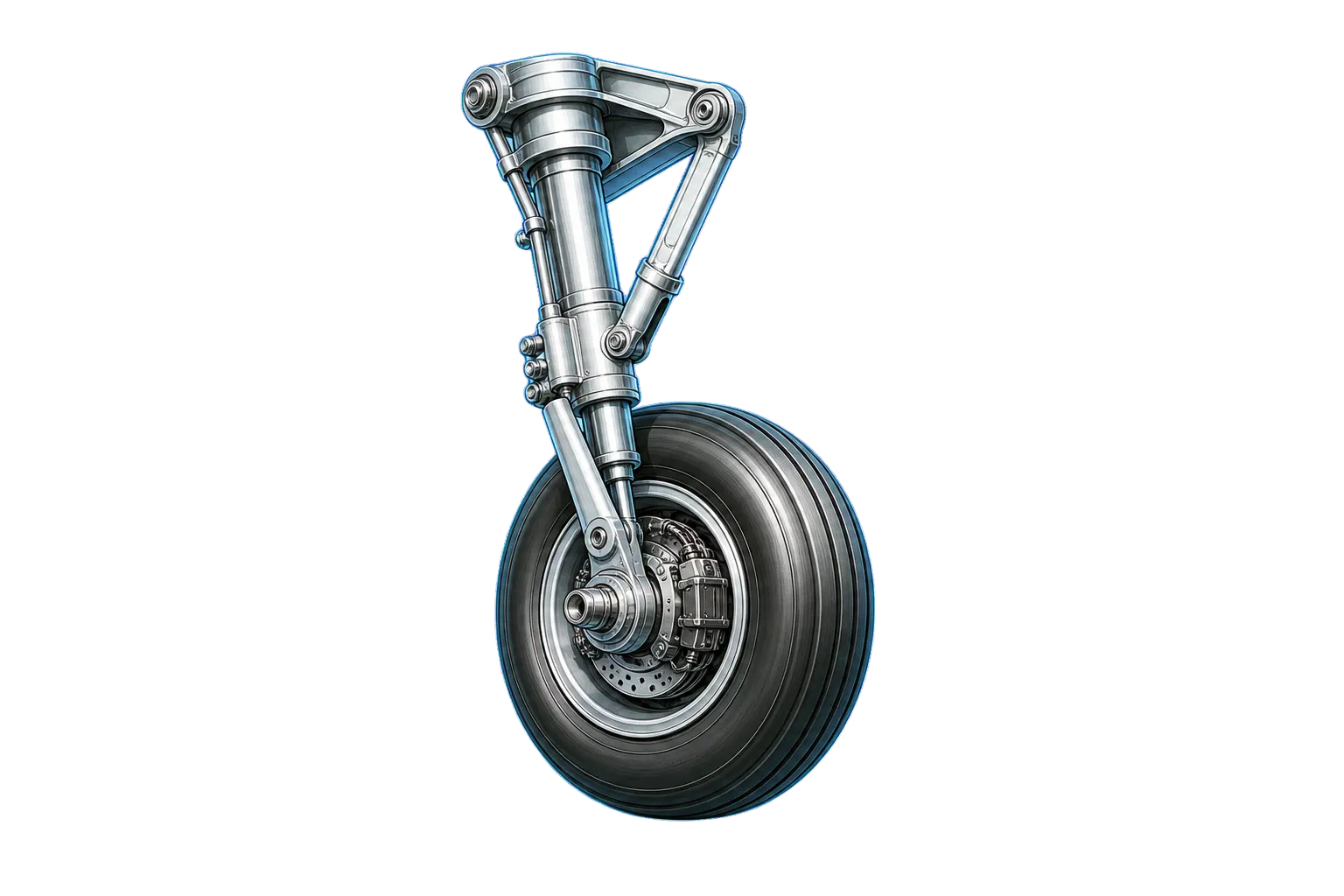
Insufficiently greased stabilizer brace lock linkages and over-torqued lock linkage attachment bolts could lead to failure to extend and down-lock the main landing gear (MLG), affecting safe landing.
AI-generated summary from the source AD text. Verify against the official source before acting.
Required Actions
Inspect the apex joints of the stabilizer brace lock link in the MLG for clearance; rectify and repair the clearance gap if necessary; lubricate the apex joints of the stabilizer brace lock link in the MLG.
AI-generated summary from the source AD text. Verify against the official source before acting.
Compliance Time
Before further flight
AI-generated summary from the source AD text. Verify against the official source before acting.
Affected Aircraft
Bombardier, Inc. Model DHC-8-400 series airplanes.
AI-generated summary from the source AD text. Verify against the official source before acting.
Federal Register Abstract
We are adopting a new airworthiness directive (AD) for certain Bombardier, Inc. Model DHC-8-400 series airplanes. This AD was prompted by reports of two in-service incidents where one side of the main landing gear (MLG) did not achieve down-lock. This AD requires doing a detailed inspection of the apex joints of the stabilizer brace lock link in the MLG for clearance; rectifying and repairing the clearance gap, if necessary; and lubricating the apex joints of the stabilizer brace lock link in the MLG. We are issuing this AD to detect and correct insufficiently greased stabilizer brace lock linkage of the MLG and over-torqued lock linkage attachment bolts, which could lead to the failure to extend and down-lock the MLG, and could affect the safe landing of the airplane.
Applicability Source Text
Show captured applicability text from the source AD
(c) Applicability

    This AD applies to Bombardier, Inc. Model DHC-8-400, -401 and -
402 airplanes, certificated in any category, serial numbers 4001
through 4454 inclusive.
Document Text
Show stored source text (verify against official source)
[Federal Register Volume 80, Number 20 (Friday, January 30, 2015)]
[Rules and Regulations]
[Pages 5025-5028]
From the Federal Register Online via the Government Publishing Office [<a href="http://www.gpo.gov">www.gpo.gov</a>]
[FR Doc No: 2015-01180]
-----------------------------------------------------------------------
DEPARTMENT OF TRANSPORTATION
Federal Aviation Administration
14 CFR Part 39
[Docket No. FAA-2014-0188; Directorate Identifier 2013-NM-157-AD;
Amendment 39-18079; AD 2015-02-12]
RIN 2120-AA64
Airworthiness Directives; Bombardier, Inc. Airplanes
AGENCY: Federal Aviation Administration (FAA), Department of
Transportation (DOT).
ACTION: Final rule.
-----------------------------------------------------------------------
SUMMARY: We are adopting a new airworthiness directive (AD) for certain
Bombardier, Inc. Model DHC-8-400 series airplanes. This AD was prompted
by reports of two in-service incidents where one side of the main
landing gear (MLG) did not achieve down-lock. This AD requires doing a
detailed inspection of the apex joints of the stabilizer brace lock
link in the MLG for clearance; rectifying and repairing the clearance
gap, if necessary; and lubricating the apex joints of the stabilizer
brace lock link in the MLG. We are issuing this AD to detect and
correct insufficiently greased stabilizer brace lock linkage of the MLG
and over-torqued lock linkage attachment bolts, which could lead to the
failure to extend and down-lock the MLG, and could affect the safe
landing of the airplane.
DATES: This AD becomes effective March 6, 2015.
The Director of the Federal Register approved the incorporation by
reference of a certain publication listed in this AD as of March 6,
2015.
ADDRESSES: You may examine the AD docket on the Internet at <a href="http://www.regulations.gov/#!docketDetail">http://www.regulations.gov/#!docketDetail</a>;D=FAA-2014-0188 or in person at the
Docket Management Facility, U.S. Department of Transportation, Docket
Operations, M-30, West Building Ground Floor, Room W12-140, 1200 New
Jersey Avenue SE., Washington, DC.
For service information identified in this AD, contact Bombardier,
Inc., Q-Series Technical Help Desk, 123 Garratt Boulevard, Toronto,
Ontario M3K 1Y5, Canada; telephone 416-375-4000; fax 416-375-4539;
email <a href="/cdn-cgi/l/email-protection#215549450f50524453484452614044534e0f434e4c434053454844530f424e4c"><span class="__cf_email__" data-cfemail="16627e7238676573647f736556777364793874797b747764727f73643875797b">[email protected]</span></a>; Internet <a href="http://www.bombardier.com">http://www.bombardier.com</a>. You may view this referenced service information at
the FAA, Transport Airplane Directorate, 1601 Lind Avenue SW., Renton,
WA. For information on the availability of this material at the FAA,
call 425-227-1221.
FOR FURTHER INFORMATION CONTACT: Luke Walker, Aerospace Engineer,
Airframe and Mechanical Systems Branch, ANE-171, FAA, New York Aircraft
Certification Office, 1600 Stewart Avenue, Suite 410, Westbury, NY
11590; telephone 516-228-7363; fax 516-794-5531.
SUPPLEMENTARY INFORMATION:
Discussion
We issued a notice of proposed rulemaking (NPRM) to amend 14 CFR
part 39 by adding an AD that would apply to certain Bombardier, Inc.
Model DHC-8-400 series airplanes. The NPRM published in the Federal
Register on April 8, 2014 (79 FR 19299).
Transport Canada Civil Aviation (TCCA), which is the aviation
authority for Canada, has issued Canadian Airworthiness Directive CF-
2013-19, dated July 18, 2013 (referred to after this as the Mandatory
Continuing Airworthiness Information, or ``the MCAI''), to correct an
unsafe condition certain Bombardier, Inc. Model DHC-8-400 series
airplanes. The MCAI states:
There have been two reported in-service incidents where one side
of the main landing gear (MLG) did not achieve down-lock resulting
in a gear unsafe indication. In both cases, the MLG was ultimately
extended and down-lock was achieved through the use of the alternate
extension system or by cycling the MLG. The investigation revealed
that in both cases, the MLG stabilizer brace lock linkages were
insufficiently greased and the lock linkage attachment bolts were
over-torqued.
Failure to extend and down-lock the MLG could adversely affect
the safe landing of the aeroplane.
This [TCCA] AD mandates the [detailed] inspection, rectification
[and repair the clearance gap] as required, and lubrication of both
MLG stabilizer brace lock link apex joints.
You may examine the MCAI in the AD docket on the Internet at <a href="http://www.regulations.gov/#!documentDetail">http://www.regulations.gov/#!documentDetail</a>;D=FAA-2014-0188-0002.
Comments
We gave the public the opportunity to participate in developing
this AD. The following presents the comments received on the NPRM (79
FR 19299, April 8, 2014) and the FAA's response to each comment.
Request To Include Only Requirements That Affect the Unsafe Condition
Horizon Air requested that the NPRM (79 FR 19299, April 8, 2014)
require only the section of the Accomplishment Instructions that
corrects the unsafe condition. Horizon Air stated that the job set-up
and close-out sections
[[Page 5026]]
specified in the Accomplishment Instructions of Bombardier Service
Bulletin 84-32-121, dated May 27, 2013, do not directly correct the
unsafe condition. Horizon Air also stated that incorporating the job
set-up and close-out sections as a requirement of the NPRM restricts
the operator's ability to perform other maintenance in conjunction with
the incorporation of the service information. Horizon Air stated that
it would like the NPRM to mandate section 3.B. of the Accomplishment
Instructions, which addresses the unsafe condition.
We agree with the commenter's request and rationale. We have
changed paragraphs (g), (g)(2), and (h) of this AD to specify that the
actions be done in accordance with paragraph 3.B., ``Procedure,'' of
the Accomplishment Instructions of Bombardier Service Bulletin 84-32-
121, dated May 27, 2013.
Request To Remove Requirement To Include AD Reference in Repair
Approvals
Horizon Air requested that the sentence in paragraph (g)(2) of the
NPRM (79 FR 19299, April 8, 2014), stating, ``For a repair method to be
approved, the repair approval must specifically refer to this AD,'' be
removed. Horizon Air stated the sentence should not be included in the
NPRM, or at the very least it should be modified because it will place
an unnecessary regulatory burden on operators with airplanes built in
Canada.
Horizon Air stated that Transport Canada Civil Aviation (TCCA) is
the aviation authority for the Bombardier, Inc. Model DHC-8-400 series
airplanes. Horizon Air also stated that the NPRM restates the
requirement of the Canadian AD. Horizon Air stated that any repairs
created by Bombardier, Inc. would have to be in compliance with the
Canadian AD and the repair would specifically refer to the Canadian AD.
Horizon Air stated that the bilateral agreement between Canada and the
United States accepts documents approved by TCCA as meeting the
requirements for FAA approval. Horizon Air asked whether the FAA AD
number is really necessary when the repair is approved by TCAA and
specifically refers to the Canadian AD. Horizon Air also stated that
the repair meets the approval requirements from TCAA.
Horizon Air stated that the language specified in paragraph (g)(2)
of the NPRM would force an operator who incorporated a repair method
prior to the effective date of the AD to go back to the manufacturer
and request a revision to the repair method to add the FAA AD number,
even if the repair method referenced the Canadian AD.
Horizon Air stated that it has discussed this statement with
Bombardier Aerospace, and the Q400 Engineering Department Management
stated it is under the TCCA ``umbrella'' and it can only make reference
to a Canadian AD on its repair drawings. Horizon Air stated that if
this requirement is retained in the NPRM it would require an operator
to somehow have a repair drawing revised to include the FAA AD number.
Horizon Air also stated that this statement in the NPRM should allow
the Canadian AD number to be equivalent to the FAA AD number.
Horizon Airlines stated that an operator could pursue an
alternative method of compliance (AMOC), but that would add additional
time and cost to comply with the NPRM. Horizon Airlines also stated
that the additional time required for an AMOC will most likely delay
the airplane's return to service. Horizon Airlines stated that if the
AMOC is needed on a weekend or on a Federal holiday, the return to
service would take even longer.
We concur with the commenter's request to remove from this AD the
requirement that repair approvals specifically refer to this AD.
Since late 2006, we have included a standard paragraph titled
``Airworthy Product'' in all MCAI ADs in which the FAA develops an AD
based on a foreign authority's AD. The MCAI or referenced service
information in an FAA AD often directs the owner/operator to contact
the manufacturer for corrective actions, such as a repair. Briefly, the
Airworthy Product paragraph allowed owners/operators to use corrective
actions provided by the manufacturer if those actions were FAA-
approved. In addition, the paragraph stated that any actions approved
by the State of Design Authority (or its delegated agent) are
considered to be FAA-approved.
In the NPRM (79 FR 19299, April 8, 2014), we proposed to prevent
the use of repairs that were not specifically developed to correct the
unsafe condition, by requiring that the repair approval provided by the
State of Design Authority or its delegated agent specifically refer to
this FAA AD. This change was intended to clarify the method of
compliance and to provide operators with better visibility of repairs
that are specifically developed and approved to correct the unsafe
condition. In addition, we proposed to change the phrase ``its
delegated agent'' to include ``the Design Approval Holder (DAH) with a
State of Design Authority's design organization approval (DOA)'' to
refer to a DAH authorized to approve required repairs for the AD.
Comments were provided to another NPRM (Directorate Identifier
2012-NM-101-AD (79 FR 19299, April 8, 2014)) about these proposed
changes. One commenter (UPS) to that NPRM stated the following: ``The
proposed wording, being specific to repairs, eliminates the
interpretation that Airbus messages are acceptable for approving minor
deviations (corrective actions) needed during accomplishment of an AD
mandated Airbus service bulletin.''
This comment has made the FAA aware that some operators have
misunderstood or misinterpreted the Airworthy Product paragraph to
allow the owner/operator to use messages provided by the manufacturer
as approval of deviations during the accomplishment of an AD-mandated
action. The Airworthy Product paragraph does not approve messages or
other information provided by the manufacturer for deviations to the
requirements of the AD-mandated actions. The Airworthy Product
paragraph only addresses the requirement to contact the manufacturer
for corrective actions for the identified unsafe condition and does not
cover deviations from other AD requirements. However, deviations to AD-
required actions are addressed in 14 CFR 39.17, and anyone may request
the approval for an alternative method of compliance to the AD-required
actions using the procedures found in 14 CFR 39.19.
To address this misunderstanding and misinterpretation of the
Airworthy Product paragraph, we have changed that paragraph and
retitled it ``Contacting the Manufacturer.'' This paragraph now
clarifies that for any requirement in this AD to obtain corrective
actions from a manufacturer, the actions must be accomplished using a
method approved by the FAA, TCCA, or Bombardier, Inc.'s TCCA Design
Approval Organization (DAO).
The Contacting the Manufacturer paragraph also clarifies that, if
approved by the DAO, the approval must include the DAO-authorized
signature. The DAO signature indicates that the data and information
contained in the document are TCCA-approved, which is also FAA-
approved. Messages and other information provided by the manufacturer
that do not contain the DAO-authorized signature approval are not TCCA-
approved, unless TCCA directly approves the manufacturer's message or
other information.
This clarification does not remove flexibility afforded previously
by the Airworthy Product paragraph.
[[Page 5027]]
Consistent with long-standing FAA policy, such flexibility was never
intended for required actions. This is also consistent with the
recommendation of the AD Implementation Aviation Rulemaking Committee
to increase flexibility in complying with ADs by identifying those
actions in manufacturers' service instructions that are ``Required for
Compliance'' with ADs. We continue to work with manufacturers to
implement this recommendation. But once we determine that an action is
required, any deviation from the requirement must be approved as an
alternative method of compliance.
Other commenters pointed out that in many cases the foreign
manufacturer's service bulletin and the foreign authority's MCAI may
have been issued some time before the FAA AD. Therefore, the DAO may
have provided U.S. operators with an approved repair, developed with
full awareness of the unsafe condition, before the FAA AD is issued.
Under these circumstances, to comply with the FAA AD, the operator
would be required to go back to the manufacturer's DAO and obtain a new
approval document, adding time and expense to the compliance process
with no safety benefit.
Based on the comment, we removed the requirement from this AD that
the DAH-provided repair specifically refer to this AD. Before adopting
such a requirement in the future, the FAA will coordinate with affected
DAHs and verify they are prepared to implement means to ensure that
their repair approvals consider the unsafe condition addressed in an
AD. Any such requirements will be adopted through the normal AD
rulemaking process, including notice-and-comment procedures, when
appropriate.
We have also decided not to include a generic reference to either
the ``delegated agent'' or the ``DAH with State of Design Authority
design organization approval,'' but instead we will provide the
specific delegation approval granted by the State of Design Authority
for the DAH.
Conclusion
We reviewed the relevant data, considered the comments received,
and determined that air safety and the public interest require adopting
this AD with the changes described previously and minor editorial
changes. We have determined that these minor changes:
<bullet> Are consistent with the intent that was proposed in the
NPRM (79 FR 19299, April 8, 2014) for correcting the unsafe condition;
and
<bullet> Do not add any additional burden upon the public than was
already proposed in the NPRM (79 FR 19299, April 8, 2014).
We also determined that these changes will not increase the
economic burden on any operator or increase the scope of this AD.
Related Service Information
Bombardier, Inc., has issued Bombardier Service Bulletin 84-32-121,
dated May 27, 2013. This service information describes doing a detailed
inspection of the apex joints of the stabilizer brace lock link in the
MLG for clearance; rectifying and repairing the clearance gap, if
necessary; and lubricating the apex joints of the stabilizer brace lock
link in the MLG. You can find this information at <a href="http://www.regulations.gov">http://www.regulations.gov</a> by searching for and locating Docket No. FAA-2014-
0188.
Costs of Compliance
We estimate that this AD affects 75 airplanes of U.S. registry.
We also estimate that it will take about 3 work-hours per product
to comply with the basic requirements of this AD. The average labor
rate is $85 per work-hour. Required parts will cost about $0 per
product. Based on these figures, we estimate the cost of this AD on
U.S. operators to be $19,125, or $255 per product.
We have received no definitive data that would enable us to provide
cost estimates for the on-condition actions specified in this AD.
Authority for This Rulemaking
Title 49 of the United States Code specifies the FAA's authority to
issue rules on aviation safety. Subtitle I, section 106, describes the
authority of the FAA Administrator. ``Subtitle VII: Aviation
Programs,'' describes in more detail the scope of the Agency's
authority.
We are issuing this rulemaking under the authority described in
``Subtitle VII, Part A, Subpart III, Section 44701: General
requirements.'' Under that section, Congress charges the FAA with
promoting safe flight of civil aircraft in air commerce by prescribing
regulations for practices, methods, and procedures the Administrator
finds necessary for safety in air commerce. This regulation is within
the scope of that authority because it addresses an unsafe condition
that is likely to exist or develop on products identified in this
rulemaking action.
Regulatory Findings
We determined that this AD will not have federalism implications
under Executive Order 13132. This AD will not have a substantial direct
effect on the States, on the relationship between the national
government and the States, or on the distribution of power and
responsibilities among the various levels of government.
For the reasons discussed above, I certify that this AD:
1. Is not a ``significant regulatory action'' under Executive Order
12866;
2. Is not a ``significant rule'' under the DOT Regulatory Policies
and Procedures (44 FR 11034, February 26, 1979);
3. Will not affect intrastate aviation in Alaska; and
4. Will not have a significant economic impact, positive or
negative, on a substantial number of small entities under the criteria
of the Regulatory Flexibility Act.
Examining the AD Docket
You may examine the AD docket on the Internet at <a href="http://www.regulations.gov/#!docketDetail">http://www.regulations.gov/#!docketDetail</a>;D=FAA-2014-0188; or in person at the
Docket Management Facility between 9 a.m. and 5 p.m., Monday through
Friday, except Federal holidays. The AD docket contains this AD, the
regulatory evaluation, any comments received, and other information.
The street address for the Docket Operations office (telephone 800-647-
5527) is in the ADDRESSES section.
List of Subjects in 14 CFR Part 39
Air transportation, Aircraft, Aviation safety, Incorporation by
reference, Safety.
Adoption of the Amendment
Accordingly, under the authority delegated to me by the
Administrator, the FAA amends 14 CFR part 39 as follows:
PART 39--AIRWORTHINESS DIRECTIVES
0
1. The authority citation for part 39 continues to read as follows:
Authority: 49 U.S.C. 106(g), 40113, 44701.
Sec. 39.13 [Amended]
0
2. The FAA amends Sec. 39.13 by adding the following new airworthiness
directive (AD):
2015-02-12 Bombardier, Inc.: Amendment 39-18079. Docket No. FAA-
2014-0188; Directorate Identifier 2013-NM-157-AD.
(a) Effective Date
This AD becomes effective March 6, 2015.
[[Page 5028]]
(b) Affected ADs
None.
(c) Applicability
This AD applies to Bombardier, Inc. Model DHC-8-400, -401 and -
402 airplanes, certificated in any category, serial numbers 4001
through 4454 inclusive.
(d) Subject
Air Transport Association (ATA) of America Code 32; Main Landing
Gear.
(e) Reason
This AD was prompted by reports of two in-service incidents
where one side of the main landing gear (MLG) did not achieve down-
lock. We are issuing this AD to detect and correct insufficiently
greased stabilizer brace lock linkage of the MLG and over-torqued
lock linkage attachment bolts, which could lead to the failure to
extend and down-lock the MLG, and could affect the safe landing of
the airplane.
(f) Compliance
Comply with this AD within the compliance times specified,
unless already done.
(g) Inspection
Within 1,000 flight hours or 6 months after the effective date
of this AD, whichever occurs first: Do a detailed inspection of the
apex joints of the stabilizer brace lock link in the main landing
gear (MLG) for clearance, in accordance with paragraph 3.B.,
``Procedure,'' of the Accomplishment Instructions of Bombardier
Service Bulletin 84-32-121, dated May 27, 2013.
(1) If the clearance gap is 0.001 inches (0.025 millimeters) or
greater, do the action in paragraph (h) of this AD at the time
specified in paragraph (h) of this AD.
(2) If the clearance gap is less than 0.001 inches (0.025
millimeters), before further flight, rectify the clearance gap, in
accordance with paragraph 3.B., ``Procedure,'' of the Accomplishment
Instructions of Bombardier Service Bulletin 84-32-121, dated May 27,
2013; and do the action in paragraph (h) of this AD at the time
specified in paragraph (h) of this AD. If the clearance gap cannot
be rectified in accordance with Bombardier Service Bulletin 84-32-
121, dated May 27, 2013: Before further flight, repair using a
method approved by the Manager, New York Aircraft Certification
Office (ACO), ANE-170, FAA; or Transport Canada Civil Aviation
(TCCA); or Bombardier, Inc.'s TCCA Design Approval Organization
(DAO). After the repair is done, do the action in paragraph (h) of
this AD at the time specified in paragraph (h) of this AD.
Note 1 to paragraphs (g) and (h) of this AD: Completion of the
actions in this AD does not affect the actions specified in the
existing maintenance review board (MRB) task number 320001-201.
(h) Lubrication
Within 1,000 flight hours or 6 months after the effective date
of this AD, whichever occurs first: Lubricate the apex joints of the
stabilizer brace lock link in the MLG, in accordance with paragraph
3.B., ``Procedure,'' of the Accomplishment Instructions of
Bombardier Service Bulletin 84-32-121, dated May 27, 2013.
(i) Other FAA AD Provisions
The following provisions also apply to this AD:
(1) Alternative Methods of Compliance (AMOCs): The Manager, New
York Aircraft Certification Office (ACO), ANE-170, FAA, has the
authority to approve AMOCs for this AD, if requested using the
procedures found in 14 CFR 39.19. In accordance with 14 CFR 39.19,
send your request to your principal inspector or local Flight
Standards District Office, as appropriate. If sending information
directly to the ACO, send it to ATTN: Program Manager, Continuing
Operational Safety, FAA, New York ACO, 1600 Stewart Avenue, Suite
410, Westbury, NY 11590; telephone 516-228-7300; fax 516-794-5531.
Before using any approved AMOC, notify your appropriate principal
inspector, or lacking a principal inspector, the manager of the
local flight standards district office/certificate holding district
office. The AMOC approval letter must specifically reference this
AD.
(2) Contacting the Manufacturer: For any requirement in this AD
to obtain corrective actions from a manufacturer, the action must be
accomplished using a method approved by the Manager, New York ACO,
ANE-170, FAA; or TCCA; or Bombardier, Inc.'s TCCA DAO. If approved
by the DAO, the approval must include the DAO-authorized signature.
(j) Related Information
Refer to Mandatory Continuing Airworthiness Information (MCAI)
Canadian Airworthiness Directive CF-2013-19, dated July 31, 2013,
for related information. This MCAI may be found in the AD docket on
the Internet at <a href="http://www.regulations.gov">http://www.regulations.gov</a>. This MCAI may be found
in the AD docket on the Internet at <a href="http://www.regulations.gov">http://www.regulations.gov</a> by
searching for and locating it in Docket No. FAA-2014-0188.
(k) Material Incorporated by Reference
(1) The Director of the Federal Register approved the
incorporation by reference (IBR) of the service information listed
in this paragraph under 5 U.S.C. 552(a) and 1 CFR part 51.
(2) You must use this service information as applicable to do
the actions required by this AD, unless this AD specifies otherwise.
(i) Bombardier Service Bulletin 84-32-121, dated May 27, 2013.
(ii) Reserved.
(3) For service information identified in this AD, contact
Bombardier, Inc., Q-Series Technical Help Desk, 123 Garratt
Boulevard, Toronto, Ontario M3K 1Y5, Canada; telephone 416-375-4000;
fax 416-375-4539; email <a href="/cdn-cgi/l/email-protection#72061a165c030117001b1701321317001d5c101d1f101300161b17005c111d1f"><span class="__cf_email__" data-cfemail="7e0a161a500f0d1b0c171b0d3e1f1b0c11501c11131c1f0c1a171b0c501d1113">[email protected]</span></a>; Internet
<a href="http://www.bombardier.com">http://www.bombardier.com</a>.
(4) You may view this service information at the FAA, Transport
Airplane Directorate, 1601 Lind Avenue SW., Renton, WA. For
information on the availability of this material at the FAA, call
425-227-1221.
(5) You may view this service information that is incorporated
by reference at the National Archives and Records Administration
(NARA). For information on the availability of this material at
NARA, call 202-741-6030, or go to: <a href="http://www.archives.gov/federal-register/cfr/ibr-locations.html">http://www.archives.gov/federal-register/cfr/ibr-locations.html</a>.
Issued in Renton, Washington, on January 14, 2015.
John P. Piccola,
Acting Manager, Transport Airplane Directorate, Aircraft Certification
Service.
[FR Doc. 2015-01180 Filed 1-29-15; 8:45 am]
BILLING CODE 4910-13-P
Source: Official FAA Source ↗
Retrieved: Apr 6, 2026
Rights: U.S. Government Public Domain
This site is not affiliated with or endorsed by the FAA. Always verify with official sources.
Related Airworthiness Directives
2019-15-09 Recurring
final ruleAirworthiness Directives; Bombardier, Inc., Airplanes
Unsafe Condition: cracking of the outboard spoiler actuator mounting brackets, which could cause inoperability or jam of a single spoiler panel and possible jam of the aileron circuit.
2018-22-03
final ruleAirworthiness Directives; Bombardier, Inc., Airplanes
Unsafe Condition: Cracked and corroded barrel nuts, part number DSC228-12, at the mid-spar location of the horizontal-stabilizer-to-vertical-stabilizer attachment joint due to inadequate cadmium plating, which could...
2018-20-18
final ruleAirworthiness Directives; Bombardier, Inc., Airplanes
Unsafe Condition: Faulty switches in the power lever module could result in uncommanded deployment of the ground spoilers and a possible runway excursion.
2018-17-17
final ruleAirworthiness Directives; Bombardier, Inc., Airplanes
Unsafe Condition: Loose windshield heater terminal lugs could create sparks that lead to burning of the lugs and, due to the excessive heat, cracking of the windshields. If not corrected, such a condition could caus...