AD 2013-09-04
Applicability
| Type | Manufacturer | Model | Details |
|---|---|---|---|
| aircraft | Bombardier Inc. | DHC-8-400 | Airworthiness Directives; Bombardier, Inc. Airplanes |
| aircraft | Bombardier Inc. | DHC-8-401 | Airworthiness Directives; Bombardier, Inc. Airplanes |
| aircraft | Bombardier Inc. | DHC-8-402 | Airworthiness Directives; Bombardier, Inc. Airplanes |
Unsafe Condition
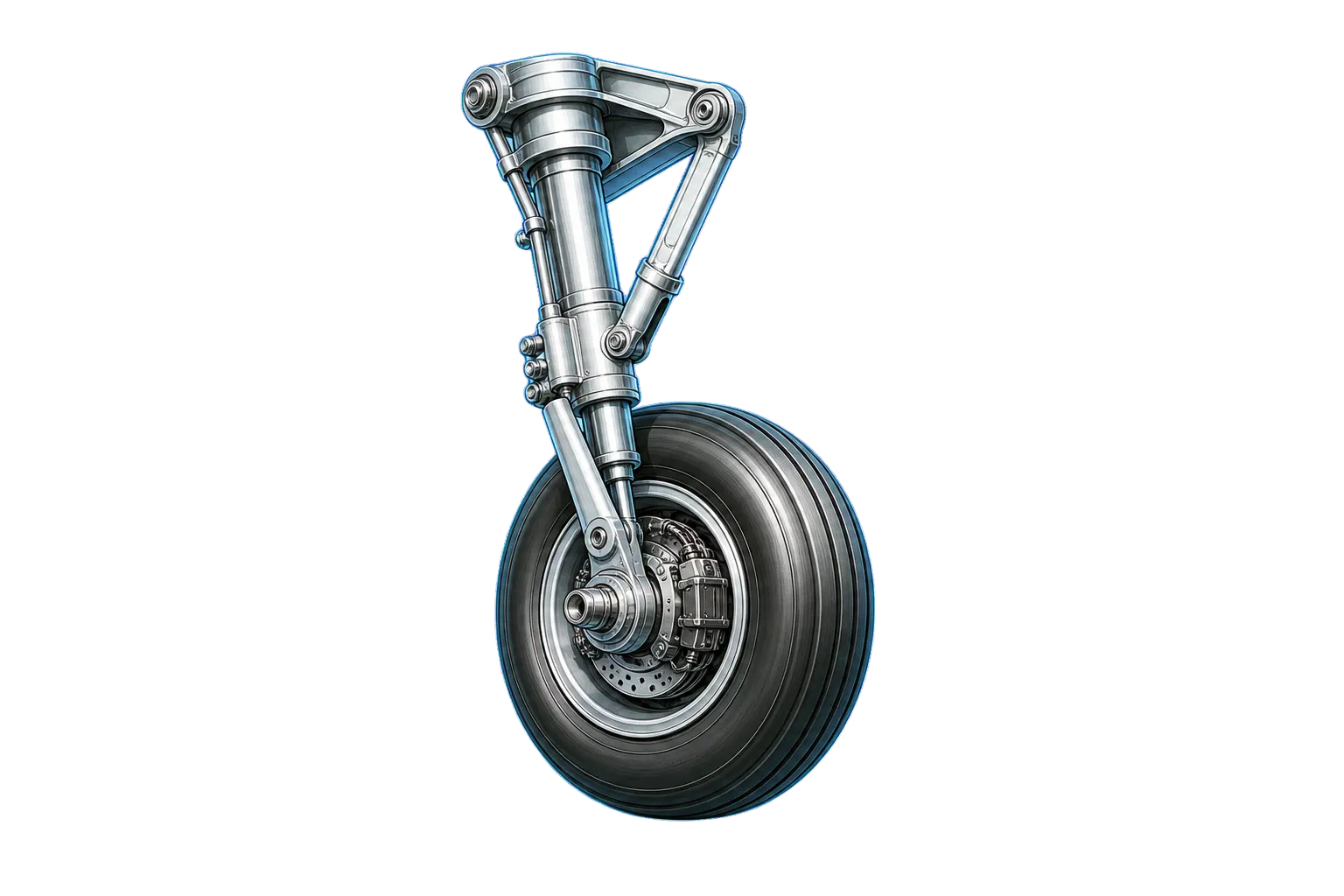
Chafing found on the main landing gear (MLG) yoke, attributed to contact between the nacelle fire detection wires and the MLG yoke. Chafing could lead to cracking and subsequent failure of the MLG yoke, which could adversely affect the safe landing of the airplane. Additionally, chafing of the nacelle fire detection wires could cause them to fail and prevent the detection of a fire in the nacelle assembly.
AI-generated summary from the source AD text. Verify against the official source before acting.
Required Actions
Inspect the nacelle fire detection wires and the MLG yoke for damage; replace damaged nacelle fire detection wires if necessary; repair the MLG yoke if necessary; and install brackets and associated hardware to secure the fire detection wires.
AI-generated summary from the source AD text. Verify against the official source before acting.
Compliance Time
Within 6,000 flight hours or 36 months after the effective date of this AD, whichever occurs first.
AI-generated summary from the source AD text. Verify against the official source before acting.
Affected Aircraft
Bombardier, Inc. Model DHC-8-400, -401, and -402 airplanes; certificated in any category; serial numbers 4001 through 4382 inclusive.
AI-generated summary from the source AD text. Verify against the official source before acting.
Federal Register Abstract
We are adopting a new airworthiness directive (AD) for certain Bombardier, Inc. Model DHC-8-400 series airplanes. This AD was prompted by reports of chafing found on the main landing gear (MLG) yoke. The chafing was attributed to contact between the nacelle fire detection wires and the MLG yoke. This AD requires inspections of the nacelle fire detection wires and the MLG yoke for damage; replacing nacelle fire detection wires, if necessary; repairing the MLG yoke, if necessary; and installing brackets and associated hardware to secure the fire detection wires. We are issuing this AD to prevent chafing between the nacelle fire detection wires and the MLG yoke. Chafing could lead to cracking and subsequent failure of the MLG yoke, which could adversely affect the safe landing of the airplane. In addition, chafing of the nacelle fire detection wires could cause them to fail and prevent the detection of a fire in the nacelle assembly.
Applicability Source Text
Show captured applicability text from the source AD
(c) Applicability

    This AD applies to Bombardier, Inc. Model DHC-8-400, -401, and -
402 airplanes; certificated in any category; serial numbers 4001
through 4382 inclusive.
Document Text
Show stored source text (verify against official source)
[Federal Register Volume 78, Number 125 (Friday, June 28, 2013)]
[Rules and Regulations]
[Pages 38823-38825]
From the Federal Register Online via the Government Publishing Office [<a href="http://www.gpo.gov">www.gpo.gov</a>]
[FR Doc No: 2013-14430]
-----------------------------------------------------------------------
DEPARTMENT OF TRANSPORTATION
Federal Aviation Administration
14 CFR Part 39
[Docket No. FAA-2012-1155; Directorate Identifier 2012-NM-115-AD;
Amendment 39-17445; AD 2013-09-04]
RIN 2120-AA64
Airworthiness Directives; Bombardier, Inc. Airplanes
AGENCY: Federal Aviation Administration (FAA), Department of
Transportation (DOT).
ACTION: Final Rule.
-----------------------------------------------------------------------
SUMMARY: We are adopting a new airworthiness directive (AD) for certain
Bombardier, Inc. Model DHC-8-400 series airplanes. This AD was prompted
by reports of chafing found on the main landing gear (MLG) yoke. The
chafing was attributed to contact between the nacelle fire detection
wires and the MLG yoke. This AD requires inspections of the nacelle
fire detection wires and the MLG yoke for damage; replacing nacelle
fire detection wires, if necessary; repairing the MLG yoke, if
necessary; and installing brackets and associated hardware to secure
the fire detection wires. We are issuing this AD to prevent chafing
between the nacelle fire detection wires and the MLG yoke. Chafing
could lead to cracking and subsequent failure of the MLG yoke, which
could adversely affect the safe landing of the airplane. In addition,
chafing of the nacelle fire detection wires could cause them to fail
and prevent the detection of a fire in the nacelle assembly.
[[Page 38824]]
DATES: This AD becomes effective August 2, 2013.
The Director of the Federal Register approved the incorporation by
reference of a certain publication listed in this AD as of August 2,
2013.
ADDRESSES: You may examine the AD docket on the Internet at <a href="http://www.regulations.gov">http://www.regulations.gov</a> or in person at the U.S. Department of
Transportation, Docket Operations, M-30, West Building Ground Floor,
Room W12-140, 1200 New Jersey Avenue SE., Washington, DC.
FOR FURTHER INFORMATION CONTACT: Assata Dessaline, Aerospace Engineer,
Avionics and Services Branch, ANE-171, FAA, New York Aircraft
Certification Office (ACO), 1600 Stewart Avenue, Suite 410, Westbury,
New York 11590; telephone (516) 228-7301; fax (516) 794-5531.
SUPPLEMENTARY INFORMATION:
Discussion
We issued a notice of proposed rulemaking (NPRM) to amend 14 CFR
part 39 to include an AD that would apply to the specified products.
That NPRM was published in the Federal Register on November 5, 2012 (77
FR 66413). That NPRM proposed to correct an unsafe condition for the
specified products. The Mandatory Continuing Airworthiness Information
(MCAI) states:
There have been two (2) in-service reports of chafing found on the
main landing gear (MLG) yoke. The chafing was attributed to contact
between the nacelle fire detection wire and the MLG yoke. This
chafing may lead to cracking and subsequent failure of the MLG yoke.
Failure of the MLG yoke could adversely affect the safe landing of
the aeroplane. In addition, failure of the fire detection wire could
prevent the detection of a fire in the nacelle assembly.
This [Canadian] Airworthiness Directive (AD) mandates the [detailed]
inspection of the nacelle fire detection wires and [detailed
inspection of the] MLG yoke for damage [chafing, nicks, cracking]
and the installation of new brackets to secure the fire detection
wire to prevent chafing against the MLG yoke [and corrective actions
if necessary].
Corrective actions include replacing damaged wires with new wires and
repairing the MLG yoke. You may obtain further information by examining
the MCAI in the AD docket.
Comments
We gave the public the opportunity to participate in developing
this AD. We considered the comments received.
Request To Allow Reference to Canadian AD
Horizon Air requested that the last sentence in paragraph
(g)(2)(ii) of the NPRM (77 FR 66413, November 5, 2012) be deleted. That
sentence states, ``The approved repair must specifically reference this
AD.'' Horizon Air stated that Bombardier references Transport Canada
Civil Aviation ADs on repair drawings and the requirement to reference
an FAA AD has not been included in previous ADs issued by the FAA.
Horizon noted that a reference to the Canadian AD should be sufficient
and the final rule should be changed to allow a reference to the
Canadian AD.
For the reasons presented by the commenter we agree to delete the
last sentence of paragraph (g)(2)(ii) in this AD. That sentence was
inadvertently included in the NPRM (77 FR 66413, November 5, 2012).
Request To Change Certain Reference to Brackets
Horizon Air requested that paragraph (g)(3) of the NPRM (77 FR
66413, November 5, 2012) be revised to delete the word ``new'' from the
sentence, ``Install new brackets and associated hardware . . . .''
Horizon acknowledged that this sentence was included in Canadian AD CF-
2012-15, dated April 30, 2012, which is referenced in the NPRM, but
based on the FAA's policy of strict interpretation of the word ``new''
as a zero-time part, this sentence places an additional requirement on
U.S. operators to ensure that only zero-time brackets are installed.
We agree to revise paragraph (g)(3) in this final rule to delete
the word ``new.'' This will remove the requirement that operators only
install ``new'' brackets. We also deleted the word ``new'' in the
SUMMARY section of this final rule.
Conclusion
We reviewed the available data, including the comments received,
and determined that air safety and the public interest require adopting
the AD with the changes described previously and minor editorial
changes. We have determined that these changes:
<bullet> Are consistent with the intent that was proposed in the
NPRM (77 FR 66413, November 5, 2012) for correcting the unsafe
condition; and
<bullet> Do not add any additional burden upon the public than was
already proposed in the NPRM (77 FR 66413, November 5, 2012).
Costs of Compliance
We estimate that this AD will affect 80 products of U.S. registry.
We also estimate that it will take about 3 work-hours per product to
comply with the basic requirements of this AD. The average labor rate
is $85 per work-hour. Required parts will cost about $332 per product.
Where the service information lists required parts costs that are
covered under warranty, we have assumed that there will be no charge
for these parts. As we do not control warranty coverage for affected
parties, some parties may incur costs higher than estimated here. Based
on these figures, we estimate the cost of this AD to the U.S. operators
to be $46,960, or $587 per product.
Authority for This Rulemaking
Title 49 of the United States Code specifies the FAA's authority to
issue rules on aviation safety. Subtitle I, section 106, describes the
authority of the FAA Administrator. ``Subtitle VII: Aviation
Programs,'' describes in more detail the scope of the Agency's
authority.
We are issuing this rulemaking under the authority described in
``Subtitle VII, Part A, Subpart III, Section 44701: General
requirements.'' Under that section, Congress charges the FAA with
promoting safe flight of civil aircraft in air commerce by prescribing
regulations for practices, methods, and procedures the Administrator
finds necessary for safety in air commerce. This regulation is within
the scope of that authority because it addresses an unsafe condition
that is likely to exist or develop on products identified in this
rulemaking action.
Regulatory Findings
We determined that this AD will not have federalism implications
under Executive Order 13132. This AD will not have a substantial direct
effect on the States, on the relationship between the national
government and the States, or on the distribution of power and
responsibilities among the various levels of government.
For the reasons discussed above, I certify that this AD:
1. Is not a ``significant regulatory action'' under Executive Order
12866;
2. Is not a ``significant rule'' under the DOT Regulatory Policies
and Procedures (44 FR 11034, February 26, 1979);
3. Will not affect intrastate aviation in Alaska; and
4. Will not have a significant economic impact, positive or
negative, on a substantial number of small entities under the criteria
of the Regulatory Flexibility Act.
We prepared a regulatory evaluation of the estimated costs to
comply with this AD and placed it in the AD docket.
[[Page 38825]]
Examining the AD Docket
You may examine the AD docket on the Internet at <a href="http://www.regulations.gov">http://www.regulations.gov</a>; or in person at the Docket Operations office
between 9 a.m. and 5 p.m., Monday through Friday, except Federal
holidays. The AD docket contains the NPRM (77 FR 66413, November 5,
2012), the regulatory evaluation, any comments received, and other
information. The street address for the Docket Operations office
(telephone (800) 647-5527) is in the ADDRESSES section. Comments will
be available in the AD docket shortly after receipt.
List of Subjects in 14 CFR Part 39
Air transportation, Aircraft, Aviation safety, Incorporation by
reference, Safety.
Adoption of the Amendment
Accordingly, under the authority delegated to me by the
Administrator, the FAA amends 14 CFR part 39 as follows:
PART 39--AIRWORTHINESS DIRECTIVES
0
1. The authority citation for part 39 continues to read as follows:
Authority: 49 U.S.C. 106(g), 40113, 44701.
Sec. 39.13 [Amended]
0
2. The FAA amends Sec. 39.13 by adding the following new AD:
2013-09-04 Bombardier, Inc.:
Amendment 39-17445. Docket No. FAA-2012-1155; Directorate
Identifier 2012-NM-115-AD.
(a) Effective Date
This airworthiness directive (AD) becomes effective August 2,
2013.
(b) Affected ADs
None.
(c) Applicability
This AD applies to Bombardier, Inc. Model DHC-8-400, -401, and -
402 airplanes; certificated in any category; serial numbers 4001
through 4382 inclusive.
(d) Subject
Joint Aircraft System Component (JASC)/Air Transport Association
(ATA) of America Code 26, Fire protection.
(e) Reason
This AD was prompted by reports of chafing found on the main
landing gear (MLG) yoke. We are issuing this AD to prevent chafing
between the nacelle fire detection wires and the MLG yoke. Chafing
could lead to cracking and subsequent failure of the MLG yoke, which
could adversely affect the safe landing of the airplane. In
addition, chafing of the nacelle fire detection wires could cause
them to fail and prevent the detection of a fire in the nacelle
assembly.
(f) Compliance
You are responsible for having the actions required by this AD
performed within the compliance times specified, unless the actions
have already been done.
(g) Inspections and Installation
Within 6,000 flight hours or 36 months after the effective date
of this AD, whichever occurs first, accomplish the actions specified
in paragraphs (g)(1), (g)(2), and (g)(3) of this AD, in accordance
with the Accomplishment Instructions of Bombardier Service Bulletin
84-26-11, Revision A, dated January 25, 2012.
(1) Do a detailed inspection of the left and right nacelle fire
detection wires for damage (i.e., chafing). If damage is found on
any nacelle fire detection wire: Before further flight, remove and
replace the damaged wire with a new wire, in accordance with the
Accomplishment Instructions of Bombardier Service Bulletin 84-26-11,
Revision A, dated January 25, 2012.
(2) Do a detailed inspection of the MLG yoke for damage (e.g.,
chafing, nicks, cracking).
(i) If any damage is found within the limitations specified in
Figure 8 of Bombardier Service Bulletin 84-26-11, Revision A, dated
January 25, 2012: Before further flight, repair the MLG yoke, in
accordance with Figure 9, steps 1 through 10, of Bombardier Service
Bulletin 84-26-11, Revision A, dated January 25, 2012.
(ii) If any damage exceeds the limitations specified in Figure 8
of Bombardier Service Bulletin 84-26-11, Revision A, dated January
25, 2012: Before further flight, repair the MLG yoke using a method
approved by either the Manager, New York Aircraft Certification
Office (ACO), ANE-170, FAA; or Transport Canada Civil Aviation (or
its delegated agent).
(3) Install brackets and associated hardware, in accordance with
the Accomplishment Instructions of Bombardier Service Bulletin 84-
26-11, Revision A, dated January 25, 2012.
(h) Credit for Previous Actions
This paragraph provides credit for actions required by
paragraphs (g)(1), (g)(2), and (g)(3) of this AD, if those actions
were performed before the effective date of this AD using Bombardier
Service Bulletin 84-26-11, dated December 19, 2011, which is not
incorporated by reference in this AD.
(i) Other FAA AD Provisions
The following provisions also apply to this AD:
(1) Alternative Methods of Compliance (AMOCs): The Manager, New
York ACO, ANE-170, FAA, has the authority to approve AMOCs for this
AD, if requested using the procedures found in 14 CFR 39.19. In
accordance with 14 CFR 39.19, send your request to your principal
inspector or local Flight Standards District Office, as appropriate.
If sending information directly to the ACO, send it to ATTN: Program
Manager, Continuing Operational Safety, FAA, New York ACO, 1600
Stewart Avenue, Suite 410, Westbury, New York 11590; telephone 516-
228-7300; fax 516-794-5531. Before using any approved AMOC, notify
your appropriate principal inspector, or lacking a principal
inspector, the manager of the local flight standards district
office/certificate holding district office. The AMOC approval letter
must specifically reference this AD.
(2) Airworthy Product: For any requirement in this AD to obtain
corrective actions from a manufacturer or other source, use these
actions if they are FAA-approved. Corrective actions are considered
FAA-approved if they are approved by the State of Design Authority
(or their delegated agent). You are required to assure the product
is airworthy before it is returned to service.
(j) Related Information
(1) Refer to MCAI Canadian Airworthiness Directive CF-2012-15,
dated April 30, 2012 (<a href="http://wwwapps3.tc.gc.ca/Saf-Sec-Sur/2/cawis-swimn/attachment.asp?aiid=CF-2012-15&revid=0&cntr=CF&file=CFCF-2012-15.pdf&type=PDE">http://wwwapps3.tc.gc.ca/Saf-Sec-Sur/2/cawis-swimn/attachment.asp?aiid=CF-2012-15&revid=0&cntr=CF&file=CFCF-2012-15.pdf&type=PDE</a>), for related information.
(2) Service information identified in this AD that is not
incorporated by reference in this AD may be obtained at the
addresses specified in paragraphs (k)(3) and (k)(4) of this AD.
(k) Material Incorporated by Reference
(1) The Director of the Federal Register approved the
incorporation by reference (IBR) of the service information listed
in this paragraph under 5 U.S.C. 552(a) and 1 CFR part 51.
(2) You must use this service information as applicable to do
the actions required by this AD, unless the AD specifies otherwise.
(i) Bombardier Service Bulletin 84-26-11, Revision A, dated
January 25, 2012.
(ii) Reserved.
(3) For service information identified in this AD, contact
Bombardier, Inc., Q Series Technical Help Desk, 123 Garratt
Boulevard, Toronto, Ontario M3K 1Y5, Canada; telephone 416-375-4000;
fax 416-375-4539; email <a href="/cdn-cgi/l/email-protection#cfbba7abe1bebcaabda6aabc8faeaabda0e1ada0a2adaebdaba6aabde1aca0a2"><span class="__cf_email__" data-cfemail="72061a165c030117001b1701321317001d5c101d1f101300161b17005c111d1f">[email protected]</span></a>; Internet
<a href="http://www.bombardier.com">http://www.bombardier.com</a>.
(4) You may review copies of the service information at the FAA,
Transport Airplane Directorate, 1601 Lind Avenue SW., Renton, WA.
For information on the availability of this material at the FAA,
call 425-227-1221.
(5) You may view this service information that is incorporated
by reference at the National Archives and Records Administration
(NARA). For information on the availability of this material at
NARA, call 202-741-6030, or go to: <a href="http://www.archives.gov/federal-register/cfr/ibr-locations.html">http://www.archives.gov/federal-register/cfr/ibr-locations.html</a>.
Issued in Renton, Washington, on April 23, 2013.
Jeffrey E. Duven,
Acting Manager, Transport Airplane Directorate, Aircraft Certification
Service.
[FR Doc. 2013-14430 Filed 6-27-13; 8:45 am]
BILLING CODE 4910-13-P
Source: Official FAA Source ↗
Retrieved: Apr 4, 2026
Rights: U.S. Government Public Domain
This site is not affiliated with or endorsed by the FAA. Always verify with official sources.
Related Airworthiness Directives
2019-15-09 Recurring
final ruleAirworthiness Directives; Bombardier, Inc., Airplanes
Unsafe Condition: cracking of the outboard spoiler actuator mounting brackets, which could cause inoperability or jam of a single spoiler panel and possible jam of the aileron circuit.
2018-22-03
final ruleAirworthiness Directives; Bombardier, Inc., Airplanes
Unsafe Condition: Cracked and corroded barrel nuts, part number DSC228-12, at the mid-spar location of the horizontal-stabilizer-to-vertical-stabilizer attachment joint due to inadequate cadmium plating, which could...
2018-20-18
final ruleAirworthiness Directives; Bombardier, Inc., Airplanes
Unsafe Condition: Faulty switches in the power lever module could result in uncommanded deployment of the ground spoilers and a possible runway excursion.
2018-17-17
final ruleAirworthiness Directives; Bombardier, Inc., Airplanes
Unsafe Condition: Loose windshield heater terminal lugs could create sparks that lead to burning of the lugs and, due to the excessive heat, cracking of the windshields. If not corrected, such a condition could caus...