AD 2012-02-01
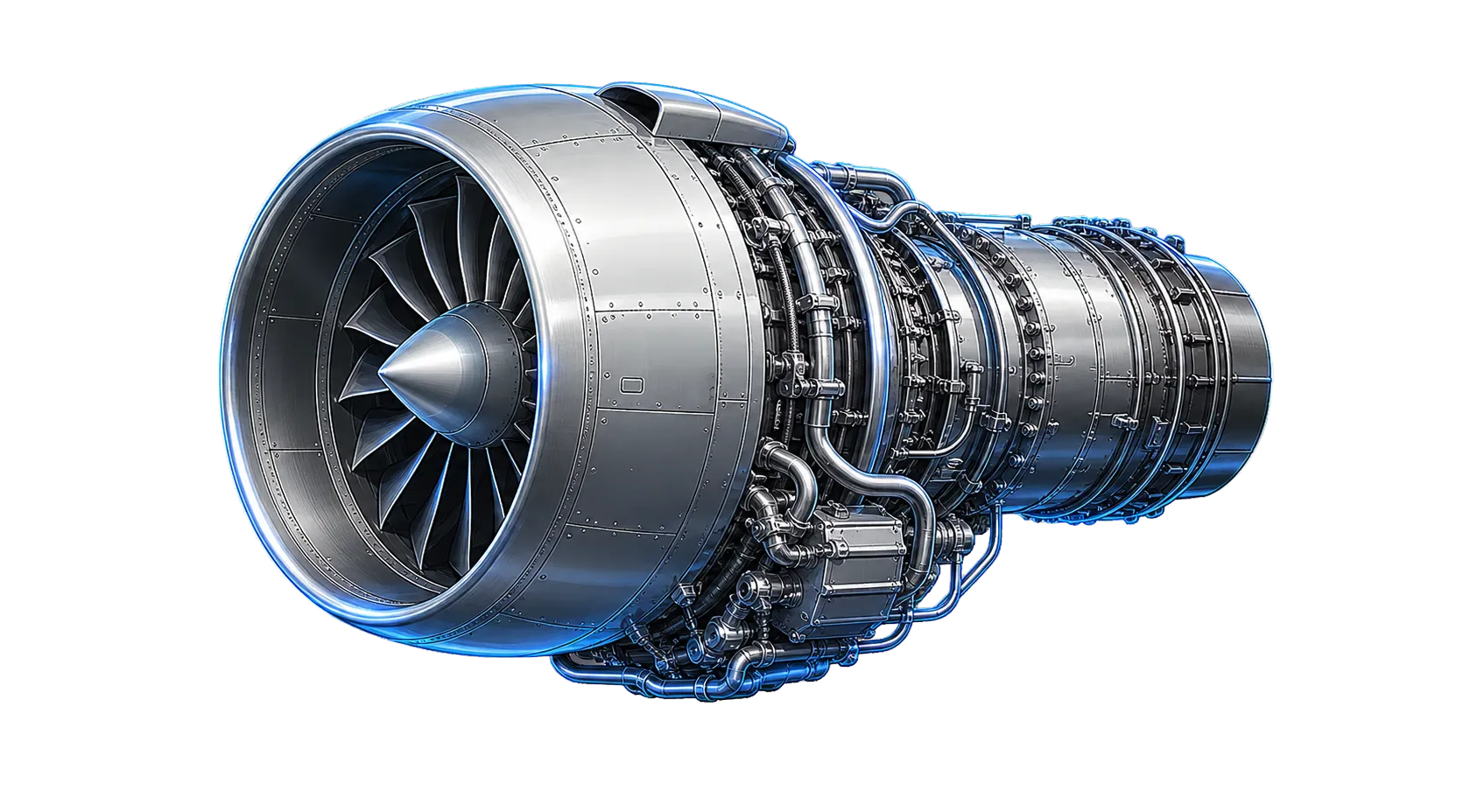
Applicability
| Type | Manufacturer | Model | Details |
|---|---|---|---|
| engine | Pratt & Whitney Division | PW2037 | Airworthiness Directives; Pratt & Whitney (PW) Turbofan Engines |
| engine | Pratt & Whitney Division | PW2037M | Airworthiness Directives; Pratt & Whitney (PW) Turbofan Engines |
| engine | Pratt & Whitney Division | PW2040 | Airworthiness Directives; Pratt & Whitney (PW) Turbofan Engines |
Unsafe Condition
Fan blade leading edge erosion can result in a fan thrust deterioration mode (FTDM) condition, which cannot be detected by the crew and reduces the engine's capability of producing required thrust.
AI-generated summary from the source AD text. Verify against the official source before acting.
Required Actions
Initial and repetitive maintenance to restore the leading edge contour of specified fan blades or applying performance decrements as specified in the Airplane Flight Manual.
AI-generated summary from the source AD text. Verify against the official source before acting.
Compliance Time
Within 500 cycles-in-service after the effective date of this AD or within 1,000 cycles-in-service after the last leading edge restoration, whichever occurs later.
AI-generated summary from the source AD text. Verify against the official source before acting.
Affected Aircraft
Pratt & Whitney PW2037, PW2037(M), and PW2040 turbofan engines with certain fan blades with a cutback leading edge, installed.
AI-generated summary from the source AD text. Verify against the official source before acting.
Federal Register Abstract
We are adopting a new airworthiness directive (AD) for Pratt & Whitney (PW) PW2037, PW2037(M), and PW2040 turbofan engines with certain fan blades with a cutback leading edge, installed. This AD was prompted by reports from PW that fan blade leading edge erosion can result in a fan thrust deterioration mode (FTDM) condition, a condition that cannot be detected by the crew, and that reduces the engine's capability of producing required thrust. This AD requires initial and repetitive maintenance to the leading edge of cutback fan blades or applying performance decrements as specified in the Airplane Flight Manual. We are issuing this AD to correct undetectable fan thrust deterioration on these PW products.
Applicability Source Text
Show captured applicability text from the source AD
(c) Applicability

    This AD applies to Pratt & Whitney (PW) PW2037, PW2037(M), and
PW2040 turbofan engines with six or more fan blades, part numbers
(P/Ns) 1B6531, 1B6231-001, or 1A9031-001 (fan blade set P/Ns 1B6521,
1B6221-001, and 1A9721-001), with a cutback leading edge, installed.
Document Text
Show stored source text (verify against official source)
[Federal Register Volume 77, Number 54 (Tuesday, March 20, 2012)]
[Rules and Regulations]
[Pages 16139-16143]
From the Federal Register Online via the Government Publishing Office [<a href="http://www.gpo.gov">www.gpo.gov</a>]
[FR Doc No: 2012-6500]
-----------------------------------------------------------------------
DEPARTMENT OF TRANSPORTATION
Federal Aviation Administration
14 CFR Part 39
[Docket No. FAA-2008-1095; Directorate Identifier 2008-NE-34-AD;
Amendment 39-16924; AD 2012-02-01]
RIN 2120-AA64
Airworthiness Directives; Pratt & Whitney (PW) Turbofan Engines
AGENCY: Federal Aviation Administration (FAA), DOT.
ACTION: Final rule.
-----------------------------------------------------------------------
SUMMARY: We are adopting a new airworthiness directive (AD) for Pratt &
Whitney (PW) PW2037, PW2037(M), and PW2040 turbofan engines with
certain fan blades with a cutback leading edge, installed. This AD was
prompted by reports from PW that fan blade leading edge erosion can
result in a fan thrust deterioration mode (FTDM) condition, a condition
that cannot be detected by the crew, and that reduces the engine's
capability of producing required thrust. This AD requires initial and
repetitive maintenance to the leading edge of cutback fan blades or
applying performance decrements as specified in the Airplane Flight
Manual.
[[Page 16140]]
We are issuing this AD to correct undetectable fan thrust deterioration
on these PW products.
DATES: This AD is effective April 24, 2012.
The Director of the Federal Register approved the incorporation by
reference of certain publications listed in the AD as of April 24,
2012.
ADDRESSES: For service information identified in this AD, contact Pratt
& Whitney, 400 Main St., East Hartford, CT 06108; phone: (860) 565-
8770; fax: (860) 565-4503 or Boeing Commercial Airplanes, Attention:
Data & Services Management, P.O. Box 3707, MC 2H-65, Seattle, WA 98124-
2207; phone: (206) 544-5000, extension 1; fax: (206) 766-5680; email:
<a href="/cdn-cgi/l/email-protection#f9949cd79b969c9a9694b99b969c90979ed79a9694"><span class="__cf_email__" data-cfemail="abc6ce85c9c4cec8c4c6ebc9c4cec2c5cc85c8c4c6">[email protected]</span></a>; Internet: <a href="https://www.myboeingfleet.com">https://www.myboeingfleet.com</a>. You may
review copies of the referenced service information at the FAA, Engine
& Propeller Directorate, 12 New England Executive Park, Burlington, MA.
For information on the availability of this material at the FAA, call
781-238-7125.
Examining the AD Docket
You may examine the AD docket on the Internet at <a href="http://www.regulations.gov">http://www.regulations.gov</a>; or in person at the Docket Management Facility
between 9 a.m. and 5 p.m., Monday through Friday, except Federal
holidays. The AD docket contains this AD, the regulatory evaluation,
any comments received, and other information. The address for the
Docket Office (phone: 800-647-5527) is Document Management Facility,
U.S. Department of Transportation, Docket Operations, M-30, West
Building Ground Floor, Room W12-140, 1200 New Jersey Avenue SE.,
Washington, DC 20590.
FOR FURTHER INFORMATION CONTACT: Ian Dargin, Aerospace Engineer, Engine
Certification Office, FAA, Engine & Propeller Directorate, 12 New
England Executive Park, Burlington, MA 01803; phone: (781) 238-7178;
fax: (781) 238-7199; email: <a href="/cdn-cgi/l/email-protection#9ef7fff0b0faffecf9f7f0def8ffffb0f9f1e8"><span class="__cf_email__" data-cfemail="1f767e71317b7e6d7876715f797e7e31787069">[email protected]</span></a>.
SUPPLEMENTARY INFORMATION:
Discussion
We issued a notice of proposed rulemaking (NPRM) to amend 14 CFR
part 39 to include an AD that would apply to the specified products.
That NPRM published in the Federal Register on March 25, 2010 (75 FR
14377). That NPRM proposed to require initial and repetitive
maintenance to restore the leading edge contour of PW2000 fan blade
part numbers (P/Ns) 1B6531, 1B6231-001, or 1A9031-001 (fan blade set P/
Ns 1B6521, 1B6221-001, and 1A9721-001).
Comments
We gave the public the opportunity to participate in developing
this AD. The following presents the comments received on our proposal
and the FAA's response to each comment.
Request for Additional Alternative Methods of Compliance (AMOCs)
Three commenters, UPS, Cheshire Engine Center, and Delta Tech Ops,
asked us to include Engine Manual, 1A6231, Chapter/Section 72-31-12,
Repair-18, and PW Service Bulletin (SB) PW2000 72-513, Revision 4,
dated August 20, 1997, as an AMOC to the AD. The commenters stated that
Repair-18 is a bench repair that removes erosion damage and restores
the leading edge contour on fan blades with cutback leading edges. The
commenters stated that Repair-18 results in a restored leading edge
similar to Repair-14, which is already included in the proposed rule as
an AMOC. The commenters stated that Repair-14 is a patch weld repair
used to restore the cutback leading edge.
We agree that Repair-18 and PW SB PW2000 72-513, Revision 4, dated
August 20, 1997 are acceptable methods of resolving the fan thrust
deterioration. We changed paragraph (f) of the AD to include Pratt &
Whitney PW2037, PW2040, PW2240, PW2337 Turbofan Engine Manual, Part No.
1A6231, Chapter/Section 72-31-12, Repair-14 and Repair-18, and PW SB
PW2000 72-513, Revision 4, dated August 20, 1997, as additional methods
with which to comply with this AD.
One commenter, The Boeing Company (Boeing), asked us to add
Airplane Flight Manual (AFM) D631N007, Section 1, page 11, Code 0P00
(Operation with Cutback Fan Blades) to the AMOC already published in
the NPRM. The commenter stated that the performance adjustments for the
PW2000 series engines that are installed on 757-300 airplanes are not
in AFM D631N002, Appendix 24. They are in AFM D631N007, Section 1, Code
0P00.
We partially agree. We changed paragraph (f) of this AD to include
``Boeing 757 Airplane Flight Manual (AFM), Document D631N002'' and
``Boeing 757 Airplane Flight Manual, Document D631N007'' as additional
methods with which to comply with this AD. We also changed paragraphs
(f)(1)(vi) and (f)(1)(vii) of this AD to clarify that the method of
compliance with those paragraphs is to revise the AFM. In addition, we
changed paragraph (f)(3) of this AD to provide for removing certain
information from the AFM when that information is included in the
general revisions of the AFM. We coordinated all changes to the AFM
with the FAA Transport Airplane Directorate.
One commenter, Delta Tech Ops, asked us to include PW SB PW2000 72-
737 in the Alternative Methods of Compliance section. The commenter
stated that PW SB PW2000 72-737 modifies the cutback fan blades
affected by the AD to the non-cutback configuration.
We disagree. If the cutback fan blades affected by the AD are
modified to return them to the non-cutback configuration, they are no
longer affected by this AD. This AD only applies to fan blade, P/Ns
1B6531, 1B6231-001, or 1A9031-001 (fan blade set P/Ns 1B6521, 1B6221-
001, and 1A9721-001), with a cutback leading edge. We didn't change the
AD.
Request To Clarify Compliance Time
Two commenters, United Airlines and Delta Tech Ops, asked us to
clarify that the AD repair doesn't have to be performed immediately if
the blade leading edge has recently been cutback or restored. The
commenters made this request to recognize that some blade leading edges
have been recently cutback using PW SB PW2000 72-513 or restored using
engine manual Repair-14 or Repair-18.
We agree. This AD is to ensure that cutback blades are repaired
within 1,000 cycles-in-service after the last leading edge restoration.
We changed paragraph (f) to ``Within 500 cycles-in-service (CIS) after
the effective date of this AD or within 1,000 CIS after the last
leading edge restoration, whichever occurs later, do one of the
following.''
Request To Allow Additional Cycles for the PW2037 and PW2037(M) Engines
One commenter, United Airlines, asked us to match the compliance
time in the AD with PW ASB PW2000 A72-729 to allow an additional 500
CIS for the PW2037 and PW2037(M) engines as compared to the compliance
time for the PW2040 engines.
We disagree. The additional 500 CIS allowed for PW2037 and
PW2037(M) engines was applicable when the alert service bulletin was
first published in June 2008. This AD is to ensure cutback blades are
repaired within 1,000 CIS after the last leading edge restoration. We
didn't change the AD.
Request To Address Consequence of Performing the Cutback Leading Edge
Repair on a Non-Cutback Blade
One commenter, United Airlines, asked us to address the consequence
of the cutback blade leading edge repair being mistakenly performed on
a non-
[[Page 16141]]
cutback blade. The commenter felt that because of overlap in
dimensional requirements, discerning a cutback blade from a non-cutback
blade either visually or by measuring the chord length, is difficult.
The commenter also stated that the ``cb'' marking for a cutback blade
may become illegible after engine operation and that the cutback blade
tooling can fit on non-cutback blades and cause damage.
We disagree. Each operator must ensure that their personnel are
properly trained and certificated to perform this maintenance. We
didn't change the AD.
Eratta
During review of the comments we received, we discovered that we
had referred to additional methods of compliance in the NPRM as
Alternative Methods of Compliance (AMOCs). AMOC, in the aviation
industry, has a specific and unique meaning. We changed the compliance
section of this AD to indicate that operators may choose from several
corrective action(s), which are additional methods of compliance, to
resolve the unsafe condition. We also emphasized that operators must
choose one method and then they must use the complete method. We did
not add or remove any requirements when we made this correction.
We also rephrased the unsafe condition statement to clearly
indicate the unsafe condition this AD addresses.
Conclusion
We reviewed the relevant data, considered the comments received,
and determined that air safety and the public interest require adopting
the AD with the changes described previously.
We also determined that these changes will not increase the
economic burden on any operator or increase the scope of the AD.
Costs of Compliance
We estimate that this AD affects 480 engines installed on airplanes
of U.S. registry. We also estimate that it will take about 12 work-
hours per engine to perform the actions, and that the average labor
rate is $85 per work-hour. No parts are required. Based on these
figures, we estimate the total cost of the AD to U.S. operators to be
$489,600 per year.
Authority for This Rulemaking
Title 49 of the United States Code specifies the FAA's authority to
issue rules on aviation safety. Subtitle I, section 106, describes the
authority of the FAA Administrator. Subtitle VII: Aviation Programs,
describes in more detail the scope of the Agency's authority.
We are issuing this rulemaking under the authority described in
Subtitle VII, Part A, Subpart III, Section 44701: ``General
requirements.'' Under that section, Congress charges the FAA with
promoting safe flight of civil aircraft in air commerce by prescribing
regulations for practices, methods, and procedures the Administrator
finds necessary for safety in air commerce. This regulation is within
the scope of that authority because it addresses an unsafe condition
that is likely to exist or develop on products identified in this
rulemaking action.
Regulatory Findings
This AD will not have federalism implications under Executive Order
13132. This AD will not have a substantial direct effect on the States,
on the relationship between the national government and the States, or
on the distribution of power and responsibilities among the various
levels of government.
For the reasons discussed above, I certify that this AD:
(1) Is not a ``significant regulatory action'' under Executive
Order 12866,
(2) Is not a ``significant rule'' under DOT Regulatory Policies and
Procedures (44 FR 11034, February 26, 1979),
(3) Will not affect intrastate aviation in Alaska, and
(4) Will not have a significant economic impact, positive or
negative, on a substantial number of small entities under the criteria
of the Regulatory Flexibility Act.
List of Subjects in 14 CFR Part 39
Air transportation, Aircraft, Aviation safety, Incorporation by
reference, Safety.
Adoption of the Amendment
Accordingly, under the authority delegated to me by the
Administrator, the FAA amends 14 CFR part 39 as follows:
PART 39--AIRWORTHINESS DIRECTIVES
0
1. The authority citation for part 39 continues to read as follows:
Authority: 49 U.S.C. 106(g), 40113, 44701.
Sec. 39.13 [Amended]
0
2. The FAA amends Sec. 39.13 by adding the following new airworthiness
directive (AD):
2012-02-01 Pratt & Whitney: Amendment 39-16924; Docket No. FAA-2008-
1095; Directorate Identifier 2008-NE-34-AD.
(a) Effective Date
This AD is effective April 24, 2012.
(b) Affected ADs
None.
(c) Applicability
This AD applies to Pratt & Whitney (PW) PW2037, PW2037(M), and
PW2040 turbofan engines with six or more fan blades, part numbers
(P/Ns) 1B6531, 1B6231-001, or 1A9031-001 (fan blade set P/Ns 1B6521,
1B6221-001, and 1A9721-001), with a cutback leading edge, installed.
(d) Unsafe Condition
This AD was prompted by reports from PW that fan blade leading
edge erosion can result in a fan thrust deterioration mode (FTDM)
condition, a condition that cannot be detected by the crew, and that
reduces the engine's capability of producing required thrust. We are
issuing this AD to correct undetectable fan thrust deterioration on
these PW products.
(e) Compliance
You are responsible for having the actions required by this AD
performed within the compliance times specified unless the actions
have already been done.
(f) Restoration of the Fan Blade Leading Edge Contour
(1) Within 500 cycles-in-service (CIS) after the effective date
of this AD or within 1,000 CIS after the last leading edge
restoration, whichever occurs later, do one of the following.
Whichever method you choose, you must implement the method in full.
(i) For engines installed on the airplane, perform the initial
restoration using Accomplishment Instructions For Engines Installed
on Aircraft, paragraphs 1. through 1.T. of PW Alert Service Bulletin
(ASB) PW2000 A72-729, Revision 2, dated October 13, 2010.
(ii) For engines that are not installed on the airplane, perform
the initial restoration using Accomplishment Instructions For
Engines Not Installed on Aircraft, paragraphs 1. through 1.S. of PW
ASB PW2000 A72-729, Revision 2, dated October 13, 2010.
(iii) Perform Repair-14, dated February 1, 2006, from a Pratt &
Whitney PW2037, PW2040, PW2240, PW2337 Turbofan Engine Manual, Part
No. 1A6231, Chapter/Section 72-31-12.
(iv) Perform Repair-18, dated February 1, 2004, from a Pratt &
Whitney PW2037, PW2040, PW2240, PW2337 Turbofan Engine Manual, Part
No. 1A6231, Chapter/Section 72-31-12.
(v) Perform PW Service Bulletin PW2000 72-513, Revision 4, dated
August 20, 1997.
(vi) Revise the Limitations Section of the Boeing 757 Airplane
Flight Manual (AFM), Document D631N002, to include the following
limitation. This may be done by inserting a copy of this AD into the
AFM.
[[Page 16142]]
[GRAPHIC] [TIFF OMITTED] TR20MR12.040
(vii) Revise the Limitations Section of the Boeing 757 Airplane
Flight Manual, Document D631N007, to include the following
limitation. This may be done by inserting a copy of this AD into the
AFM.
[GRAPHIC] [TIFF OMITTED] TR20MR12.041
(2) If you chose one of the methods in paragraphs (f)(1)(i)
through (f)(1)(v) of this AD, thereafter, within 1,000 CIS, repeat
one of the methods in paragraphs (f)(1)(i) through (f)(1)(v) of this
AD. Whichever method you choose, you must implement the method in
full.
(3) If you chose one of the methods in paragraphs (f)(1)(vi) or
(f)(1)(vii) of this AD, you have fully complied with the
requirements of this AD and no further action is required. When a
statement identical to that in paragraph (f)(1)(vi) or (f)(1)(vii)
of this AD has been included in the Limitations Section of the
general revisions of the AFM, the general revisions may be inserted
into the AFM, and the copy of this AD may be removed from the AFM.
(g) Alternative Methods of Compliance
The certification office specified in paragraph (g)(1) or (g)(2)
of this AD, as applicable, has the authority to approve AMOCs for
this AD, if requested using the procedures found in 14 CFR 39.19.
(1) For paragraphs (f)(1)(vi) and (f)(1)(vii) of this AD: The
Manager, Seattle Aircraft Certification Office (ACO), FAA. Send
information to ATTN: Chris R. Parker, Aerospace Engineer, Propulsion
Branch, ANM-140S, FAA, Seattle ACO, 1601 Lind Avenue SW., Renton,
Washington 98057-3356; phone: 425-917-6496; fax: 425-917-6590.
Information may be emailed to: <a href="/cdn-cgi/l/email-protection#41786c000f0c6c12242035352d246c00020e6c000c0e026c1324303424323532012720206f262e37"><span class="__cf_email__" data-cfemail="2b12066a656606784e4a5f5f474e066a6864066a66646806794e5a5e4e585f586b4d4a4a054c445d">[email protected]</span></a>.
(2) For requirements of paragraphs of this AD other than those
identified in paragraph (g)(1) of this AD: The Manager, Engine
Certification Office (ECO), FAA. Send information to ATTN: Ian
Dargin, Aerospace Engineer, FAA, ECO, 12 New England Executive Park,
Burlington, MA 01803; phone: (781) 238-7178; fax: (781) 238-7199.
(h) Related Information
(i) The Boeing 757 Airplane Flight Manual, Document D631N002,
and the Boeing 757 Airplane Flight Manual, Document D631N007 pertain
to the subject of this AD. Contact Boeing Commercial Airplanes,
Attention: Data & Services Management, P.O. Box 3707, MC 2H-65,
Seattle, WA 98124-2207; phone: (206) 544-5000, extension 1; fax:
(206) 766-5680; email: <a href="/cdn-cgi/l/email-protection#7d1018531f12181e12103d1f121814131a531e1210"><span class="__cf_email__" data-cfemail="234e460d414c46404c4e63414c464a4d440d404c4e">[email protected]</span></a>; Internet: <a href="https://www.myboeingfleet.com">https://www.myboeingfleet.com</a>, for a copy of this service information.
(ii) For more information about this AD, contact Ian Dargin,
Engine Certification Office, FAA, 12 New England Executive Park,
Burlington, MA 01803; phone: (781) 238-7178; fax: (781) 238-7199;
email: <a href="/cdn-cgi/l/email-protection#620b030c4c060310050b0c220403034c050d14"><span class="__cf_email__" data-cfemail="b5dcd4db9bd1d4c7d2dcdbf5d3d4d49bd2dac3">[email protected]</span></a>.
[[Page 16143]]
(i) Material Incorporated by Reference
(1) You must use the following service information to do the
actions required by this AD, unless the AD specifies otherwise. The
Director of the Federal Register approved the incorporation by
reference (IBR) of the following service information under 5 U.S.C.
552(a) and 1 CFR part 51 on the date specified:
(i) Pratt & Whitney Alert Service Bulletin PW2000 A72-729,
Revision 2, dated October 13, 2010, approved for IBR April 24, 2012.
(ii) Pratt & Whitney Service Bulletin PW2000 A72-513, Revision
4, dated August 20, 1997, approved for IBR April 24, 2012.
(iii) LPC First Stage Blade Assembly Repair-14, dated February
1, 2006, of the Pratt & Whitney PW2037, PW2040, PW2240, PW2337
Turbofan Engine Manual (``PW2000 Series Engine Manual''), Part No.
1A6231, revision 102, dated February 1, 2012, approved for IBR April
24, 2012.
(iv) LPC First Stage Blade Assembly Repair-18, dated February 1,
2004, of the Pratt & Whitney PW2037, PW2040, PW2240, PW2337 Turbofan
Engine Manual (``PW2000 Series Engine Manual''), Part No. 1A6231,
revision 102, dated February 1, 2012, approved for IBR April 24,
2012.
(2) For service information identified in this AD, contact Pratt
& Whitney, 400 Main St., East Hartford, CT 06108; phone: (860) 565-
8770; fax: (860) 565-4503.
(3) You may review copies of the service information at the FAA,
12 New England Executive Park, Burlington, MA. For information on
the availability of this material at the FAA, call 781-238-7125.
(4) You may also review copies of the service information that
is incorporated by reference at the National Archives and Records
Administration (NARA). For information on the availability of this
material at an NARA facility, call 202-741-6030, or go to <a href="http://www.archives.gov/federal_register/code_of_federal_regulations/ibr_locations.html">http://www.archives.gov/federal_register/code_of_federal_regulations/ibr_locations.html</a>.
Issued in Burlington, Massachusetts, on January 13, 2012.
Peter A. White,
Manager, Engine & Propeller Directorate, Aircraft Certification
Service.
Kalene C. Yanamura,
Acting Manager, Transport Airplane Directorate, Aircraft Certification
Service.
[FR Doc. 2012-6500 Filed 3-19-12; 8:45 am]
BILLING CODE 4910-13-P
Source: Official FAA Source ↗
Retrieved: Apr 6, 2026
Rights: U.S. Government Public Domain
This site is not affiliated with or endorsed by the FAA. Always verify with official sources.
Related Airworthiness Directives
2009-14-05
final ruleAirworthiness Directives; Pratt & Whitney Models PW2037, PW2037(M), and PW2040 Turbofan Engines
Unsafe Condition: Material defects in the 12th stage disks of certain high-pressure compressor (HPC) drum rotor disk assemblies, which could lead to cracks extending from the disk bore to the rim, potentially result...
2009-10-08
final ruleAirworthiness Directives; Pratt & Whitney Models PW2037, PW2037(M), and PW2040 Turbofan Engines
Unsafe Condition: Out-of-tolerance condition of the high-pressure turbine (HPT) 2nd stage hub blade slots, which could result in an uncontained release of turbine blades and blade retention lugs, and damage to the a...
2007-02-06
final ruleAirworthiness Directives; Pratt & Whitney PW2000 Series Turbofan Engines
Unsafe Condition: Tooling damage during manufacture of the 8th stage high pressure compressor (HPC) drum rotor disk assembly could lead to failure of the assembly, resulting in an uncontained engine failure and dama...
2005-18-03
final ruleAirworthiness Directives; Pratt & Whitney PW2000 Series Turbofan Engines
Unsafe Condition: Uncontained failures of critical rotating engine parts due to undetected conditions in life-limited parts.