AD 2011-23-09
Applicability
| Type | Manufacturer | Model | Details |
|---|---|---|---|
| aircraft | Bombardier Inc. | CL-600-2C10 (Regional Jet Series 700) | Airworthiness Directives; Bombardier, Inc. Airplanes |
| aircraft | Bombardier Inc. | CL-600-2C10 (Regional Jet Series 701) | Airworthiness Directives; Bombardier, Inc. Airplanes |
| aircraft | Bombardier Inc. | CL-600-2C10 (Regional Jet Series 702) | Airworthiness Directives; Bombardier, Inc. Airplanes |
| aircraft | Bombardier Inc. | CL-600-2D15 (Regional Jet Series 705) | Airworthiness Directives; Bombardier, Inc. Airplanes |
| aircraft | Bombardier Inc. | CL-600-2D24 (Regional Jet Series 900) | Airworthiness Directives; Bombardier, Inc. Airplanes |
Unsafe Condition
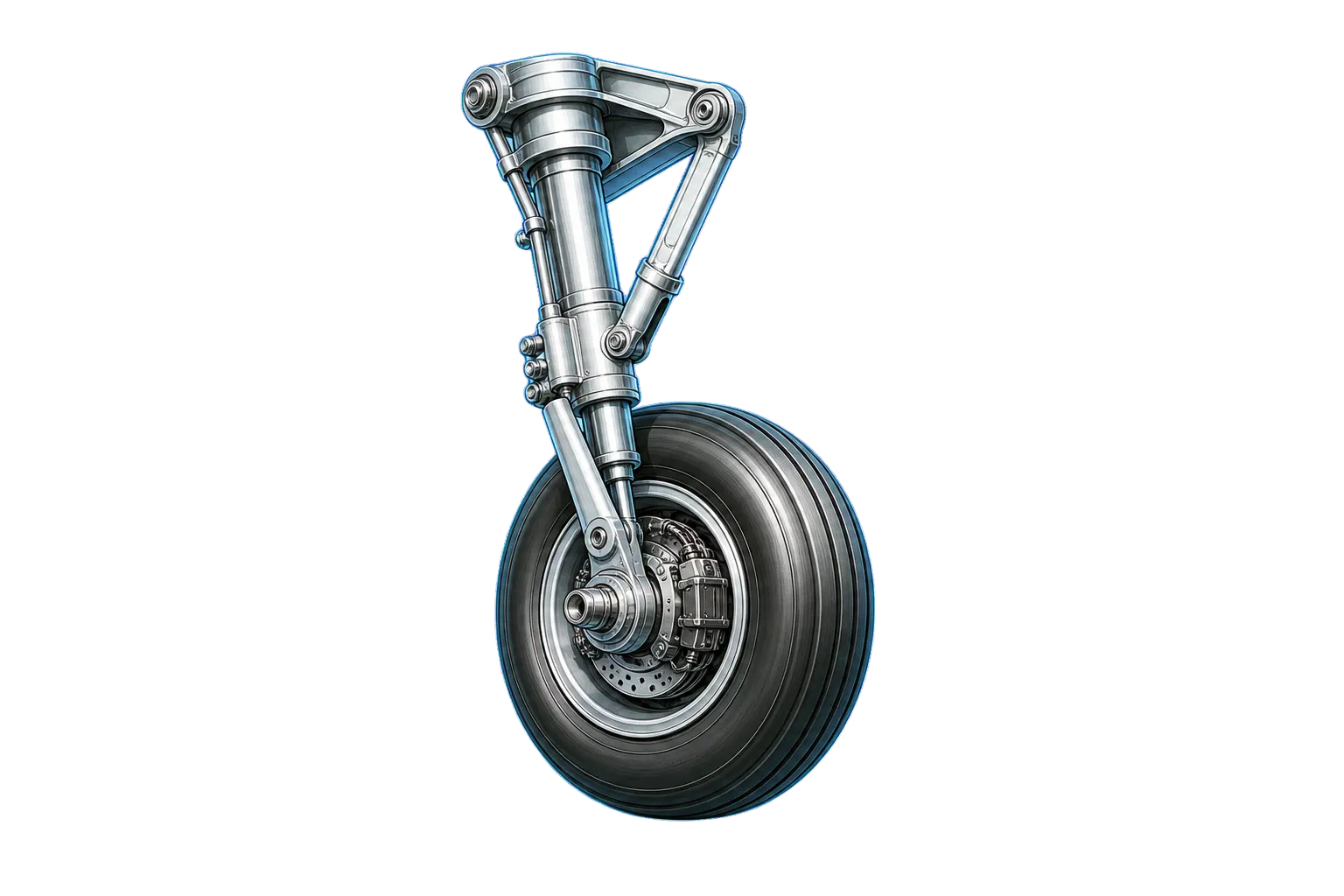
Failure of the MLG piston axle, P/N 49203-3 or 49203-5, resulting from fretting between the inboard axle sleeve and axle thrust face, damage to the protective coating, and consequent stress corrosion.
AI-generated summary from the source AD text. Verify against the official source before acting.
Required Actions
Inspect the MLG piston axles, P/N 49203-3 and 49203-5, for damage and corrosion of the protective coating. Repair as necessary. Repeat inspections as required.
AI-generated summary from the source AD text. Verify against the official source before acting.
Compliance Time
Within 12 months of the effective date.
AI-generated summary from the source AD text. Verify against the official source before acting.
Affected Aircraft
Bombardier, Inc. Model CL-600-2C10 (Regional Jet Series 700, 701, & 702), CL-600-2D15 (Regional Jet Series 705), and CL-600-2D24 (Regional Jet Series 900) airplanes.
AI-generated summary from the source AD text. Verify against the official source before acting.
Federal Register Abstract
We are adopting a new airworthiness directive (AD) for Bombardier, Inc. Model CL-600-2C10 (Regional Jet Series 700, 701, & 702), CL-600-2D15 (Regional Jet Series 705), and CL-600-2D24 (Regional Jet Series 900) airplanes. This AD results from mandatory continuing airworthiness information (MCAI) originated by an aviation authority of another country to identify and correct an unsafe condition on an aviation product. The MCAI describes the unsafe condition as:
Document Text
Show stored source text (verify against official source)
[Federal Register Volume 76, Number 214 (Friday, November 4, 2011)]
[Rules and Regulations]
[Pages 68306-68310]
From the Federal Register Online via the Government Publishing Office [<a href="http://www.gpo.gov">www.gpo.gov</a>]
[FR Doc No: 2011-28360]
-----------------------------------------------------------------------
DEPARTMENT OF TRANSPORTATION
Federal Aviation Administration
14 CFR Part 39
[Docket No. FAA-2011-0031; Directorate Identifier 2010-NM-135-AD;
Amendment 39-16860; AD 2011-23-09]
RIN 2120-AA64
Airworthiness Directives; Bombardier, Inc. Airplanes
AGENCY: Federal Aviation Administration (FAA), Department of
Transportation (DOT).
ACTION: Final rule.
-----------------------------------------------------------------------
SUMMARY: We are adopting a new airworthiness directive (AD) for
Bombardier, Inc. Model CL-600-2C10 (Regional Jet Series 700, 701, &
702), CL-600-2D15 (Regional Jet Series 705),
[[Page 68307]]
and CL-600-2D24 (Regional Jet Series 900) airplanes. This AD results
from mandatory continuing airworthiness information (MCAI) originated
by an aviation authority of another country to identify and correct an
unsafe condition on an aviation product. The MCAI describes the unsafe
condition as:
There have been two reported cases of failure of the MLG [main
landing gear] piston axle, P/N [part number] 49203-3 or 49203-5,
resulting from fretting between the inboard axle sleeve and axle
thrust face, damage to the protective coating and consequent stress
corrosion. In both cases, the MLG did not collapse.
* * * * *
The unsafe condition is failure of the MLG, which could adversely
affect the airplane's safe landing. We are issuing this AD to require
actions to correct the unsafe condition on these products.
DATES: This AD becomes effective December 9, 2011.
The Director of the Federal Register approved the incorporation by
reference of a certain publication listed in this AD as of December 9,
2011.
ADDRESSES: You may examine the AD docket on the Internet at <a href="http://www.regulations.gov">http://www.regulations.gov</a> or in person at the U.S. Department of
Transportation, Docket Operations, M-30, West Building Ground Floor,
Room W12-140, 1200 New Jersey Avenue SE., Washington, DC.
FOR FURTHER INFORMATION CONTACT: Andreas Rambalakos, Aerospace
Engineer, Airframe and Mechanical Systems Branch, ANE-171, FAA, New
York Aircraft Certification Office (ACO), 1600 Stewart Avenue, Suite
410, Westbury, New York 11590; telephone (516) 228-7345; fax (516) 794-
5531.
SUPPLEMENTARY INFORMATION:
Discussion
We issued a notice of proposed rulemaking (NPRM) to amend 14 CFR
part 39 to include an AD that would apply to the specified products.
That NPRM was published in the Federal Register on January 25, 2011 (76
FR 4264). That NPRM proposed to correct an unsafe condition for the
specified products. The MCAI states:
There have been two reported cases of failure of the MLG [main
landing gear] piston axle, P/N [part number] 49203-3 or 49203-5,
resulting from fretting between the inboard axle sleeve and axle
thrust face, damage to the protective coating and consequent stress
corrosion. In both cases, the MLG did not collapse.
In order to avoid future axle failures, which could potentially
result in gear collapse and collateral damage, this [Canadian]
directive mandates repetitive visual inspection [for damage and
corrosion of the protective coating] and repair, as necessary, of
the MLG piston axles, P/N 49203-3 and 49203-5.
The unsafe condition is failure of the MLG, which could adversely
affect the airplane's safe landing. You may obtain further information
by examining the MCAI in the AD docket.
Comments
We gave the public the opportunity to participate in developing
this AD. We considered the comments received.
Request To Include Additional Piston Axle Part Numbers
Comair, Inc. (Comair) requested that we revise paragraph (g) of the
NPRM (76 FR 4264, January 25, 2011) to include MLG piston axles having
P/Ns 49263-1 and 49263-3. Comair explained that it has been in contact
with Goodrich regarding these part numbers. Comair expressed that
Goodrich's response supports what Comair surmised from the Goodrich
component maintenance manual (CMM) for P/N 49000, which was that P/Ns
49263-1 and 49263-3 are a next higher assembly (NHA) part number
consisting of a piston axle with a metering pin assembly installed.
Comair stated that the Goodrich CMM for P/N 49000 uses the following
nomenclature, ``Piston/Axle/Metering Pin Assy (Pre SB 32-45).''
Comair also explained that there have been several instances where
Comair has sent Goodrich Landing Gear Services a piston/axle having P/N
49203-3 for repair. Comair stated that while the piston/axle was at
Goodrich, a metering pin was installed.
Comair expressed that when the piston/axle was returned, the
authorized release certificate (Form One) only contained P/N 49263-1,
and that Form One does not list the part number for the piston/axle and
metering pin, only the higher assembly part number. Comair further
explained that when they received the piston/axle back into stock, the
part number had changed from 49203-3 to 49263-1, during the receiving
process. Comair stated that, consequently, when the piston/axle is
installed on the airplane, it shows that P/N 49263-1 is installed;
therefore, as the NPRM is written, Comair asserted that the NPRM would
not apply by part number. Comair suggested that if P/Ns 49203-3 and
49203-5 exhibit an unsafe condition, then P/Ns 49263-1 and 49263-3
should be considered to have the same fretting concern and the same
unsafe condition.
We agree, for clarification, to include MLG piston axles having P/
Ns 49263-1 and 49263-3, in a note in the final rule. It has also come
to our attention that several operators failed to do the inspection
because the MLG rework paperwork (Form One) from Goodrich only
annotated piston/axle/metering pin assembly NHA having P/N 49263-1 or
49263-3, while the NPRM only proposed to require inspection for MLG
piston axles having P/N 49203-3 or 49203-5. While neither this AD nor
Canadian AD CF-2010-15, dated May 13, 2010, require inspection for MLG
piston axles having P/N 49263-1 or 49263-3, we want to avoid the
possibility of an operator overlooking the intent of this final rule
simply because the operator's overhaul paperwork is the only document
that references the NHA part number. This change has been coordinated
with Transport Canada Civil Aviation. We have revised this final rule
to include new Note 2 to inform operators that MLG piston axles having
P/N 49203-3 or 49203-5 that are installed on the airplane could be
identified as having P/N 49263-1 or 49263-3. We have re-identified
subsequent notes accordingly.
Request To Extend the Proposed Compliance Time
Mesa Airlines (Mesa) requested that we revise the NPRM (76 FR 4264,
January 25, 2011) to extend the proposed compliance time of 12 months
for the initial inspection specified in paragraph (h)(1) of the NPRM to
24 months. Mesa explained that its request is due to the number of
applicable components, the size of its fleet, repair vendor capacity,
and the turn time for the piston axle if needed.
We disagree to extend the compliance time specified in paragraph
(h)(1) of the final rule. In developing an appropriate compliance time
for this action, we considered the urgency associated with the subject
unsafe condition, the availability of required parts, and the practical
aspect of accomplishing the required inspection within a period of time
that corresponds to the normal scheduled maintenance for most affected
operators. According to the manufacturer, an ample number of required
parts will be available to modify the airplanes identified in the
Applicability section of this final rule within the compliance time. In
consideration of these items, we have determined that a 12-month
compliance time for the initial inspection in paragraph (h)(1) of this
final rule is appropriate. However, under the provisions of paragraph
(l) of the final rule, we will consider requests for approval of an
extension of the compliance time if sufficient data are submitted to
substantiate that the new compliance time would provide an
[[Page 68308]]
acceptable level of safety. We have not changed the final rule in this
regard.
Request To Add a Compliance Time for Proposed Terminating Action
In its request to extend the proposed compliance time for the
initial inspection, Mesa added the following statement, ``6,000 hrs. to
terminate.'' Mesa did not provide any explanation for this request.
From this statement, we infer that Mesa requested that we include a
compliance time of 6,000 flight hours after the initial inspection for
the terminating action required by paragraph (j) of the final rule. We
disagree with adding a compliance time to paragraph (j) of the final
rule. Mesa has not provided any justification for this request.
Further, including an additional compliance time would necessitate
additional rulemaking, and we do not consider that delaying this action
until that time is warranted, since the actions required by this AD are
adequate to ensure continued safety of the affected fleet. We have not
changed the final rule in this regard.
Request To Add a Provision for Piston Axles That Require Overhaul
Mesa also requested that we revise the NPRM (76 FR 4264, January
25, 2011) to add a paragraph to paragraph (h) of the NPRM to allow for
a provision for MLG piston axles which are scheduled for overhaul. Mesa
suggested the following wording: ``(4) For any piston axle that has
been in service more than 48 months, of the effective date of this AD
and is due to be overhauled within 36 months of the effective date of
this AD, must be complied with at schedule overhaul.''
We disagree to include a provision for MLG axles which are
scheduled for overhaul. Mesa has not provided any technical
justification for this request. However, affected operators may request
to allow for a provision for MLG piston axles which are scheduled for
overhaul, under the provisions of paragraph (l) of this final rule by
submitting data, substantiating that the change would provide an
acceptable level of safety. We have not changed the final rule in this
regard.
Request To Clarify Paragraph (i) of the NPRM (76 FR 4264, January 25,
2011)
Mesa also requested that we clarify paragraph (i) of the NPRM (76
FR 4264, January 25, 2011). Mesa has not specified what aspect of the
requirement it wants clarified, nor has it provided any reason for this
request.
We agree to clarify paragraph (i) in this comment section of this
final rule. Paragraph (i) of this final rule states the compliance time
for doing the inspections specified in paragraph (h) of this AD for
airplanes that have the mark ``32-45'' in the MOD STATUS field on the
piston axle nameplate, or for airplanes that have done one of the
repair engineering orders listed in the service information in
paragraph (i) of this AD; within the compliance times required in
paragraph (i) of this AD, these airplanes do the inspection and repeat
the inspection as required by paragraph (h) of this AD. We have also
added paragraphs (i)(1), (i)(2), and (i)(3) to the final rule to
clarify the compliance times for paragraph (i).
Clarification
We have revised paragraph (g) of this final rule to clarify that
the compliance times for doing the inspection required by paragraph (g)
of this final rule are the same as the applicable compliance times
specified in paragraphs (h) and (i) of this final rule.
We have also added Note 3 to this final rule to clarify that the
MCAI specifies to inspect only airplanes having certain serial numbers
that are part of the MCAI applicability. Because the affected part
could be rotated onto any of the airplanes listed in the applicability,
this AD requires the inspection be done on all airplanes.
Conclusion
We reviewed the available data, including the comments received,
and determined that air safety and the public interest require adopting
the AD with the change described previously. We determined that this
change will not increase the economic burden on any operator or
increase the scope of the AD.
Differences Between This AD and the MCAI or Service Information
We have reviewed the MCAI and related service information and, in
general, agree with their substance. But we might have found it
necessary to use different words from those in the MCAI to ensure the
AD is clear for U.S. operators and is enforceable. In making these
changes, we do not intend to differ substantively from the information
provided in the MCAI and related service information.
We might also have required different actions in this AD from those
in the MCAI in order to follow our FAA policies. Any such differences
are highlighted in a NOTE within the AD.
Costs of Compliance
We estimate that this AD will affect 380 products of U.S. registry.
We also estimate that it will take about 22 work-hours per product to
comply with the basic requirements of this AD. The average labor rate
is $85 per work-hour. Based on these figures, we estimate the cost of
this AD to the U.S. operators to be $710,600, or $1,870 per product.
Authority for This Rulemaking
Title 49 of the United States Code specifies the FAA's authority to
issue rules on aviation safety. Subtitle I, section 106, describes the
authority of the FAA Administrator. ``Subtitle VII: Aviation
Programs,'' describes in more detail the scope of the Agency's
authority.
We are issuing this rulemaking under the authority described in
``Subtitle VII, Part A, Subpart III, Section 44701: General
requirements.'' Under that section, Congress charges the FAA with
promoting safe flight of civil aircraft in air commerce by prescribing
regulations for practices, methods, and procedures the Administrator
finds necessary for safety in air commerce. This regulation is within
the scope of that authority because it addresses an unsafe condition
that is likely to exist or develop on products identified in this
rulemaking action.
Regulatory Findings
We determined that this AD will not have federalism implications
under Executive Order 13132. This AD will not have a substantial direct
effect on the States, on the relationship between the national
government and the States, or on the distribution of power and
responsibilities among the various levels of government.
For the reasons discussed above, I certify this AD:
1. Is not a ``significant regulatory action'' under Executive Order
12866;
2. Is not a ``significant rule'' under the DOT Regulatory Policies
and Procedures (44 FR 11034, February 26, 1979); and
3. Will not have a significant economic impact, positive or
negative, on a substantial number of small entities under the criteria
of the Regulatory Flexibility Act.
We prepared a regulatory evaluation of the estimated costs to
comply with this AD and placed it in the AD docket.
Examining the AD Docket
You may examine the AD docket on the Internet at <a href="http://www.regulations.gov">http://www.regulations.gov</a>; or in person at the Docket Operations office
between 9 a.m. and 5 p.m., Monday through Friday, except Federal
holidays. The AD docket contains the NPRM (76 FR 4264, January 25,
2011), the regulatory evaluation, any comments received, and other
information. The street address for
[[Page 68309]]
the Docket Operations office (telephone (800) 647-5527) is in the
ADDRESSES section. Comments will be available in the AD docket shortly
after receipt.
List of Subjects in 14 CFR Part 39
Air transportation, Aircraft, Aviation safety, Incorporation by
reference, Safety.
Adoption of the Amendment
Accordingly, under the authority delegated to me by the
Administrator, the FAA amends 14 CFR part 39 as follows:
PART 39--AIRWORTHINESS DIRECTIVES
0
1. The authority citation for part 39 continues to read as follows:
Authority: 49 U.S.C. 106(g), 40113, 44701.
Sec. 39.13 [Amended]
0
2. The FAA amends Sec. 39.13 by adding the following new AD:
2011-23-09 Bombardier, Inc.: Amendment 39-16860. Docket No. FAA-
2011-0031; Directorate Identifier 2010-NM-135-AD.
Effective Date
(a) This airworthiness directive (AD) becomes effective December
9, 2011.
Affected ADs
(b) None.
Applicability
(c) This AD applies to all Bombardier, Inc. Model CL-600-2C10
(Regional Jet Series 700, 701 & 702), CL-600-2D15 (Regional Jet
Series 705), and CL-600-2D24 (Regional Jet Series 900) airplanes;
certificated in any category.
Note 1: This AD is not applicable to piston axles having part
number (P/N) 49203-7 or P/N 49203-9, which were installed in
production on Bombardier, Inc. Model CL-600-2C10 airplanes having
serial numbers (S/Ns) 10266 and subsequent; and Models CL-600-2D15
and CL-600-2D24 airplanes having S/Ns 15155 and subsequent.
Subject
(d) Air Transport Association (ATA) of America Code 32: Landing
Gear.
Reason
(e) The mandatory continuing airworthiness information (MCAI)
states:
There have been two reported cases of failure of the MLG [main
landing gear] piston axle, P/N 49203-3 or 49203-5, resulting from
fretting between the inboard axle sleeve and axle thrust face,
damage to the protective coating and consequent stress corrosion. In
both cases, the MLG did not collapse.
* * * * *
The unsafe condition is failure of the MLG, which could
adversely affect the airplane's safe landing.
Compliance
(f) You are responsible for having the actions required by this
AD performed within the compliance times specified, unless the
actions have already been done.
Inspection and Repair
(g) At the applicable time in paragraph (h)(1), (h)(2), (h)(3)
or (i) of this AD, inspect to determine whether the airplane has a
main landing gear piston axle having P/N 49203-3 or 49203-5. A
review of airplane maintenance records is acceptable in lieu of this
inspection if the part number of the main landing gear piston axle
can be conclusively determined from that review.
Note 2: Operators should be aware that the Goodrich authorized
release certificate (Form One) provided for MLG piston axles
following overhaul, refers to only the higher assembly P/N 49263-1
or 49263-3; therefore, it is possible that MLG piston axles having
P/N 49203-3 or 49203-5 that are installed on the airplane could be
identified as having P/N 49263-1 or 49263-3.
(h) Except as required by paragraph (i) of this AD, if, during
the inspection required by paragraph (g) of this AD, the landing
gear piston axle is determined to have P/N 49203-3 or 49203-5: At
the applicable time specified in paragraph (h)(1), (h)(2), or (h)(3)
of this AD, do a detailed inspection for corrosion and damage of the
inboard and outboard piston axles, in accordance with the
Accomplishment Instructions of Bombardier Service Bulletin 670BA-32-
023, Revision C, dated January 29, 2009. Before further flight,
repair any corrosion or damage found, in accordance with the
Accomplishment Instructions of Bombardier Service Bulletin 670BA-32-
023, Revision C, dated January 29, 2009. Within 30 months after the
initial inspection, or within 12 months after the effective date of
this AD, whichever occurs later, do the inspection specified in this
paragraph; and repeat the inspection thereafter at intervals not to
exceed 30 months.
(1) For any piston axle that has been in service for 48 months
or more as of the effective date of this AD: Inspect within 12
months after the effective date of this AD.
(2) For any piston axle that has been in service for 24 months
or more, but less than 48 months, as of the effective date of this
AD: Inspect within 24 months after the effective date of this AD.
(3) For any piston axle that has been in service for less than
24 months as of the effective date of this AD: Inspect within 36
months after the effective date of this AD.
(i) For airplanes that have mark ``32-45'' in the MOD STATUS
field of the piston axle nameplate or that have incorporated one of
the Bombardier repair engineering orders listed in paragraph 1.D. of
Bombardier Service Bulletin 670BA-32-023, Revision C, dated January
29, 2009: At the latest of the applicable times specified in
paragraphs (i)(1), (i)(2), and (i)(3) of this AD, do the inspection
specified in paragraph (h) of this AD and repeat the inspection
thereafter at the time specified in paragraph (h) of this AD:
(1) Within 30 months after marking ``32-45'' in the MOD STATUS
field of the piston axle nameplate.
(2) Within 30 months after incorporating one of the Bombardier
repair engineering orders listed in paragraph 1.D. of Bombardier
Service Bulletin 670BA-32-023, Revision C, dated January 29, 2009.
(3) Within 12 months after the effective date of this AD.
Terminating Action
(j) Installing a piston axle having P/N 49203-7 or P/N 49203-9
on any airplane constitutes a terminating action for the
requirements of paragraphs (h), (h)(1), (h)(2), and (h)(3) of this
AD, for that airplane.
Credit for Actions Accomplished in Accordance With Previous Service
Information
(k) Inspections and repairs accomplished before the effective
date of this AD according to any service bulletin specified in table
1 of this AD, are considered acceptable for compliance with the
corresponding inspections and repairs specified in paragraph (h) of
this AD.
Table 1--Credit for Accomplishment of Previous Service Information
----------------------------------------------------------------------------------------------------------------
Document Revision Date
----------------------------------------------------------------------------------------------------------------
Bombardier Service Bulletin 670BA-32- Original............................ October 24, 2007.
023.
Bombardier Service Bulletin 670BA-32- A................................... January 7, 2008.
023.
Bombardier Service Bulletin 670BA-32- B................................... March 5, 2008.
023.
----------------------------------------------------------------------------------------------------------------
FAA AD Differences
Note 3: This AD differs from the MCAI and/or service information
as follows: The MCAI specifies to inspect only airplanes having
certain serial numbers that are part of the MCAI applicability.
Because the affected part could be rotated onto any of the airplanes
listed in the applicability, this AD requires the inspection be done
on all airplanes.
Other FAA AD Provisions
(l) The following provisions also apply to this AD:
(1) Alternative Methods of Compliance (AMOCs): The Manager, New
York Aircraft Certification Office (ACO), ANE-170, FAA,
[[Page 68310]]
has the authority to approve AMOCs for this AD, if requested using
the procedures found in 14 CFR 39.19. In accordance with 14 CFR
39.19, send your request to your principal inspector or local Flight
Standards District Office, as appropriate. If sending information
directly to the ACO, send it to ATTN: Program Manager, Continuing
Operational Safety, FAA, New York ACO, 1600 Stewart Avenue, Suite
410, Westbury, New York, 11590; telephone (516) 228-7300; fax (516)
794-5531. Before using any approved AMOC, notify your appropriate
principal inspector, or lacking a principal inspector, the manager
of the local flight standards district office/certificate holding
district office. The AMOC approval letter must specifically
reference this AD.
(2) Airworthy Product: For any requirement in this AD to obtain
corrective actions from a manufacturer or other source, use these
actions if they are FAA-approved. Corrective actions are considered
FAA-approved if they are approved by the State of Design Authority
(or their delegated agent). You are required to assure the product
is airworthy before it is returned to service.
Related Information
(m) Refer to MCAI Canadian Airworthiness Directive CF-2010-15,
dated May 13, 2010; and Bombardier Service Bulletin 670BA-32-023,
Revision C, dated January 29, 2009; for related information.
Material Incorporated by Reference
(n) You must use Bombardier Service Bulletin 670BA-32-023,
Revision C, dated January 29, 2009, including Appendix A, Revision
B, dated March 5, 2008, to do the actions required by this AD,
unless the AD specifies otherwise.
(1) The Director of the Federal Register approved the
incorporation by reference of this service information under 5
U.S.C. 552(a) and 1 CFR part 51.
(2) For service information identified in this AD, contact
Bombardier, Inc., 400 C[ocirc]te-Vertu Road West, Dorval,
Qu[eacute]bec H4S 1Y9, Canada; telephone (514) 855-5000; fax (514)
855-7401; email <a href="/cdn-cgi/l/email-protection#34405c501a57465e745551465b1a565b59565546505d51461a575b59"><span class="__cf_email__" data-cfemail="e0948884ce83928aa08185928fce828f8d82819284898592ce838f8d">[email protected]</span></a>; Internet <a href="http://www.bombardier.com">http://www.bombardier.com</a>.
(3) You may review copies of the service information at the FAA,
Transport Airplane Directorate, 1601 Lind Avenue SW., Renton,
Washington. For information on the availability of this material at
the FAA, call (425) 227-1221.
(4) You may also review copies of the service information that
is incorporated by reference at the National Archives and Records
Administration (NARA). For information on the availability of this
material at NARA, call (202) 741-6030, or go to: <a href="http://www.archives.gov/federal_register/code_of_federal_regulations/ibr_locations.html">http://www.archives.gov/federal_register/code_of_federal_regulations/ibr_locations.html</a>.
Issued in Renton, Washington, on October 21, 2011.
Kalene C. Yanamura,
Acting Manager, Transport Airplane Directorate, Aircraft Certification
Service.
[FR Doc. 2011-28360 Filed 11-3-11; 8:45 am]
BILLING CODE 4910-13-P
Source: Official FAA Source ↗
Retrieved: Apr 6, 2026
Rights: U.S. Government Public Domain
This site is not affiliated with or endorsed by the FAA. Always verify with official sources.
Related Airworthiness Directives
2023-10-02
final ruleAirworthiness Directives; Transport and Commuter Category Airplanes
Unsafe Condition: Radio altimeter anomalies that are undetected by the automation or pilot, particularly close to the ground (e.g., landing flare), could lead to loss of continued safe flight and landing. Additional...
2022-15-08
final ruleAirworthiness Directives; Various Transport Airplanes
Unsafe Condition: Smoke and fumes in the flight deck, which could result in excessive flightcrew workload and injury to flight deck occupants.
2020-08-13
final ruleAirworthiness Directives; Bombardier, Inc. Airplanes
Unsafe Condition: Fractures of the rudder primary feel unit shaft, which could result in a loss of feel in the yaw axis and thereby impact the controllability of the airplane.
2020-03-17 Recurring
final ruleAirworthiness Directives; Bombardier, Inc., Airplanes
Unsafe Condition: damaged or detached window louver panel assemblies (WLPAs) and blowout panels (BOPs), which could delay smoke detection in the cargo compartment in the event of a fire and result in an uncontrolled...