AD 2010-25-06
Applicability
| Type | Manufacturer | Model | Details |
|---|---|---|---|
| aircraft | Boeing | 737-200 | Airworthiness Directives; The Boeing Company Model 737-200, -300, -400, and -500 Series Airplanes |
Unsafe Condition
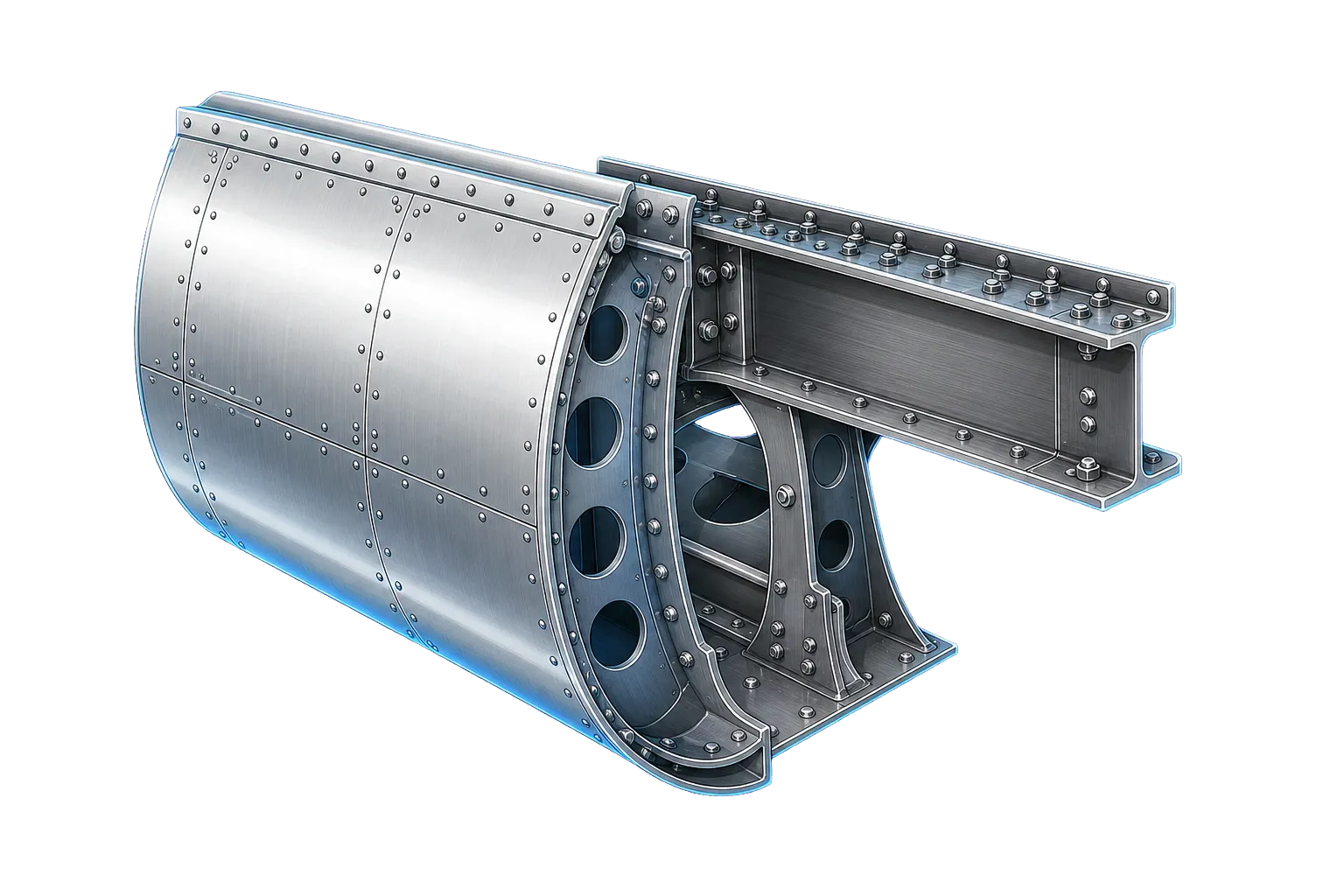
Fatigue cracks at certain frame sections and stub beam cracking caused by high flight cycle stresses from both pressurization and maneuver loads, which could result in reduced structural integrity of the frames and accelerated skin crack growth, potentially leading to rapid decompression of the fuselage.
AI-generated summary from the source AD text. Verify against the official source before acting.
Required Actions
Conduct repetitive inspections for cracking of certain fuselage frames and stub beams, and perform corrective actions if necessary. Optional repair is available to terminate repetitive inspections. For airplanes with a certain repair, continue repetitive inspections and corrective actions as necessary.
AI-generated summary from the source AD text. Verify against the official source before acting.
Compliance Time
Within 4,500 flight cycles after the effective date of the AD or within 9,000 flight cycles after the previous inspection done in accordance with Boeing Alert Service Bulletin 737-53A1254.
AI-generated summary from the source AD text. Verify against the official source before acting.
Affected Aircraft
The Boeing Company Model 737-200, -300, -400, and -500 series airplanes.
AI-generated summary from the source AD text. Verify against the official source before acting.
Federal Register Abstract
We are adopting a new airworthiness directive (AD) for certain Model 737-200, -300, -400, and -500 series airplanes. This AD requires repetitive inspections for cracking of certain fuselage frames and stub beams, and corrective actions if necessary. This AD also provides for an optional repair, which would terminate the repetitive inspections. For airplanes on which a certain repair is done, this AD also requires repetitive inspections for cracking of certain fuselage frames and stub beams, and corrective actions if necessary. This AD results from reports of the detection of fatigue cracks at certain frame sections, in addition to stub beam cracking, caused by high flight cycle stresses from both pressurization and maneuver loads. We are issuing this AD to detect and correct fatigue cracking of certain fuselage frames and stub beams and possible severed frames, which could result in reduced structural integrity of the frames. This reduced structural integrity can increase loading in the fuselage skin, which will accelerate skin crack growth and could result in rapid decompression of the fuselage.
Document Text
Show stored source text (verify against official source)
[Federal Register Volume 75, Number 248 (Tuesday, December 28, 2010)]
[Rules and Regulations]
[Pages 81409-81412]
From the Federal Register Online via the Government Publishing Office [<a href="http://www.gpo.gov">www.gpo.gov</a>]
[FR Doc No: 2010-32354]
=======================================================================
-----------------------------------------------------------------------
DEPARTMENT OF TRANSPORTATION
Federal Aviation Administration
14 CFR Part 39
[Docket No. FAA-2010-0437; Directorate Identifier 2009-NM-130-AD;
Amendment 39-16539; AD 2010-25-06]
RIN 2120-AA64
Airworthiness Directives; The Boeing Company Model 737-200, -300,
-400, and -500 Series Airplanes
AGENCY: Federal Aviation Administration (FAA), DOT.
ACTION: Final rule.
-----------------------------------------------------------------------
SUMMARY: We are adopting a new airworthiness directive (AD) for certain
Model 737-200, -300, -400, and -500 series airplanes. This AD requires
repetitive inspections for cracking of certain fuselage frames and stub
beams, and corrective actions if necessary. This AD also provides for
an optional repair, which would terminate the repetitive inspections.
For airplanes on which a certain repair is done, this AD also requires
repetitive inspections for cracking of certain fuselage frames and stub
beams, and corrective actions if necessary. This AD results from
reports of the detection of fatigue cracks at certain frame sections,
in addition to stub beam cracking, caused by high flight cycle stresses
from both pressurization and maneuver loads. We are issuing this AD to
detect and correct fatigue cracking of certain fuselage frames and stub
beams and possible
[[Page 81410]]
severed frames, which could result in reduced structural integrity of
the frames. This reduced structural integrity can increase loading in
the fuselage skin, which will accelerate skin crack growth and could
result in rapid decompression of the fuselage.
DATES: This AD is effective February 1, 2011.
The Director of the Federal Register approved the incorporation by
reference of a certain publication listed in the AD as of February 1,
2011.
ADDRESSES: For service information identified in this AD, contact
Boeing Commercial Airplanes, Attention: Data & Services Management, P.
O. Box 3707, MC 2H-65, Seattle, Washington 98124-2207; telephone 206-
544-5000, extension 1; fax 206-766-5680; e-mail <a href="/cdn-cgi/l/email-protection#2f424a014d404a4c40426f4d404a464148014c4042"><span class="__cf_email__" data-cfemail="325f571c505d57515d5f72505d575b5c551c515d5f">[email protected]</span></a>;
Internet <a href="https://www.myboeingfleet.com">https://www.myboeingfleet.com</a>.
Examining the AD Docket
You may examine the AD docket on the Internet at <a href="http://www.regulations.gov">http://www.regulations.gov</a>; or in person at the Docket Management Facility
between 9 a.m. and 5 p.m., Monday through Friday, except Federal
holidays. The AD docket contains this AD, the regulatory evaluation,
any comments received, and other information. The address for the
Docket Office (telephone 800-647-5527) is the Document Management
Facility, U.S. Department of Transportation, Docket Operations, M-30,
West Building Ground Floor, Room W12-140, 1200 New Jersey Avenue, SE.,
Washington, DC 20590.
FOR FURTHER INFORMATION CONTACT: Wayne Lockett, Aerospace Engineer,
Airframe Branch, ANM-120S, FAA, Seattle Aircraft Certification Office,
1601 Lind Avenue, SW., Renton, Washington 98057-3356; telephone (425)
917-6447; fax (425) 917-6590.
SUPPLEMENTARY INFORMATION:
Discussion
We issued a notice of proposed rulemaking (NPRM) to amend 14 CFR
part 39 to include an airworthiness directive (AD) that would apply to
certain Model 737-200, -300, -400, and -500 series airplanes. That NPRM
was published in the Federal Register on May 7, 2010 (75 FR 25124).
That NPRM proposed to require repetitive inspections for cracking of
certain fuselage frames and stub beams, and corrective actions if
necessary. That NPRM also proposed an optional repair, which would
terminate the repetitive inspections. For airplanes on which a certain
repair is done, that NPRM also proposed to require repetitive
inspections for cracking of certain fuselage frames and stub beams, and
corrective actions if necessary.
Comments
We gave the public the opportunity to participate in developing
this AD. We considered the comments received.
Request To Change Paragraph (i)
Boeing asked that paragraph (i) of the NPRM be changed to include a
high frequency eddy current (HFEC) inspection. Boeing stated that
Boeing Alert Service Bulletin 737-53A1254, Revision 1, dated July 9,
2009, provides two options for inspections: detailed and HFEC. Boeing
added that for areas where the repair hinders the inspection, both
detailed and HFEC inspection options were provided, depending on which
option was chosen for the original inspection.
We agree with the commenter for the reasons provided. We have
changed paragraph (i) of this AD to include an option for the HFEC
inspection.
Request To Change Compliance Time
Boeing also asked that the compliance time specified in paragraph
(g)(3) of the NPRM be changed to ``the sooner of (i) within 4,500
flight cycles after the effective date of the AD or (ii) within 9,000
flight cycles after the previous inspection done in accordance with
Boeing Alert Service Bulletin 737-53A1254, dated February 17, 2005.''
Boeing stated that new data indicate that the repeat interval for the
area below the floor should be changed to 9,000 flight cycles from
4,500 flight cycles. Boeing added that for airplanes on which the
inspection in the original issue of Boeing Alert Service Bulletin 737-
53A1254 has been done, the compliance time as written in Boeing Alert
Service Bulletin 737-53A1254, Revision 1 (i.e., 3,000 flight cycles
from release of Revision 1 or 4,500 flight cycles from previous
inspection, whichever is sooner), could cause a significant impact by
putting some airplanes out of compliance. Boeing noted that the NPRM
could potentially allow a longer compliance time than that in the
original issue of the service bulletin. Boeing recommends that
paragraph (g)(3) be changed as specified previously.
We acknowledge the commenter's concern and provide the following.
The compliance times required by paragraph (g) are at the ``later of,''
not the ``sooner of,'' the compliance times specified in paragraphs
(g)(3)(i) and (g)(3)(ii). We agree that the compliance times specified
in paragraphs (g)(3)(i) and (g)(3)(ii) of this AD are somewhat
confusing and can be clarified. Therefore, we have combined paragraphs
(g)(3)(i) and (g)(3)(ii) with paragraph (g)(3) to provide that
clarification.
Request To Change Initial Inspection Threshold
Southwest Airlines asked that the initial inspection threshold
required by paragraphs (g)(1) and (g)(2) of the NPRM be changed.
Southwest stated that the specified threshold will pose a significant
burden on its airline to complete the inspections within the required
timeframe. Southwest projected that half of its Model 737-300 and -500
fleet will require an out-of-sequence maintenance visit to support this
inspection threshold. Southwest added that this is based on its current
substantial maintenance schedule, fleet utilization, and the proposed
compliance thresholds based on each airplane's total flight cycles.
We do not agree with the commenter's request. No supporting data
were submitted proposing alternative inspection thresholds to maintain
an adequate level of safety for its fleet. However, under the
provisions of paragraph (m) of this AD, we will consider requests for
approval of an alternative inspection threshold if sufficient data are
submitted to substantiate that changing the initial inspection
threshold would provide an acceptable level of safety. We have not
changed the AD in this regard.
Conclusion
We reviewed the relevant data, considered the comments received,
and determined that air safety and the public interest require adopting
the AD with the changes described previously. We also determined that
these changes will not increase the economic burden on any operator or
increase the scope of the AD.
Costs of Compliance
We estimate that this AD affects 635 airplanes of U.S. registry.
The following table provides the estimated costs for U.S. operators to
comply with this AD.
[[Page 81411]]
Table--Estimated Costs
----------------------------------------------------------------------------------------------------------------
Average Number of
Work labor U.S.-
Action hours rate per Cost per product registered Fleet cost
hour airplanes
----------------------------------------------------------------------------------------------------------------
BS 616 and BS 639 inspection/lower 15 $85 $1,275 per 635 $809,625 per
frame and stub beam. inspection cycle. inspection cycle.
----------------------------------------------------------------------------------------------------------------
Authority for This Rulemaking
Title 49 of the United States Code specifies the FAA's authority to
issue rules on aviation safety. Subtitle I, section 106, describes the
authority of the FAA Administrator. ``Subtitle VII: Aviation
Programs,'' describes in more detail the scope of the Agency's
authority.
We are issuing this rulemaking under the authority described in
``Subtitle VII, Part A, Subpart III, Section 44701: General
requirements.'' Under that section, Congress charges the FAA with
promoting safe flight of civil aircraft in air commerce by prescribing
regulations for practices, methods, and procedures the Administrator
finds necessary for safety in air commerce. This regulation is within
the scope of that authority because it addresses an unsafe condition
that is likely to exist or develop on products identified in this
rulemaking action.
Regulatory Findings
This AD will not have federalism implications under Executive Order
13132. This AD will not have a substantial direct effect on the States,
on the relationship between the national government and the States, or
on the distribution of power and responsibilities among the various
levels of government.
For the reasons discussed above, I certify that this AD:
(1) Is not a ``significant regulatory action'' under Executive
Order 12866,
(2) Is not a ``significant rule'' under DOT Regulatory Policies and
Procedures (44 FR 11034, February 26, 1979), and
(3) Will not have a significant economic impact, positive or
negative, on a substantial number of small entities under the criteria
of the Regulatory Flexibility Act.
You can find our regulatory evaluation and the estimated costs of
compliance in the AD Docket.
List of Subjects in 14 CFR Part 39
Air transportation, Aircraft, Aviation safety, Incorporation by
reference, Safety.
Adoption of the Amendment
0
Accordingly, under the authority delegated to me by the Administrator,
the FAA amends 14 CFR part 39 as follows:
PART 39--AIRWORTHINESS DIRECTIVES
0
1. The authority citation for part 39 continues to read as follows:
Authority: 49 U.S.C. 106(g), 40113, 44701.
Sec. 39.13 [Amended]
0
2. The FAA amends Sec. 39.13 by adding the following new AD:
2010-25-06 The Boeing Company: Amendment 39-16539. Docket No. FAA-
2010-0437; Directorate Identifier 2009-NM-130-AD.
Effective Date
(a) This airworthiness directive (AD) is effective February 1,
2011.
Affected ADs
(b) None.
Applicability
(c) This AD applies to The Boeing Company Model 737-200, -300, -
400, and -500 series airplanes, certificated in any category; as
identified in Boeing Alert Service Bulletin 737-53A1254, Revision 1,
dated July 9, 2009.
Subject
(d) Air Transport Association (ATA) of America Code 53:
Fuselage.
Unsafe Condition
(e) This AD results from the detection of fatigue cracks at
certain frame sections, in addition to stub beam cracking, caused by
high flight cycle stresses from both pressurization and maneuver
loads. The Federal Aviation Administration is issuing this AD to
detect and correct fatigue cracking of certain fuselage frames and
stub beams and possible severed frames, which could result in
reduced structural integrity of the frames. This reduced structural
integrity can increase loading in the fuselage skin, which will
accelerate skin crack growth and could result in rapid decompression
of the fuselage.
Compliance
(f) You are responsible for having the actions required by this
AD performed within the compliance times specified, unless the
actions have already been done.
Repetitive Inspections and Corrective Actions
(g) At the applicable time specified in paragraph (g)(1),
(g)(2), or (g)(3) of this AD: Do a detailed or high frequency eddy
current (HFEC) inspection for cracking of body station (BS) 616 and
BS 639 frame webs, inner chord, and outer chord, and the stub beams;
and do all applicable related investigative and corrective actions;
by accomplishing all the actions specified in Part 1 of the
Accomplishment Instructions of Boeing Alert Service Bulletin 737-
53A1254, Revision 1, dated July 9, 2009, except as specified in
paragraphs (i) and (j) of this AD. Do all applicable related
investigative and corrective actions before further flight.
Thereafter, repeat the inspection at intervals not to exceed 4,500
flight cycles since accomplishing the detailed inspection or at
intervals not to exceed 9,000 flight cycles since accomplishing the
HFEC inspection, as applicable.
(1) For airplanes on which no inspection of the BS 616 and BS
639 frames specified in Boeing Alert Service Bulletin 737-53A1254,
dated February 17, 2005, has been done as of the effective date of
this AD, and that have accumulated fewer than 55,000 total flight
cycles as of the effective date of this AD: Inspect within 3,000
flight cycles after the effective date of this AD, or before the
accumulation of 56,500 total flight cycles, whichever occurs first.
(2) For airplanes on which no inspection of the BS 616 and BS
639 frames specified in Boeing Alert Service Bulletin 737-53A1254,
dated February 17, 2005, has been done as of the effective date of
this AD, and that have accumulated 55,000 or more total flight
cycles as of the effective date of this AD: Inspect within 1,500
flight cycles after the effective date of this AD.
(3) For airplanes on which a detailed or HFEC inspection of the
BS 616 and BS 639 frames, specified in Boeing Alert Service Bulletin
737-53A1254, dated February 17, 2005, has been done as of the
effective date of this AD: Inspect within 4,500 flight cycles after
the previous inspection done in accordance with Boeing Alert Service
Bulletin 737-53A1254, dated February 17, 2005, or within 3,000
flight cycles after the effective date of this AD, whichever occurs
later.
Post-Repair Repetitive Inspections and Corrective Actions
(h) For airplanes on which the repair specified in Part 4 of the
Accomplishment Instructions of Boeing Alert Service Bulletin 737-
53A1254, Revision 1, dated July 9, 2009, has been done: At the
applicable time specified in paragraphs (h)(1) and (h)(2) of this
AD, do a detailed or HFEC inspection for
[[Page 81412]]
cracking of the replacement frame section (frame webs, inner chord,
and outer chord); and do all applicable related investigative and
corrective actions; by accomplishing all the actions specified in
Part 1 of the Accomplishment Instructions of Boeing Alert Service
Bulletin 737-53A1254, Revision 1, dated July 9, 2009, except as
specified in paragraphs (i) and (j) of this AD. Do all applicable
related investigative and corrective actions before further flight.
Thereafter, repeat the inspection at intervals not to exceed 4,500
flight cycles since accomplishing the detailed inspection or at
intervals not to exceed 9,000 flight cycles since accomplishing the
HFEC inspection, as applicable.
(1) For airplanes on which a partial frame splice repair at BS
616 or BS 639 has been done, and the inner chord and web have been
cold-worked: Inspect within 44,000 flight cycles after the repair
has been done.
(2) For airplanes on which a partial frame splice repair at BS
616 or BS 639 has been done, and the inner chord and web have not
been cold-worked: Inspect within 29,000 flight cycles after that
repair has been done.
Alternative Inspection of Repaired or Modified Area
(i) For airplanes on which a repair or preventative modification
exists on the inner chord below the floor which prevents the
accomplishment of the detailed or HFEC inspection in that area as
required by paragraph (g) of this AD: In lieu of inspecting that
area, do a detailed or HFEC inspection of the inner chord along the
length of the repair and around the fastener heads in accordance
with Part 1 of the Accomplishment Instructions of Boeing Alert
Service Bulletin 737-53A1254, Revision 1, dated July 9, 2009.
Exceptions to Service Information
(j) Where Boeing Alert Service Bulletin 737-53A1254, Revision 1,
dated July 9, 2009, specifies to contact Boeing for repair
instructions and repair: Before further flight, repair the cracking
using a method approved in accordance with the procedures specified
in paragraph (m) of this AD.
(k) Although Boeing Alert Service Bulletin 737-53A1254, Revision
1, dated July 9, 2009, specifies to submit information to the
manufacturer, this AD does not include that requirement.
Terminating Action
(l) Doing the repair specified in Part 4 of Boeing Alert Service
Bulletin 737-53A1254, Revision 1, dated July 9, 2009, terminates the
repetitive inspection requirements of paragraph (g) of this AD for
the repaired frame only.
Alternative Methods of Compliance (AMOCs)
(m)(1) The Manager, Seattle Aircraft Certification Office (ACO),
FAA, has the authority to approve AMOCs for this AD, if requested
using the procedures found in 14 CFR 39.19. Send information to
ATTN: Wayne Lockett, Aerospace Engineer, Airframe Branch, ANM-120S,
FAA, Seattle Aircraft Certification Office, 1601 Lind Avenue, SW.,
Renton, Washington 98057-3356; telephone (425) 917-6447; fax (425)
917-6590. Or, e-mail information to <a href="/cdn-cgi/l/email-protection#3f06127e7172126c5a5e4b4b535a127e7c70127e72707c126d5a4e4a5a4c4b4c7f595e5e11585049"><span class="__cf_email__" data-cfemail="e6dfcba7a8abcbb5838792928a83cba7a5a9cba7aba9a5cbb483979383959295a6808787c8818990">[email protected]</span></a>.
(2) To request a different method of compliance or a different
compliance time for this AD, follow the procedures in 14 CFR 39.19.
Before using any approved AMOC on any airplane to which the AMOC
applies, notify your principal maintenance inspector (PMI) or
principal avionics inspector (PAI), as appropriate, or lacking a
principal inspector, your local Flight Standards District Office.
The AMOC approval letter must specifically reference this AD.
(3) An AMOC that provides an acceptable level of safety may be
used for any repair required by this AD, if it is approved by an
Authorized Representative for the Boeing Commercial Airplanes
Organization Designation Authorization (ODA) that has been
authorized by the Manager, Seattle ACO, to make those findings. For
a repair method to be approved, the repair must meet the
certification basis of the airplane.
Material Incorporated by Reference
(n) You must use Boeing Alert Service Bulletin 737-53A1254,
Revision 1, dated July 9, 2009, to do the actions required by this
AD, unless the AD specifies otherwise.
(1) The Director of the Federal Register approved the
incorporation by reference of this service information under 5
U.S.C. 552(a) and 1 CFR part 51.
(2) For service information identified in this AD, contact
Boeing Commercial Airplanes, Attention: Data & Services Management,
P. O. Box 3707, MC 2H-65, Seattle, Washington 98124-2207; telephone
206-544-5000, extension 1; fax 206-766-5680; e-mail
<a href="/cdn-cgi/l/email-protection#d0bdb5feb2bfb5b3bfbd90b2bfb5b9beb7feb3bfbd"><span class="__cf_email__" data-cfemail="e48981ca868b81878b89a4868b818d8a83ca878b89">[email protected]</span></a>; Internet <a href="https://www.myboeingfleet.com">https://www.myboeingfleet.com</a>.
(3) You may review copies of the service information at the FAA,
Transport Airplane Directorate, 1601 Lind Avenue, SW., Renton,
Washington. For information on the availability of this material at
the FAA, call 425-227-1221.
(4) You may also review copies of the service information that
is incorporated by reference at the National Archives and Records
Administration (NARA). For information on the availability of this
material at NARA, call 202-741-6030, or go to: <a href="http://www.archives.gov/federal_register/code_of_federal_regulations/ibr_locations.html">http://www.archives.gov/federal_register/code_of_federal_regulations/ibr_locations.html</a>.
Issued in Renton, Washington on December 16, 2010.
Ali Bahrami,
Manager, Transport Airplane Directorate, Aircraft Certification
Service.
[FR Doc. 2010-32354 Filed 12-27-10; 8:45 am]
BILLING CODE 4910-13-P
Source: Official FAA Source ↗
Retrieved: Apr 6, 2026
Rights: U.S. Government Public Domain
This site is not affiliated with or endorsed by the FAA. Always verify with official sources.
Related Airworthiness Directives
2025-02-02 Recurring
final ruleAirworthiness Directives; The Boeing Company Airplanes
Unsafe Condition: cracks in the frame inner chord and web at station (STA) 727 between S-11L and S-13L, which could result in the inability of a principal structural element to sustain limit load, and adversely affe...
2023-13-12 Recurring
final ruleAirworthiness Directives; The Boeing Company Airplanes
Unsafe Condition: premature aging of certain passenger chemical oxygen generators, which could fail to deliver oxygen during an emergency, possibly resulting in injury to the airplane occupants.

2023-12-13
final ruleAirworthiness Directives; The Boeing Company Airplanes
Unsafe Condition: Radio altimeters cannot be relied upon to perform their intended function if they experience interference from wireless broadband operations in the 5G C-Band. This interference can cause other airp...
2023-10-02
final ruleAirworthiness Directives; Transport and Commuter Category Airplanes
Unsafe Condition: Radio altimeter anomalies that are undetected by the automation or pilot, particularly close to the ground (e.g., landing flare), could lead to loss of continued safe flight and landing. Additional...