AD 2009-26-05
Applicability
| Type | Manufacturer | Model | Details |
|---|---|---|---|
| aircraft | Pilatus Aircraft Limited | PC-7 | Airworthiness Directives; PILATUS Aircraft Ltd. Model PC-7 Airplanes |
Unsafe Condition
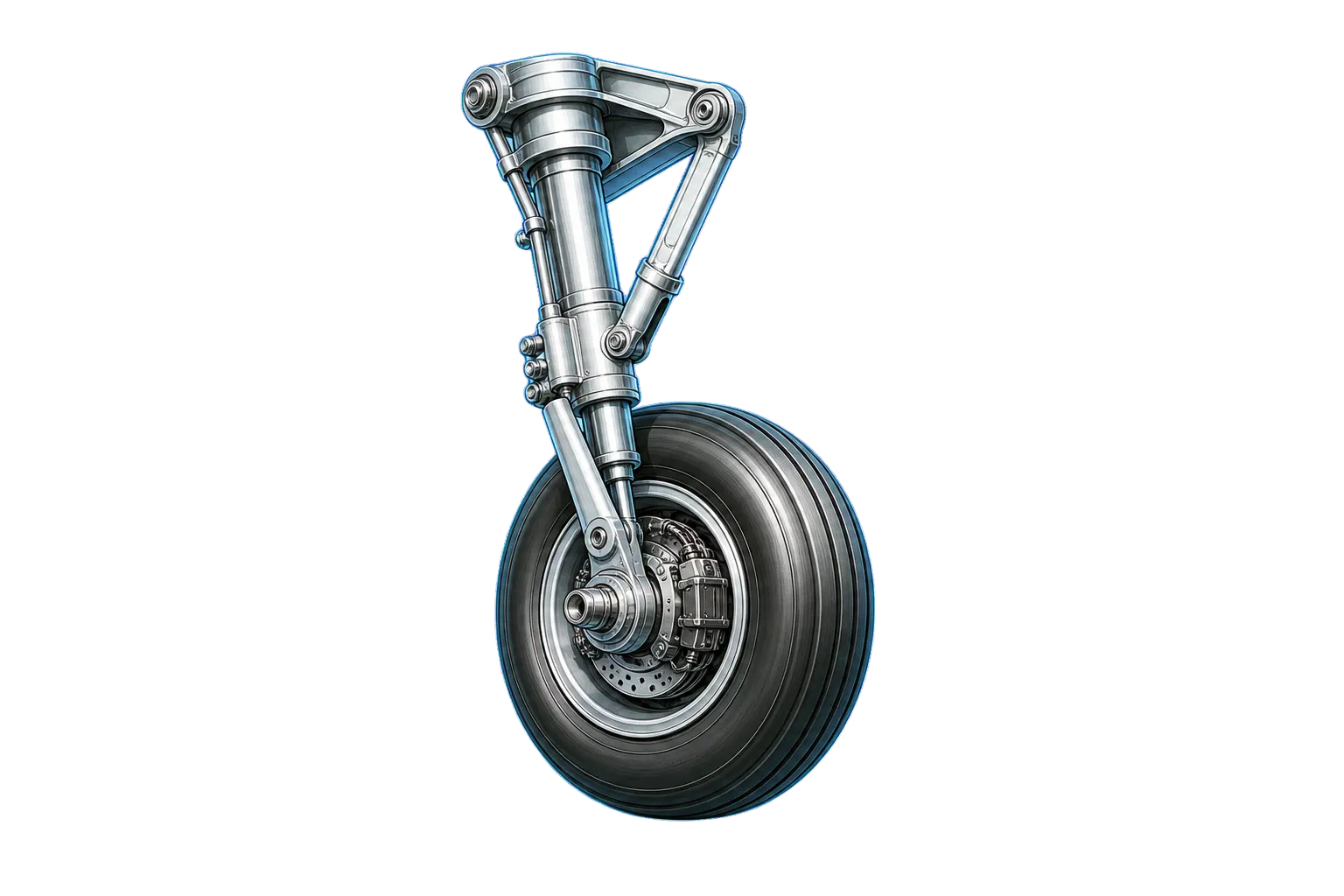
Cracks caused by stress corrosion in the main-gear support struts made from material AA2024-T351, which has a lower resistance to stress corrosion cracking. Such cracks, if undetected, could lead to the failure of the strut during landing, causing the Main Landing Gear (MLG) to collapse.
AI-generated summary from the source AD text. Verify against the official source before acting.
Required Actions
Visually inspect the left and right main-gear support struts to determine if they have rounded or chamfered clevis lugs. If chamfered clevis lugs are found, perform a Non-Destructive Inspection (NDI). Replace any cracked main-gear support struts with parts of improved design.
AI-generated summary from the source AD text. Verify against the official source before acting.
Compliance Time
Within 30 hours time-in-service (TIS) or 30 days after February 1, 2010, whichever occurs first.
AI-generated summary from the source AD text. Verify against the official source before acting.
Affected Aircraft
PILATUS Aircraft Ltd. Model PC-7 airplanes, manufacturer serial numbers 101 through 618, equipped with main-gear support struts part number (P/N) 532.10.09.039 or P/N 114.48.07.127, certificated in any category.
AI-generated summary from the source AD text. Verify against the official source before acting.
Federal Register Abstract
We are adopting a new airworthiness directive (AD) for the products listed above. This AD results from mandatory continuing airworthiness information (MCAI) issued by an aviation authority of another country to identify and correct an unsafe condition on an aviation product. The MCAI describes the unsafe condition as:
Document Text
Show stored source text (verify against official source)
[Federal Register Volume 74, Number 247 (Monday, December 28, 2009)]
[Rules and Regulations]
[Pages 68499-68501]
From the Federal Register Online via the Government Publishing Office [<a href="http://www.gpo.gov">www.gpo.gov</a>]
[FR Doc No: E9-29983]
=======================================================================
-----------------------------------------------------------------------
DEPARTMENT OF TRANSPORTATION
Federal Aviation Administration
14 CFR Part 39
[Docket No. FAA-2009-0938 Directorate Identifier 2009-CE-052-AD;
Amendment 39-16140; AD 2009-26-05]
RIN 2120-AA64
Airworthiness Directives; PILATUS Aircraft Ltd. Model PC-7
Airplanes
AGENCY: Federal Aviation Administration (FAA), Department of
Transportation (DOT).
ACTION: Final rule.
-----------------------------------------------------------------------
SUMMARY: We are adopting a new airworthiness directive (AD) for the
products listed above. This AD results from mandatory continuing
airworthiness information (MCAI) issued by an aviation authority of
another country to identify and correct an unsafe condition on an
aviation product. The MCAI describes the unsafe condition as:
This Airworthiness Directive (AD) is prompted due to the
discovery of cracks caused by stress corrosion in the main-gear
support struts. All the main-gear support struts that had cracks
were made from material AA2024-T351 which has a lower resistance to
stress corrosion cracking.
Such cracks, if undetected, could lead to the failure of the
strut during landing which could then cause the Main Landing Gear
(MLG) to collapse.
We are issuing this AD to require actions to correct the unsafe
condition on these products.
DATES: This AD becomes effective February 1, 2010.
On February 1, 2010, the Director of the Federal Register approved
the incorporation by reference of certain publications listed in this
AD.
ADDRESSES: You may examine the AD docket on the Internet at <a href="http://www.regulations.gov">http://www.regulations.gov</a> or in person at Document Management Facility, U.S.
Department of Transportation, Docket Operations, M-30, West Building
Ground Floor, Room W12-140, 1200 New Jersey Avenue, SE., Washington, DC
20590.
FOR FURTHER INFORMATION CONTACT: Doug Rudolph, Aerospace Engineer, FAA,
Small Airplane Directorate, 901 Locust, Room 301, Kansas City, Missouri
64106; telephone: (816) 329-4059; fax: (816) 329-4090; e-mail:
<a href="/cdn-cgi/l/email-protection#5d3932283a732f283932312d351d3b3c3c733a322b"><span class="__cf_email__" data-cfemail="debab1abb9f0acabbab1b2aeb69eb8bfbff0b9b1a8">[email protected]</span></a>.
SUPPLEMENTARY INFORMATION:
Discussion
We issued a notice of proposed rulemaking (NPRM) to amend 14 CFR
[[Page 68500]]
part 39 to include an AD that would apply to the specified products.
That NPRM was published in the Federal Register on October 9, 2009 (74
FR 52156). That NPRM proposed to correct an unsafe condition for the
specified products. The MCAI states:
This Airworthiness Directive (AD) is prompted due to the
discovery of cracks caused by stress corrosion in the main-gear
support struts. All the main-gear support struts that had cracks
were made from material AA2024-T351 which has a lower resistance to
stress corrosion cracking.
Such cracks, if undetected, could lead to the failure of the
strut during landing which could then cause the Main Landing Gear
(MLG) to collapse.
In order to correct and control the situation, this AD mandates
the identification of the main-gear support struts to check if they
have rounded clevis lugs and a Non-Destructive Inspection (NDI)
procedure on the main-gear support struts if they have chamfered
clevis lugs.
For main-gear support struts with chamfered clevis lugs that show
cracks during the NDI, the MCAI also requires replacing any cracked
main-gear support struts with parts of improved design. You may obtain
further information by examining the MCAI in the AD docket.
Comments
We gave the public the opportunity to participate in developing
this AD. We considered the comment received.
PILATUS Aircraft Ltd. states that there is a typographical error in
one of the affected part numbers (P/N) referenced in the proposed AD.
The P/N should read 114.48.07.127 instead of 114.48.07.172.
We agree with the commenter and will make that change in final rule
AD action.
Conclusion
We reviewed the available data, including the comment received, and
determined that air safety and the public interest require adopting the
AD with the changes described previously. We determined that these
changes will not increase the economic burden on any operator or
increase the scope of the AD.
Differences Between This AD and the MCAI or Service Information
We have reviewed the MCAI and related service information and, in
general, agree with their substance. But we might have found it
necessary to use different words from those in the MCAI to ensure the
AD is clear for U.S. operators and is enforceable. In making these
changes, we do not intend to differ substantively from the information
provided in the MCAI and related service information.
We might also have required different actions in this AD from those
in the MCAI in order to follow FAA policies. Any such differences are
highlighted in a NOTE within the AD.
Costs of Compliance
We estimate that this AD will affect 10 products of U.S. registry.
We also estimate that it will take about 4 work-hours per product to
comply with the basic requirements of this AD. The average labor rate
is $80 per work-hour.
Based on these figures, we estimate the cost of the AD on U.S.
operators to be $3,200, or $320 per product.
In addition, we estimate that any necessary follow-on actions will
take about 20 work-hours and require parts costing $20,000, for a cost
of $21,600 per product. We have no way of determining the number of
products that may need these actions.
Authority for This Rulemaking
Title 49 of the United States Code specifies the FAA's authority to
issue rules on aviation safety. Subtitle I, section 106, describes the
authority of the FAA Administrator. ``Subtitle VII: Aviation
Programs,'' describes in more detail the scope of the Agency's
authority.
We are issuing this rulemaking under the authority described in
``Subtitle VII, Part A, Subpart III, Section 44701: General
requirements.'' Under that section, Congress charges the FAA with
promoting safe flight of civil aircraft in air commerce by prescribing
regulations for practices, methods, and procedures the Administrator
finds necessary for safety in air commerce. This regulation is within
the scope of that authority because it addresses an unsafe condition
that is likely to exist or develop on products identified in this
rulemaking action.
Regulatory Findings
We determined that this AD will not have federalism implications
under Executive Order 13132. This AD will not have a substantial direct
effect on the States, on the relationship between the national
government and the States, or on the distribution of power and
responsibilities among the various levels of government.
For the reasons discussed above, I certify this AD:
(1) Is not a ``significant regulatory action'' under Executive
Order 12866;
(2) Is not a ``significant rule'' under DOT Regulatory Policies and
Procedures (44 FR 11034, February 26, 1979); and
(3) Will not have a significant economic impact, positive or
negative, on a substantial number of small entities under the criteria
of the Regulatory Flexibility Act.
We prepared a regulatory evaluation of the estimated costs to
comply with this AD and placed it in the AD Docket.
Examining the AD Docket
You may examine the AD docket on the Internet at <a href="http://www.regulations.gov">http://www.regulations.gov</a>; or in person at the Docket Management Facility
between 9 a.m. and 5 p.m., Monday through Friday, except Federal
holidays. The AD docket contains the NPRM, the regulatory evaluation,
any comments received, and other information. The street address for
the Docket Office (telephone (800) 647-5527) is in the ADDRESSES
section. Comments will be available in the AD docket shortly after
receipt.
List of Subjects in 14 CFR Part 39
Air transportation, Aircraft, Aviation safety, Incorporation by
reference, Safety.
Adoption of the Amendment
0
Accordingly, under the authority delegated to me by the Administrator,
the FAA amends 14 CFR part 39 as follows:
PART 39--AIRWORTHINESS DIRECTIVES
0
1. The authority citation for part 39 continues to read as follows:
Authority: 49 U.S.C. 106(g), 40113, 44701.
Sec. 39.13 [Amended]
0
2. The FAA amends Sec. 39.13 by adding the following new AD:
2009-26-05 Pilatus Aircraft Ltd: Amendment 39-16140; Docket No. FAA-
2009-0938; Directorate Identifier 2009-CE-052-AD.
Effective Date
(a) This airworthiness directive (AD) becomes effective February
1, 2010.
Affected ADs
(b) None.
Applicability
(c) This AD applies to Model PC-7 airplanes, manufacturer serial
numbers 101 through 618 that are:
(1) Equipped with main-gear support struts part number (P/N)
532.10.09.039 or P/N 114.48.07.127; and
(2) Certificated in any category.
Subject
(d) Air Transport Association of America (ATA) Code 32: Landing
Gear.
[[Page 68501]]
Reason
(e) The mandatory continuing airworthiness information (MCAI)
states:
This Airworthiness Directive (AD) is prompted due to the
discovery of cracks caused by stress corrosion in the main-gear
support struts. All the main-gear support struts that had cracks
were made from material AA2024-T351 which has a lower resistance to
stress corrosion cracking.
Such cracks, if undetected, could lead to the failure of the
strut during landing which could then cause the Main Landing Gear
(MLG) to collapse.
In order to correct and control the situation, this AD mandates
the identification of the main-gear support struts to check if they
have rounded clevis lugs and a Non-Destructive Inspection (NDI)
procedure on the main-gear support struts if they have chamfered
clevis lugs.
For main-gear support struts with chamfered clevis lugs that show
cracks during the NDI, the MCAI also requires replacing any cracked
main-gear support struts with parts of improved design. You may
obtain further information by examining the MCAI in the AD docket.
Actions and Compliance
(f) Unless already done, do the following actions:
(1) Within the next 30 hours time-in-service (TIS) after
February 1, 2010 (the effective date of this AD) or within the next
30 days after February 1, 2010 (the effective date of this AD),
whichever occurs first, visually inspect the left and right main-
gear support struts to determine if they have rounded or chamfered
clevis lugs. Do the inspection following paragraph 3.A. of Pilatus
PC-7 Service Bulletin No. 32-024, Rev. No. 1, dated November 17,
2008.
(2) Based on the results of the inspection required in paragraph
(f)(1) of this AD, if the main-gear support strut has rounded clevis
lugs, no further action is required except the requirement specified
in paragraph (f)(4) of this AD still applies. Make an entry in the
airplane logbook to show compliance with this AD. Based on the
reports of the results of the inspection required by this AD,
further rulemaking action may be taken to mandate repetitive
inspections or terminating action.
(3) Based on the results of the inspection required in paragraph
(f)(1) of this AD, if the main-gear support strut has chamfered
clevis lugs, before further flight do a Non-Destructive Inspection
(NDI). Do the NDI following paragraphs 3.B. through 3.E. of Pilatus
PC-7 Service Bulletin No. 32-024, Rev. No. 1, dated November 17,
2008.
(i) If cracks are found during the inspection required in
paragraph (f)(3) of this AD:
(A) Before further flight after the inspection, replace any
cracked main-gear support struts with new main-gear support struts,
P/N 532.10.09.128. Do the replacement following Pilatus PC-7 Service
Bulletin No. 32-025, Rev. No. 1, dated November 17, 2008.
(B) Within the next 10 days after the inspection, report the
cracks to Pilatus Aircraft LTD., Customer Liaison Manager, CH-6371
STANS, Switzerland, using the Crack Report Form (Figure 4) in
Pilatus PC-7 Service Bulletin No. 32-024, Rev. No. 1, dated November
17, 2008.
(ii) If no cracks are found during the inspection required in
paragraph (f)(3) of this AD, no further action is required. Make an
entry in the airplane logbook to show compliance with this AD.
(4) As of 30 days after February 1, 2010 (the effective date of
this AD), do not install any main-gear support struts, P/N
532.10.09.039 or P/N 114.48.07.127, with chamfered clevis lugs.
Note 1: If you have any main-gear support struts, P/N
532.10.09.039 or P/N 114.48.07.127, with chamfered clevis lugs held
as spares, you may return them to Pilatus Aircraft Ltd., Customer
Liaison Manager, CH-6371 STANS, Switzerland, for replacement with a
new main-gear support strut, P/N 532.10.09.128.
FAA AD Differences
Note 2: This AD differs from the MCAI and/or service
information as follows: No differences.
Other FAA AD Provisions
(g) The following provisions also apply to this AD:
(1) Alternative Methods of Compliance (AMOCs): The Manager,
Standards Office, FAA, has the authority to approve AMOCs for this
AD, if requested using the procedures found in 14 CFR 39.19. Send
information to Attn: Doug Rudolph, Aerospace Engineer, FAA, Small
Airplane Directorate, 901 Locust, Room 301, Kansas City, Missouri
64106; telephone: (816) 329-4059; fax: (816) 329-4090; e-mail:
<a href="/cdn-cgi/l/email-protection#462229332168343322292a362e0620272768212930"><span class="__cf_email__" data-cfemail="51353e24367f2324353e3d2139113730307f363e27">[email protected]</span></a>. Before using any approved AMOC on any airplane
to which the AMOC applies, notify your appropriate principal
inspector (PI) in the FAA Flight Standards District Office (FSDO),
or lacking a PI, your local FSDO.
(2) Airworthy Product: For any requirement in this AD to obtain
corrective actions from a manufacturer or other source, use these
actions if they are FAA-approved. Corrective actions are considered
FAA-approved if they are approved by the State of Design Authority
(or their delegated agent). You are required to assure the product
is airworthy before it is returned to service.
(3) Reporting Requirements: For any reporting requirement in
this AD, under the provisions of the Paperwork Reduction Act (44
U.S.C. 3501 et seq.), the Office of Management and Budget (OMB) has
approved the information collection requirements and has assigned
OMB Control Number 2120-0056.
Related Information
(h) Refer to MCAI Federal Office of Civil Aviation AD HB-2009-
011, dated September 10, 2009; and Pilatus PC-7 Service Bulletin No.
32-024, Rev. No. 1, dated November 17, 2008; and Pilatus PC-7
Service Bulletin No. 32-025, Rev. No. 1, dated November 17, 2008,
for related information.
Material Incorporated by Reference
(i) You must use Pilatus PC-7 Service Bulletin No. 32-024, Rev.
No. 1, dated November 17, 2008; and Pilatus PC-7 Service Bulletin
No. 32-025, Rev. No. 1, dated November 17, 2008, to do the actions
required by this AD, unless the AD specifies otherwise.
(1) The Director of the Federal Register approved the
incorporation by reference of this service information under 5
U.S.C. 552(a) and 1 CFR part 51.
(2) For service information identified in this AD, contact
Pilatus Aircraft LTD., Customer Service Manager, CH-6371 STANS,
Switzerland; telephone: +41 (0)41 619 62 08; fax: +41 (0)41 619 73
11; Internet: <a href="http://www.pilatus-aircraft.com/">http://www.pilatus-aircraft.com/</a>, or e-mail:
<a href="/cdn-cgi/l/email-protection#40332e2f2c212e0030292c213435336d7c2160283225267d" http: aircraft.com">aircraft.com</a>">snolan@pilatus-<a href="http://aircraft.com">aircraft.com</a></a>.
(3) You may review copies of the service information
incorporated by reference for this AD at the FAA, Central Region,
Office of the Regional Counsel, 901 Locust, Kansas City, Missouri
64106. For information on the availability of this material at the
Central Region, call (816) 329-3768.
(4) You may also review copies of the service information
incorporated by reference for this AD at the National Archives and
Records Administration (NARA). For information on the availability
of this material at NARA, call (202) 741-6030, or go to: <a href="http://www.archives.gov/federal_register/code_of_federal_regulations/ibr_locations.html">http://www.archives.gov/federal_register/code_of_federal_regulations/ibr_locations.html</a>.
Issued in Kansas City, MO, on December 8, 2009.
Margaret Kline,
Acting Manager, Small Airplane Directorate, Aircraft Certification
Service.
[FR Doc. E9-29983 Filed 12-24-09; 8:45 am]
BILLING CODE 4910-13-P
Source: Official FAA Source ↗
Retrieved: Apr 4, 2026
Rights: U.S. Government Public Domain
This site is not affiliated with or endorsed by the FAA. Always verify with official sources.
Related Airworthiness Directives
2020-26-19 Recurring
final ruleAirworthiness Directives; Pilatus Aircraft Ltd. Airplanes
Unsafe Condition: Failure to accomplish these instructions could result in an unsafe condition [discrepancies of life-limited and overhauled components, which could result in reduced structural integrity and system ...
2021-04-06
final ruleAirworthiness Directives; Pilatus Aircraft Ltd. Airplanes
Unsafe Condition: A missing release bar retaining screw on a Harley-type buckle assembly installed on a harness shoulder strap could lead to loss of pilot restraint and consequently loss of airplane control or injur...
2019-05-15
final ruleAirworthiness Directives; Pilatus Aircraft Ltd. Airplanes
Unsafe Condition: chafed and burned wires located under panel F5
2018-04-10
final ruleAirworthiness Directives; Pilatus Aircraft Limited Airplanes
Unsafe Condition: the brakes remaining activated after release of the brake pedal