AD 2009-24-21
Applicability
| Type | Manufacturer | Model | Details |
|---|---|---|---|
| aircraft | The Boeing Company | DC-9-14 | Airworthiness Directives; McDonnell Douglas Model DC-9-14, DC-9- 15, and DC-9-15F Airplanes; and McDonnell Douglas Model DC-9-20, DC-9- 30, DC-9-40, and DC-9-50 Series Airplanes |
| aircraft | The Boeing Company | DC-9-15 | Airworthiness Directives; McDonnell Douglas Model DC-9-14, DC-9- 15, and DC-9-15F Airplanes; and McDonnell Douglas Model DC-9-20, DC-9- 30, DC-9-40, and DC-9-50 Series Airplanes |
| aircraft | The Boeing Company | DC-9-15F | Airworthiness Directives; McDonnell Douglas Model DC-9-14, DC-9- 15, and DC-9-15F Airplanes; and McDonnell Douglas Model DC-9-20, DC-9- 30, DC-9-40, and DC-9-50 Series Airplanes |
| aircraft | The Boeing Company | DC-9-21 | Airworthiness Directives; McDonnell Douglas Model DC-9-14, DC-9- 15, and DC-9-15F Airplanes; and McDonnell Douglas Model DC-9-20, DC-9- 30, DC-9-40, and DC-9-50 Series Airplanes |
| aircraft | The Boeing Company | DC-9-31 | Airworthiness Directives; McDonnell Douglas Model DC-9-14, DC-9- 15, and DC-9-15F Airplanes; and McDonnell Douglas Model DC-9-20, DC-9- 30, DC-9-40, and DC-9-50 Series Airplanes |
| aircraft | The Boeing Company | DC-9-32 | Airworthiness Directives; McDonnell Douglas Model DC-9-14, DC-9- 15, and DC-9-15F Airplanes; and McDonnell Douglas Model DC-9-20, DC-9- 30, DC-9-40, and DC-9-50 Series Airplanes |
| aircraft | The Boeing Company | DC-9-32 (VC-9C) | Airworthiness Directives; McDonnell Douglas Model DC-9-14, DC-9- 15, and DC-9-15F Airplanes; and McDonnell Douglas Model DC-9-20, DC-9- 30, DC-9-40, and DC-9-50 Series Airplanes |
| aircraft | The Boeing Company | DC-9-32F | Airworthiness Directives; McDonnell Douglas Model DC-9-14, DC-9- 15, and DC-9-15F Airplanes; and McDonnell Douglas Model DC-9-20, DC-9- 30, DC-9-40, and DC-9-50 Series Airplanes |
| aircraft | The Boeing Company | DC-9-32F (C-9A) | Airworthiness Directives; McDonnell Douglas Model DC-9-14, DC-9- 15, and DC-9-15F Airplanes; and McDonnell Douglas Model DC-9-20, DC-9- 30, DC-9-40, and DC-9-50 Series Airplanes |
| aircraft | The Boeing Company | DC-9-32F (C-9B) | Airworthiness Directives; McDonnell Douglas Model DC-9-14, DC-9- 15, and DC-9-15F Airplanes; and McDonnell Douglas Model DC-9-20, DC-9- 30, DC-9-40, and DC-9-50 Series Airplanes |
| aircraft | The Boeing Company | DC-9-33F | Airworthiness Directives; McDonnell Douglas Model DC-9-14, DC-9- 15, and DC-9-15F Airplanes; and McDonnell Douglas Model DC-9-20, DC-9- 30, DC-9-40, and DC-9-50 Series Airplanes |
| aircraft | The Boeing Company | DC-9-34 | Airworthiness Directives; McDonnell Douglas Model DC-9-14, DC-9- 15, and DC-9-15F Airplanes; and McDonnell Douglas Model DC-9-20, DC-9- 30, DC-9-40, and DC-9-50 Series Airplanes |
| aircraft | The Boeing Company | DC-9-34F | Airworthiness Directives; McDonnell Douglas Model DC-9-14, DC-9- 15, and DC-9-15F Airplanes; and McDonnell Douglas Model DC-9-20, DC-9- 30, DC-9-40, and DC-9-50 Series Airplanes |
| aircraft | The Boeing Company | DC-9-41 | Airworthiness Directives; McDonnell Douglas Model DC-9-14, DC-9- 15, and DC-9-15F Airplanes; and McDonnell Douglas Model DC-9-20, DC-9- 30, DC-9-40, and DC-9-50 Series Airplanes |
| aircraft | The Boeing Company | DC-9-51 | Airworthiness Directives; McDonnell Douglas Model DC-9-14, DC-9- 15, and DC-9-15F Airplanes; and McDonnell Douglas Model DC-9-20, DC-9- 30, DC-9-40, and DC-9-50 Series Airplanes |
Unsafe Condition
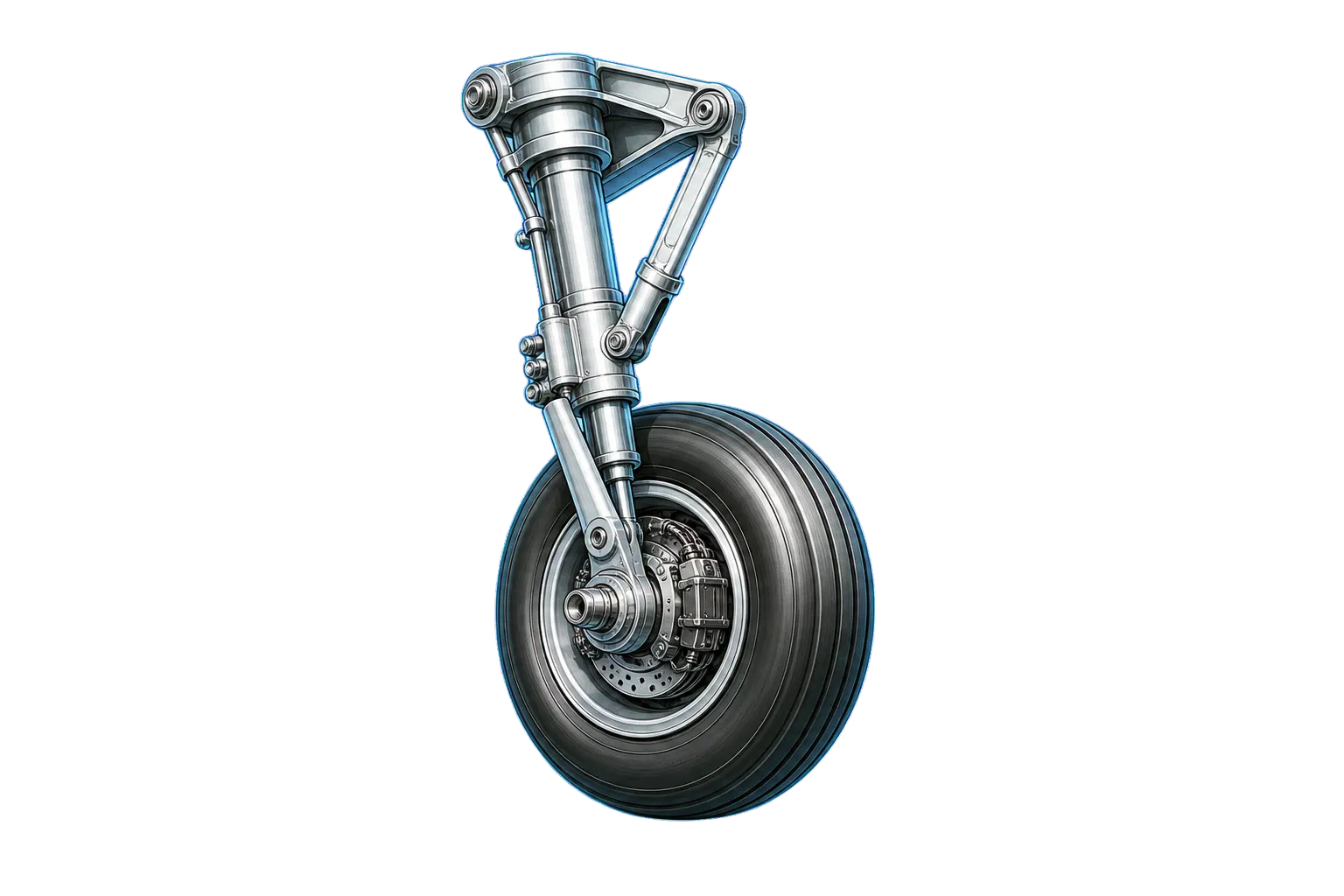
Fatigue cracks in the shock strut cylinder of the main landing gear (MLG), which could result in a collapsed MLG during takeoff or landing, and possible reduced structural integrity of the airplane.
AI-generated summary from the source AD text. Verify against the official source before acting.
Required Actions
Inspect the MLG shock strut cylinders for cracks using specified non-destructive testing methods. Review maintenance records to determine MLG service history and number of landings. Perform initial inspection before the accumulation of 60,000 total landings or at the applicable grace period, whichever is later.
AI-generated summary from the source AD text. Verify against the official source before acting.
Compliance Time
Before the accumulation of 60,000 total landings on the MLG, or at the applicable grace period specified in Table 1, whichever occurs later.
AI-generated summary from the source AD text. Verify against the official source before acting.
Affected Aircraft
All McDonnell Douglas Model DC-9-14, DC-9-15, DC-9-15F, DC-9-21, DC-9-31, DC-9-32, DC-9-32 (VC-9C), DC-9-32F, DC-9-33F, DC-9-34, DC-9-34F, DC-9-32F (C-9A, C-9B), DC-9-41, and DC-9-51 airplanes, certificated in any category.
AI-generated summary from the source AD text. Verify against the official source before acting.
Federal Register Abstract
The FAA is superseding an existing airworthiness directive (AD) that applies to all McDonnell Douglas Model DC-9-14, DC-9-15, and DC-9-15F airplanes; and McDonnell Douglas Model DC-9-20, DC-9-30, DC-9- 40, and DC-9-50 series airplanes. That AD currently requires repetitive inspections for cracks of the main landing gear (MLG) shock strut cylinder, and related investigative and corrective actions if necessary. This AD adds more work on airplanes that have main landing gear shock struts with certain identified part numbers. This AD results from two reports of a collapsed MLG and a report of cracks in two MLG cylinders. We are issuing this AD to detect and correct fatigue cracks in the shock strut cylinder of the MLG, which could result in a collapsed MLG during takeoff or landing, and possible reduced structural integrity of the airplane.
Document Text
Show stored source text (verify against official source)
[Federal Register Volume 74, Number 232 (Friday, December 4, 2009)]
[Rules and Regulations]
[Pages 63578-63581]
From the Federal Register Online via the Government Publishing Office [<a href="http://www.gpo.gov">www.gpo.gov</a>]
[FR Doc No: E9-28564]
-----------------------------------------------------------------------
DEPARTMENT OF TRANSPORTATION
Federal Aviation Administration
14 CFR Part 39
[Docket No. FAA-2009-0658; Directorate Identifier 2009-NM-058-AD;
Amendment 39-16115; AD 2009-24-21]
RIN 2120-AA64
Airworthiness Directives; McDonnell Douglas Model DC-9-14, DC-9-
15, and DC-9-15F Airplanes; and McDonnell Douglas Model DC-9-20, DC-9-
30, DC-9-40, and DC-9-50 Series Airplanes
AGENCY: Federal Aviation Administration (FAA), Department of
Transportation (DOT).
ACTION: Final rule.
-----------------------------------------------------------------------
SUMMARY: The FAA is superseding an existing airworthiness directive
(AD) that applies to all McDonnell Douglas Model DC-9-14, DC-9-15, and
DC-9-15F airplanes; and McDonnell Douglas Model DC-9-20, DC-9-30, DC-9-
40, and DC-9-50 series airplanes. That AD currently requires repetitive
inspections for cracks of the main landing gear (MLG) shock strut
cylinder, and related investigative and corrective actions if
necessary. This AD adds more work on airplanes that have main landing
gear shock struts with certain identified part numbers. This AD results
from two reports of a collapsed MLG and a report of cracks in two MLG
cylinders. We are
[[Page 63579]]
issuing this AD to detect and correct fatigue cracks in the shock strut
cylinder of the MLG, which could result in a collapsed MLG during
takeoff or landing, and possible reduced structural integrity of the
airplane.
DATES: This AD becomes effective January 8, 2010.
The Director of the Federal Register approved the incorporation by
reference of a certain publication listed in the AD as of January 8,
2010.
ADDRESSES: For service information identified in this AD, contact
Boeing Commercial Airplanes, Attention: Data & Services Management,
3855 Lakewood Boulevard, MC D800-0019, Long Beach, California 90846-
0001; telephone 206-544-5000, extension 2; fax 206-766-5683; e-mail
<a href="/cdn-cgi/l/email-protection#3a5e495f1458555f5955577a58555f53545d14595557"><span class="__cf_email__" data-cfemail="fa9e899fd498959f999597ba98959f93949dd4999597">[email protected]</span></a>; Internet <a href="https://www.myboeingfleet.com">https://www.myboeingfleet.com</a>.
Examining the AD Docket
You may examine the AD docket on the Internet at <a href="http://www.regulations.gov">http://www.regulations.gov</a>; or in person at the Docket Management Facility
between 9 a.m. and 5 p.m., Monday through Friday, except Federal
holidays. The AD docket contains this AD, the regulatory evaluation,
any comments received, and other information. The address for the
Docket Office (telephone 800-647-5527) is the Document Management
Facility, U.S. Department of Transportation, Docket Operations, M-30,
West Building Ground Floor, Room W12-140, 1200 New Jersey Avenue, SE.,
Washington, DC 20590.
FOR FURTHER INFORMATION CONTACT: Wahib Mina, ANM-120L, FAA, Los Angeles
Aircraft Certification Office, 3960 Paramount Boulevard, Lakewood,
California 90712-4137; telephone (562) 627-5324; fax (562) 627-5210.
SUPPLEMENTARY INFORMATION:
Discussion
The FAA issued a notice of proposed rulemaking (NPRM) to amend 14
CFR part 39 to include an AD that supersedes AD 2005-19-08, amendment
39-14273 (70 FR 54616, September 16, 2005). The existing AD applies to
all McDonnell Douglas Model DC-9-14, DC-9-15, and DC-9-15F airplanes;
and Model DC-9-20, DC-9-30, DC-9-40, and DC-9-50 series airplanes. That
NPRM was published in the Federal Register on July 30, 2009 (74 FR
37963). That NPRM proposed to continue to require repetitive
inspections for cracks of the main landing gear (MLG) shock strut
cylinder, and related investigative and corrective actions if
necessary. That NPRM also proposed to require more work on airplanes
that have main landing gear shock struts with certain identified part
numbers.
Comments
We provided the public the opportunity to participate in the
development of this AD. No comments have been received on the NPRM or
on the determination of the cost to the public.
Conclusion
We have carefully reviewed the available data and determined that
air safety and the public interest require adopting the AD as proposed.
Costs of Compliance
There are about 644 airplanes of the affected design in the
worldwide fleet. The following table provides the estimated costs for
U.S. operators to comply with this AD.
Estimated Costs
--------------------------------------------------------------------------------------------------------------------------------------------------------
Number of
Average U.S.-
Action Work hours labor rate Parts Cost per airplane registered Fleet cost
per hour airplanes
--------------------------------------------------------------------------------------------------------------------------------------------------------
Inspection..................... 4 to 6............ $80 None.............. $320 to $480 per 426 $136,320 to $204,480 per
inspection cycle. inspection cycle.
--------------------------------------------------------------------------------------------------------------------------------------------------------
Authority for This Rulemaking
Title 49 of the United States Code specifies the FAA's authority to
issue rules on aviation safety. Subtitle I, Section 106, describes the
authority of the FAA Administrator. Subtitle VII, Aviation Programs,
describes in more detail the scope of the Agency's authority.
We are issuing this rulemaking under the authority described in
Subtitle VII, Part A, Subpart III, Section 44701, ``General
requirements.'' Under that section, Congress charges the FAA with
promoting safe flight of civil aircraft in air commerce by prescribing
regulations for practices, methods, and procedures the Administrator
finds necessary for safety in air commerce. This regulation is within
the scope of that authority because it addresses an unsafe condition
that is likely to exist or develop on products identified in this
rulemaking action.
Regulatory Findings
We have determined that this AD will not have federalism
implications under Executive Order 13132. This AD will not have a
substantial direct effect on the States, on the relationship between
the national government and the States, or on the distribution of power
and responsibilities among the various levels of government.
For the reasons discussed above, I certify that this AD:
(1) Is not a ``significant regulatory action'' under Executive
Order 12866;
(2) Is not a ``significant rule'' under DOT Regulatory Policies and
Procedures (44 FR 11034, February 26, 1979); and
(3) Will not have a significant economic impact, positive or
negative, on a substantial number of small entities under the criteria
of the Regulatory Flexibility Act.
We prepared a regulatory evaluation of the estimated costs to
comply with this AD and placed it in the AD docket. See the ADDRESSES
section for a location to examine the regulatory evaluation.
List of Subjects in 14 CFR Part 39
Air transportation, Aircraft, Aviation safety, Incorporation by
reference, Safety.
Adoption of the Amendment
0
Accordingly, under the authority delegated to me by the Administrator,
the FAA amends 14 CFR part 39 as follows:
PART 39--AIRWORTHINESS DIRECTIVES
0
1. The authority citation for part 39 continues to read as follows:
Authority: 49 U.S.C. 106(g), 40113, 44701.
Sec. 39.13 [Amended]
0
2. The Federal Aviation Administration (FAA) amends Sec. 39.13 by
removing amendment 39-14273 (70 FR 54616, September 16, 2005) and by
[[Page 63580]]
adding the following new airworthiness directive (AD):
2009-24-21 McDonnell Douglas: Amendment 39-16115. Docket No. FAA-
2009-0658; Directorate Identifier 2009-NM-058-AD.
Effective Date
(a) This AD becomes effective January 8, 2010.
Affected ADs
(b) This AD supersedes AD 2005-19-08.
Applicability
(c) This AD applies to all McDonnell Douglas Model DC-9-14, DC-
9-15, and DC-9-15F airplanes; Model DC-9-21 airplanes; Model DC-9-
31, DC-9-32, DC-9-32 (VC-9C), DC-9-32F, DC-9-33F, DC-9-34, DC-9-34F,
and DC-9-32F (C-9A, C-9B) airplanes; Model DC-9-41 airplanes; and
Model DC-9-51 airplanes; certificated in any category.
Subject
(d) Air Transport Association (ATA) of America Code 32: Landing
gear.
Unsafe Condition
(e) This AD results from two reports of a collapsed main landing
gear (MLG) and a report of cracks in two MLG cylinders. We are
issuing this AD to detect and correct fatigue cracks in the shock
strut cylinder of the MLG, which could result in a collapsed MLG
during takeoff or landing, and possible reduced structural integrity
of the airplane.
Compliance
(f) You are responsible for having the actions required by this
AD performed within the compliance times specified, unless the
actions have already been done.
Restatement of Requirements of AD 2005-19-08, With Revised Service
Information
Records Review
(g) Except as required by paragraph (m) of this AD, before the
applicable compliance time specified in paragraph (h) or Table 1 of
this AD, as applicable, do the applicable actions in paragraphs
(g)(1) and (g)(2) of this AD.
(1) For all airplane groups: Review the airplane maintenance
records of the MLG to determine its service history and the number
of landings on the MLG shock strut cylinder.
(2) For Group 3 airplanes identified in the service bulletin:
Review the maintenance records to determine if the MLG cylinder on
each Group 3 airplane has always been on a Group 3 airplane, and do
the actions in paragraph (k) of this AD.
Inspection
(h) Inspect the MLG shock strut cylinders for cracks using the
Option 1 or Option 2 non-destructive testing inspection described in
Boeing Alert Service Bulletin DC9-32A350, Revision 1, dated August
3, 2005; or Revision 2, dated March 20, 2009; except as required by
paragraph (m) of this AD. Inspect in accordance with the
Accomplishment Instructions of Boeing Alert Service Bulletin DC9-
32A350, Revision 1, dated August 3, 2005; or Revision 2, dated March
20, 2009; except as required by paragraph (m) of this AD. After the
effective date of this AD, use only Boeing Alert Service Bulletin
DC9-32A350, Revision 2, dated March 20, 2009. Do the detailed
inspection before the accumulation of 60,000 total landings on the
MLG, or at the applicable grace period specified in Table 1 of this
AD, whichever occurs later, except as required by paragraph (m) of
this AD, and except as provided by paragraph (k) of this AD. If the
review of maintenance records is not sufficient to conclusively
determine the service history and number of landings on the MLG
shock strut cylinder, perform the initial inspection at the
applicable grace period specified in Table 1 of this AD.
Table 1--Threshold and Repetitive Interval
----------------------------------------------------------------------------------------------------------------
Airplanes identified in the
Service Bulletin as Group Threshold Repetitive interval
----------------------------------------------------------------------------------------------------------------
1................................. Within 18 months or 650 Intervals not to exceed 650 landings.
landings after October 21,
2005 (the effective date of
AD 2005-19-08), whichever
occurs first.
2................................. Within 18 months or 500 Intervals not to exceed 500 landings.
landings after October 21,
2005, whichever occurs first.
3, except as provided by paragraph Within 18 months or 2,500 Intervals not to exceed 2,500 landings.
(k) of this AD. landings after October 21,
2005, whichever occurs first.
4................................. Within 18 months or 2,100 Intervals not to exceed 2,100 landings.
landings after October 21,
2005, whichever occurs first.
----------------------------------------------------------------------------------------------------------------
No Indication of Cracking Is Found
(i) If no indication of cracking is found during the inspection
required by paragraph (h) of this AD, repeat the inspection in
accordance with Boeing Alert Service Bulletin DC9-32A350, Revision
1, dated August 3, 2005; or Boeing Alert Service Bulletin DC9-
32A350, Revision 2, dated March 20, 2009; at the applicable interval
specified in Table 1 of this AD, except as required by paragraph (m)
of this AD. After the effective date of this AD, use only Boeing
Alert Service Bulletin DC9-32A350, Revision 2, dated March 20, 2009.
Related Investigative and Corrective Actions
(j) If any indication of cracking is found during any inspection
required by paragraph (h) or (i) of this AD: Before further flight,
confirm the indication of cracking by doing all applicable related
investigative actions and doing the applicable corrective actions in
accordance with Boeing Alert Service Bulletin DC9-32A350, Revision
1, dated August 3, 2005; or Revision 2, dated March 20, 2009; except
as required by paragraph (m) of this AD. After the effective date of
this AD, use only Boeing Alert Service Bulletin DC9-32A350, Revision
2, dated March 20, 2009. Repeat the inspection at the applicable
threshold and interval specified in paragraph (h) of this AD.
MLG Cylinder Previously Installed on Group 4 Airplanes
(k) For MLG cylinders on Group 3 airplanes as identified in
Boeing Alert Service Bulletin DC9-32A350, Revision 1, dated August
3, 2005; or Revision 2, dated March 20, 2009: If the MLG cylinder
was previously installed on a Group 4 airplane, as identified in
Boeing Alert Service Bulletin DC9-32A350, Revision 1, dated August
3, 2005; or Revision 2, dated March 20, 2009; or if the service
history and number of landings cannot be determined, the MLG
cylinder must be inspected at the grace period and repetitive
interval that applies to Group 4 airplanes, as specified in Table 1
of this AD, except as required by paragraph (m) of this AD.
Actions Accomplished in Accordance With Original Issue of Service
Bulletin
(l) For airplanes with shock struts that have part numbers other
than 5924400-505 and 5924400-506: Actions done before the effective
date of this AD in accordance with Boeing Alert Service Bulletin
DC9-32A350, dated December 3, 2004, are acceptable for compliance
with the corresponding actions required by paragraphs (h), (i), (j),
and (k) of this by this AD.
New Requirements of This AD
(m) For airplanes with shock struts that have part numbers
5924400-505 and 5924400-506: Do the actions required by paragraphs
(g), (h), (i), (j), and (k), as applicable, in accordance with
Boeing Alert Service Bulletin DC9-32A350, Revision 2, dated March
20, 2009. Do the actions at the time specified in those paragraphs,
except where Table 1 of this AD specifies a compliance time after
October 21, 2005, the compliance time for these airplanes is within
the specified compliance time after the effective date of this AD.
Alternative Methods of Compliance (AMOCs)
(n)(1) The Manager, Los Angeles Aircraft Certification Office,
FAA, has the authority to approve AMOCs for this AD, if requested
[[Page 63581]]
using the procedures found in 14 CFR 39.19. Send information to
ATTN: Wahib Mina, ANM-120L, FAA, Los Angeles Aircraft Certification
Office, 3960 Paramount Boulevard, Lakewood, California 90712-4137;
telephone (562) 627-5324; fax (562) 627-5210.
(2) To request a different method of compliance or a different
compliance time for this AD, follow the procedures in 14 CFR 39.19.
Before using any approved AMOC on any airplane to which the AMOC
applies, notify your principal maintenance inspector (PMI) or
principal avionics inspector (PAI), as appropriate, or lacking a
principal inspector, your local Flight Standards District Office.
The AMOC approval letter must specifically reference this AD.
(3) An AMOC that provides an acceptable level of safety may be
used for any repair required by this AD, if it is approved by an
Authorized Representative for the Boeing Commercial Airplanes
Delegation Option Authorization Organization who has been authorized
by the Manager, Los Angeles ACO, to make those findings. For a
repair method to be approved, the repair must meet the certification
basis of the airplane, and the approval must specifically refer to
this AD.
Material Incorporated by Reference
(o) You must use Boeing Alert Service Bulletin DC9-32A350,
Revision 2, dated March 20, 2009, as applicable, to do the actions
required by this AD, unless the AD specifies otherwise.
(1) The Director of the Federal Register approved the
incorporation by reference of this service information under 5
U.S.C. 552(a) and 1 CFR part 51.
(2) For service information identified in this AD, contact
Boeing Commercial Airplanes, Attention: Data & Services Management,
3855 Lakewood Boulevard, MC D800-0019, Long Beach, California 90846-
0001; telephone 206-544-5000, extension 2; fax 206-766-5683; e-mail
<a href="/cdn-cgi/l/email-protection#4e2a3d2b602c212b2d21230e2c212b272029602d2123"><span class="__cf_email__" data-cfemail="80e4f3e5aee2efe5e3efedc0e2efe5e9eee7aee3efed">[email protected]</span></a>; Internet <a href="https://www.myboeingfleet.com">https://www.myboeingfleet.com</a>.
(3) You may review copies of the service information at the FAA,
Transport Airplane Directorate, 1601 Lind Avenue, SW., Renton,
Washington. For information on the availability of this material at
the FAA, call 425-227-1221 or 425-227-1152.
(4) You may also review copies of the service information that
is incorporated by reference at the National Archives and Records
Administration (NARA). For information on the availability of this
material at NARA, call 202-741-6030, or go to: <a href="http://www.archives.gov/federal_register/code_of_federal_regulations/ibr_locations.html">http://www.archives.gov/federal_register/code_of_federal_regulations/ibr_locations.html</a>.
Issued in Renton, Washington, on November 19, 2009.
Stephen P. Boyd,
Acting Manager, Transport Airplane Directorate, Aircraft Certification
Service.
[FR Doc. E9-28564 Filed 12-3-09; 8:45 am]
BILLING CODE 4910-13-P
Source: Official FAA Source ↗
Retrieved: Apr 4, 2026
Rights: U.S. Government Public Domain
This site is not affiliated with or endorsed by the FAA. Always verify with official sources.
Related Airworthiness Directives
2025-09-11
final ruleAirworthiness Directives; The Boeing Company Airplanes
Unsafe Condition: The discovery of jammed elevators during takeoff could result in the inability of the airplane to rotate at rotation speed V<NF>R<INF>, and lead to a rejected takeoff and high-speed runway excursion.

2024-20-02
final ruleAirworthiness Directives; The Boeing Company Airplanes
Unsafe Condition: cracked and severed structure found in the aft fuselage cant bulkhead at STA 1178.225 and vertical stabilizer rear spar installation, on a Boeing Model 717-200 airplane, and similar structure on Bo...

2023-12-15
final ruleAirworthiness Directives; The Boeing Company Airplanes
Unsafe Condition: 5G C-Band interference can cause radio altimeters to not perform their intended function, resulting in increased flightcrew workload while on approach with the flight director, autothrottle, or aut...
2023-10-02
final ruleAirworthiness Directives; Transport and Commuter Category Airplanes
Unsafe Condition: Radio altimeter anomalies that are undetected by the automation or pilot, particularly close to the ground (e.g., landing flare), could lead to loss of continued safe flight and landing. Additional...