AD 2008-13-26
Applicability
| Type | Manufacturer | Model | Details |
|---|---|---|---|
| aircraft | Lockheed Martin Corporation | 1329-23A | Airworthiness Directives; Lockheed Model 1329 Series Airplanes |
| aircraft | Lockheed Martin Corporation | 1329-23D | Airworthiness Directives; Lockheed Model 1329 Series Airplanes |
| aircraft | Lockheed Martin Corporation | 1329-23E | Airworthiness Directives; Lockheed Model 1329 Series Airplanes |
| aircraft | Lockheed Martin Corporation | 1329-25 | Airworthiness Directives; Lockheed Model 1329 Series Airplanes |
Unsafe Condition
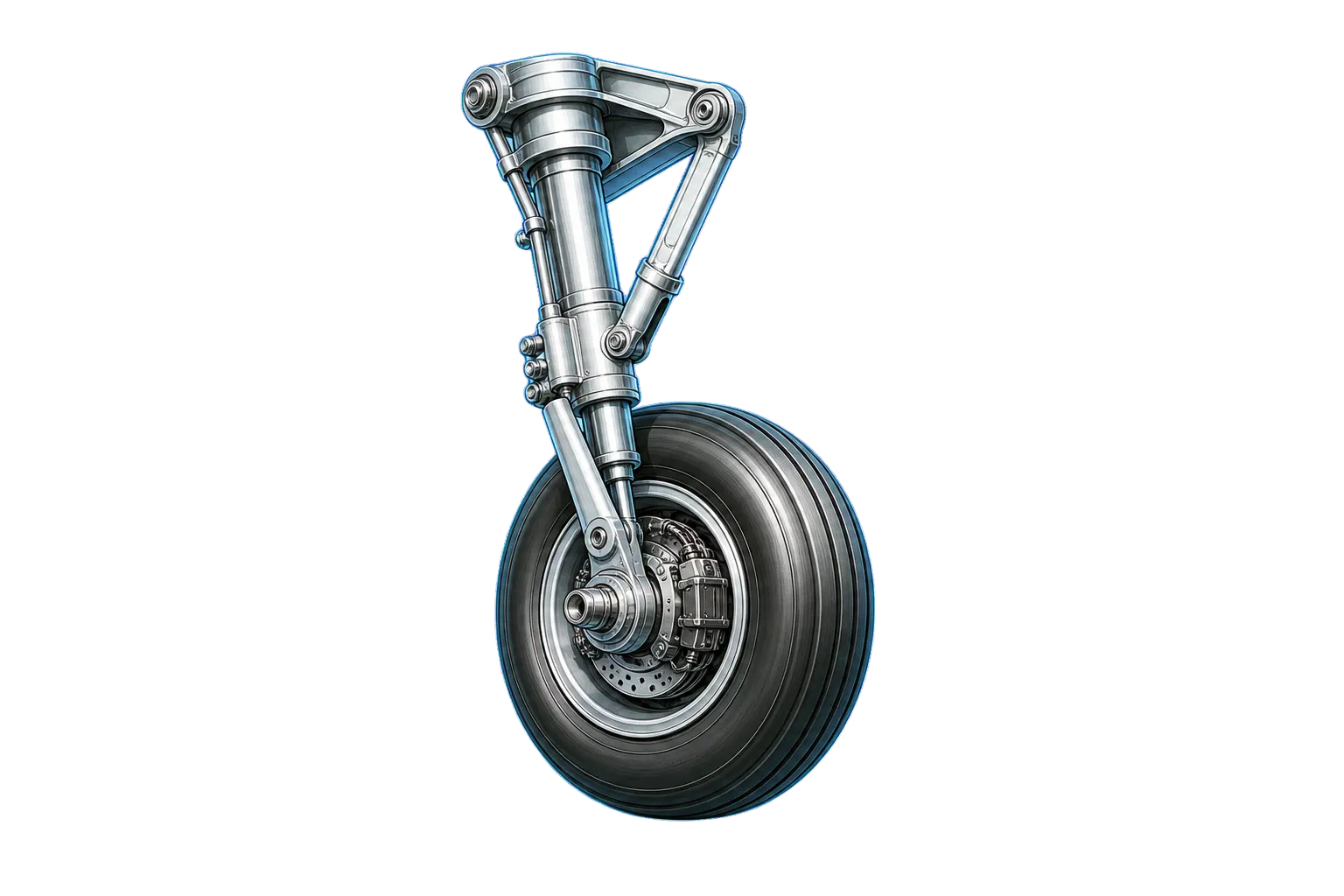
Failures of the nose landing gear (NLG) steering cylinder assembly, leading to loss of hydraulic pressure and steering control.
AI-generated summary from the source AD text. Verify against the official source before acting.
Required Actions
Determine the part number on the NLG steering cylinder assembly, determine the total flight cycles accumulated, repetitively replace the assembly, inspect for missing tow turning limit markings, and perform corrective actions if necessary.
AI-generated summary from the source AD text. Verify against the official source before acting.
Compliance Time
Within 50 flight hours after the effective date of the AD.
AI-generated summary from the source AD text. Verify against the official source before acting.
Affected Aircraft
Lockheed Model 1329 series airplanes with affected NLG steering cylinder assemblies.
AI-generated summary from the source AD text. Verify against the official source before acting.
Federal Register Abstract
We are adopting a new airworthiness directive (AD) for certain Lockheed Model 1329 series airplanes. This AD requires determining the part number on the steering cylinder assembly for the nose landing gear (NLG), determining the total flight cycles accumulated on the NLG steering cylinder assembly, repetitively replacing the assembly, inspecting for missing tow turning limit markings, and performing corrective actions if necessary. This AD results from reports of numerous failures of the NLG steering cylinder. We are issuing this AD to prevent the loss of hydraulic pressure and steering control.
Document Text
Show stored source text (verify against official source)
[Federal Register Volume 73, Number 131 (Tuesday, July 8, 2008)]
[Rules and Regulations]
[Pages 38900-38905]
From the Federal Register Online via the Government Publishing Office [<a href="http://www.gpo.gov">www.gpo.gov</a>]
[FR Doc No: E8-14470]


-----------------------------------------------------------------------

DEPARTMENT OF TRANSPORTATION

Federal Aviation Administration

14 CFR Part 39

[Docket No. FAA-2007-28255; Directorate Identifier 2007-NM-023-AD;
Amendment 39-15589; AD 2008-13-26]
RIN 2120-AA64


Airworthiness Directives; Lockheed Model 1329 Series Airplanes

AGENCY: Federal Aviation Administration (FAA), DOT.

ACTION: Final rule.

-----------------------------------------------------------------------

SUMMARY: We are adopting a new airworthiness directive (AD) for certain
Lockheed Model 1329 series airplanes. This AD requires determining the
part number on the steering cylinder assembly for the nose landing gear
(NLG), determining the total flight cycles accumulated on the NLG
steering cylinder assembly, repetitively replacing the assembly,
inspecting for missing tow turning limit markings, and performing
corrective actions if necessary. This AD results from reports of
numerous failures of the NLG steering cylinder. We are issuing this AD
to prevent the loss of hydraulic pressure and steering control.

DATES: This AD is effective August 12, 2008.
    The Director of the Federal Register approved the incorporation by
reference of certain publications listed in this AD as of August 12,
2008.

ADDRESSES: For service information identified in this AD, contact
Lockheed Martin Aeronautics Company, 86 South Cobb Drive, Marietta,
Georgia 30063.

Examining the AD Docket

    You may examine the AD docket on the Internet at <a href="http://www.regulations.gov">http://www.regulations.gov</a>; or in person at the Docket Management Facility
between 9 a.m. and 5 p.m., Monday through Friday, except Federal
holidays. The AD docket contains this AD, the regulatory evaluation,
any comments received, and other information. The address for the
Docket Office (telephone 800-647-5527) is the Document Management
Facility, U.S. Department of Transportation, Docket Operations, M-30,
West Building Ground Floor, Room W12-140, 1200 New Jersey Avenue, SE.,
Washington, DC 20590.

FOR FURTHER INFORMATION CONTACT: Hector Hernandez, Aerospace Engineer,
Systems and Equipment Branch, ACE-119A, FAA, Atlanta Aircraft
Certification Office, One Crown Center, 1895 Phoenix Boulevard, Suite
450, Atlanta, Georgia 30349; telephone (770) 703-6069; fax (770) 703-
6097.

SUPPLEMENTARY INFORMATION:

Discussion

    We issued a notice of proposed rulemaking (NPRM) to amend 14 CFR
part 39 to include an airworthiness directive (AD) that would apply to
certain Lockheed Model 1329 series

[[Page 38901]]

airplanes. That NPRM was published in the Federal Register on May 24,
2007 (72 FR 29088). That NPRM proposed to require determining the part
number on the steering cylinder assembly for the nose landing gear
(NLG), determining the total flight cycles accumulated on the NLG
steering cylinder assembly, repetitively replacing the assembly,
inspecting for missing tow turning limit markings, and performing
corrective actions if necessary.

Comments

    We gave the public the opportunity to participate in developing
this AD. We considered the comments received.

Request To Withdraw NPRM: Inadequate To Correct Unsafe Condition

    Faith Landmark Ministries requests that we withdraw the NPRM
because it does not address the real problem with the NLG steering
cylinder: Possible fatigue cracking due to machining errors during
manufacture.
    We disagree. Based on information from Lockheed Martin, due to lack
of access to this area there is no reliable inspection that can be
performed in the thread relief area where the failures are occurring.
The only way to do the inspection is to disassemble the actuator
steering cylinder--which would destroy the cylinder. Originally the NLG
steering cylinder was a life-limited part, but unknown to Lockheed
Martin the life limit was removed from the Lockheed JetStar/Handbook of
Operating and Maintenance Instructions (HOMI). We have determined that
it is necessary to issue the final rule to re-establish a relevant life
limit and to address the identified unsafe condition.

Request To Remove Certain Cylinder Part Numbers as Affected

    Faith Landmark Ministries and Carl A. Smith request that we revise
the NPRM to remove P/N JL1955-7 steering cylinder as an affected part,
because there is no record of a JL1955-7 steering cylinder failure due
to stress corrosion cracking.
    We disagree. We received reports of several more service failures
of P/N JL1955-7 steering cylinders as a result of fatigue cracking in
the thread relief area. Although no signs of corrosion were found in
these particular failures, access to this area is difficult, and a
reliable inspection cannot be performed in the thread relief area where
the failures are occurring. Further, disassembling the actuator
steering cylinder would destroy the cylinder. Crack growth cannot be
shown and inspection intervals cannot be developed because the initial
detectable crack length is longer than the critical crack length. As a
result, we find it necessary to impose a fatigue-based life limit on
the actuator steering cylinder. We have not changed the final rule
regarding this issue.

Suggestion of Possible Batch Problem

    Mr. Smith and Faith Landmark Ministries suggest the possibility of
a batch problem with the P/N JL1955-7 steering cylinder. Faith Landmark
Ministries states that four cylinders failed within two years on
Lockheed Martin airplanes that had very close serial numbers (S/N 5211,
5213, 5215, and 5218) and another cylinder failed on an airplane having
S/N 5210. Mr. Smith also notes that the airplanes on which the parts
experienced fatigue failures are bunched together (S/Ns 5210, 5213,
5215, and 5218).
    The commenters made no specific request. We have reviewed the data
and have found no evidence of any batch problem with the steering
cylinders having P/N JL1955-7. We have not changed the final rule
regarding this issue.

Request To Withdraw NPRM: Documentation Errors

    Faith Landmark Ministries requests that we withdraw the NPRM
because of major errors in the supportive documentation and data
supplied by Lockheed Martin.
    We disagree. The identified unsafe condition is a serious safety
issue that must be corrected. Lockheed Service Bulletins 329-300,
Revision C, and 329II-32-8, Revision B, both dated September 5, 2006,
were cited as the appropriate sources of service information for the
NPRM's proposed requirements. The actions specified in these service
bulletins adequately address the identified unsafe condition; however,
these service bulletins did contain discrepancies, which Lockheed
Martin has corrected in Lockheed Service Bulletin 329-300, Revision D,
and 329II-32-8, Revision C, both dated October 4, 2007. Relevant
changes to the service bulletins are outlined below. We have determined
that it is necessary to issue this final rule in order to address the
identified unsafe condition. We have revised paragraph (f) of this
final rule to require the revised service bulletins, and provided
credit for accomplishment of the earlier revisions.

Requests To Address Service Bulletin Discrepancies

    Faith Landmark Ministries requests correction of certain
discrepancies, as outlined below, in the service information cited in
the NPRM. Lockheed Martin also stated that several operators have
indicated a need for additional instructions on rebuilding the NLG
steering cylinder assembly.
    Since we issued the NPRM, Lockheed issued Lockheed Service Bulletin
329-300, Revision D, and 329II-32-8, Revision C, both dated October 4,
2007. These revisions address many of the problems noted by the
commenters, but do not add work beyond the actions specified in the
previous revision levels. The service bulletins also extend the life
limits for certain NLG steering cylinder assemblies (as set forth in
the Life Limits table below).

       Revised Jetstar NLG Steering Cylinder Assembly Life Limits
------------------------------------------------------------------------
                                                       Life limit  (in
           Component                  Part No.          flight cycles)
------------------------------------------------------------------------
7049-T73 die forging...........  JL1955-5..........                2,175
7050-T7451 plate...............  JL1955-9..........                1,113
4340 steel bar.................  JL1955-801........                3,211
------------------------------------------------------------------------

    We have revised paragraph (f) of this AD to require the revised
service bulletins and added new paragraph (j) of this AD to provide
credit for work already done in accordance with the previous revisions.
    Paragraph 2.B.(1) of the service bulletins indicates disassembling,
cleaning, and inspecting the NLG steering actuator assembly per ``HOMI
32.4.4.1'' (of the Lockheed JetStar/Handbook of Operating and
Maintenance Instructions), but the correct reference is ``HOMI Figure
32-26A.'' Faith Landmark Ministries states that for nose steering
system rigging instructions, paragraph 2.B.(5) of the service bulletins
refers to ``HOMI Figure

[[Page 38902]]

32-22,'' but the correct reference is ``HOMI Figure 32-25'' and that
paragraph 2.B.(4) should refer to ``HOMI Figure 32-26A.'' The service
bulletins have been revised to correct these discrepancies. Although
the revised service bulletins do not specify the HOMI, they incorporate
the necessary figure and instructions.
    Paragraph 2.B.(2) of the service bulletins specifies to identify
the replacement NLG steering cylinder assembly with a serial number in
the location and method specified by engineering drawing JL-1955,
Revision AE or later. Faith Landmark Ministries states that one or more
JetStar operators will probably use the same serial number so that,
after repair, overhaul, or replacement, multiple units could have the
same identifier. Further, the commenter states that the NLG steering
cylinders are not serialized, so they cannot be traced. The commenter
notes that many operators, trying to comply with an earlier version of
the service bulletin, installed exchanged overhauled units, which are
not serialized. As a result, the cylinders are mixed within the fleet,
and it is possible that some of the mis-machined cylinders are still in
service.
    We agree that the identification of the NLG steering cylinder
assembly must be clear. The revised service bulletins specify
completing the identification plate to indicate compliance with the
service bulletin, and to indicate new P/N JL1501-7 or JL1501-9 for the
NLG steering actuator assembly. It is our understanding that the
JL1955-13 cylinder assembly (which uses the JL1955-15 cylinder) will
have a serial number consisting of a vendor cage code and sequential
numerical lot number beginning at -001. For example, the serial number
should be 8 characters XXXXX001, where XXXXX is the vendor cage code
unique to the manufacturer (vendor) and -001 identifies the lot number.
The proposed serial number will tie the cylinder assembly to a specific
manufacturer and lot number for traceability. As we discussed
previously, we have revised this final rule to refer to the revised
service bulletins.

Requests for Revised Engineering Drawing

    Mr. Smith and Faith Landmark Ministries refer to two reports by the
National Transportation Safety Board (NTSB): (1) The report associated
with the NPRM (regarding a 1998 incident involving a Lockheed Model
1329 airplane on which the nose landing gear wheel locked sideways on
landing and caused the airplane to run off the runway) and (2) NTSB
Materials Laboratory Factual Report 99-107, dated April 13, 1999. The
commenters note that the Lockheed engineering drawing for the cylinder
does not clearly define the machining details of this region of the
cylinder, but shows a large radius without dimensions. The commenters
suggest that this indicates a design problem that needs to be
corrected. The commenters state that the fatigue origins were all
located in a very straight circular path in the tread relief area
around the inner surface of the cylinder.
    We infer that the commenters are requesting that we wait to issue
the final rule until a revised drawing is available. We agree that the
NTSB reports could indicate a design problem. Lockheed Martin examined
engineering drawing JL-1955, Revision AD, dated March 10, 1978, and
determined that view A on sheet 1 did not contain sufficient clarity to
consistently produce the cylinder in a condition that Lockheed Martin
had intended. Lockheed Martin examined the engineering drawing and
found that the radius was defined but needed clarification. Lockheed
Martin has prepared an engineering order against drawing JL-1955 and
determined that sufficient detail now exists to consistently produce
the cylinder with the intended thread relief groove. However, the
revised service bulletins removed any reference to drawing JL-1955,
Revision AD or AE. We have not changed the final rule regarding this
issue.

Request To Clarify Criteria for Maintenance Personnel

    Faith Landmark Ministries asserts that reassembling the NLG
steering cylinder should be done by qualified shop persons or overhaul
specialists at an appropriately rated repair station.
    We infer that the commenter is requesting that we revise the NPRM
to clarify the qualifications of personnel allowed to reassemble the
NLG steering cylinder. As long as the actions are to be accomplished by
persons prescribed in section 43.3 (``Persons authorized to perform
maintenance, preventive maintenance, rebuilding, and alterations.'') of
the Federal Aviation Regulations (14 CFR 43.3), the persons authorized
to perform the work required in an AD are not prescribed by the AD. We
have not changed the final rule regarding this issue.

Request To Remove Spares Prohibition

    Faith Landmark Ministries states that Lockheed Martin issued a
JetStar Assessment, dated June 8, 2007, which reviews the history of
the P/N JL1955-7 cylinder failures due to fatigue at the thread relief.
This is the current configuration of most JetStars. The commenter is
aware of six P/N JL1955-7 cylinders that were built as spares. The
commenter states that there is no need to remove all the existing P/N
JL1955-7 NLG cylinders from service. Lockheed Martin has developed a
way to examine these cylinders; Lockheed Martin inspected the six
cylinders that were in stock.
    We disagree with the commenter's assertion that Lockheed Martin has
developed an adequate inspection for the P/N JL1955-7 NLG cylinders
that would detect critical cracking. The JetStar assessment by Lockheed
Martin addresses the service history of the failed cylinder along with
material changes made on P/N JL1955-7, and explores the possibility of
nondestructive inspections. Lockheed Martin concluded that combined
ultrasonic and eddy current inspections would probably be ineffective.
Lockheed Martin also considered a fluorescent penetrant inspection,
provided a time interval could be calculated for continued safe flight
and the cylinder could be disassembled for inspection.
    Based on information provided to the FAA, no available
nondestructive inspection would detect a critical crack in the thread
relief area where the failures are occurring because access to this
area is unavailable. As stated previously, the only way to inspect the
area is to disassemble the steering cylinder--which would destroy the
cylinder. However, according to the provisions of paragraph (l) of the
final rule, we may approve requests for alternative method of
compliances (AMOCs) if the request includes data that prove that the
AMOC would provide an acceptable level of safety. We have not changed
the final rule regarding this issue.

Request for Information on Addressing Unsafe Condition

    Faith Landmark Ministries questions why Lockheed Martin did not
take any action by way of an AD or similar to ensure that all the P/N
JL1955-7 cylinders in the fleet were inspected for problems as soon as
Lockheed Martin noticed the grouping of aircraft serial numbers
experiencing steering cylinder failures or immediately after the
incident that occurred in Houston in 1998, and the subsequent NTSB
report.
    Only the FAA may initiate and issue ADs. Lockheed Martin did report
the in-service failures to the FAA, and communicated with the NTSB as
required. Data were gathered to enable a full assessment. The commenter
made

[[Page 38903]]

no specific request to change the NPRM. No change to the final rule is
necessary regarding this issue.

Request for Clarification of Unsafe Condition and Corrective Action

    Faith Landmark Ministries further questions why, when Service
Bulletins 329-300 and 329II-32-8 came out in 2000, they referred only
to ``corrosion problems'' and included no requirement to inspect the
steering cylinder for the mis-machined thread relief that caused the
failure of the steering cylinder in the 1998 incident that resulted
from the unsafe condition and prompted the AD.
    The incident was investigated by the NTSB. Lockheed Martin was in
contact with the NTSB and waiting for a final report and the actual
part before they could properly make the assessment as shown in the
service bulletins. The new revisions of the service bulletins issued in
2007 include an inspection of all threads for burrs or evidence of
cross threading. The commenter made no specific request to change the
NPRM. We have not changed the final rule regarding this issue.

Request To Revise Cost Estimate

    Lockheed Martin states that the estimated cost for the part should
be $14,876.57 per airplane, but the NPRM indicated no cost for parts.
    We infer that the operator requests that we revise the cost
estimate of the NPRM. We agree. The NPRM provided the estimated costs
for the inspection only. This final rule includes the costs for the
conditionally required cylinder replacement.

Request To Revise Description of Unsafe Condition

    Lockheed Martin requests that we revise the Discussion section of
the NPRM to add ``fatigue cracking in the thread relief'' as a possible
cause of the NLG steering cylinder failures.
    We agree with Lockheed Martin's rationale, but the Discussion
section is not repeated in a final rule so we have not changed this
final rule regarding this issue.

Request To Revise Lockheed Martin Address

    Lockheed Martin requests that we revise the NPRM to update its
address. We have changed the appropriate references in the final rule
accordingly.

Request To Remove Life Limit

    Lockheed Martin indicates it plans to revise Service Bulletins 329-
300 and 329II-32-8 to remove the life limit on cylinder assembly P/N
JL1955-9. Lockheed Martin believes that no P/N JL1955-9 cylinders have
been built, as this material will not be the preferred material for
replacement steering cylinders.
    We disagree that the life limit on P/N JL1955-9 should be removed.
We have received no evidence indicating that this part does not have
corrosion or fatigue issues, in light of the incidents that have
occurred. The revised service bulletins did not remove the life limit
on any of the cylinder assemblies. No change to the final rule is
necessary regarding this issue.

Request To Clarify Cost Estimate

    Four Star Int'l, Inc., states that replacement cylinders should be
made available to operators at no cost. The commenter reports that an
NLG steering actuator failed apparently due to stress, with no
corrosion observed. Because Lockheed Martin has since identified the
source of the problem, and because this operator has already paid to
replace the part once, the commenter contends that future parts costs
should be Lockheed Martin's responsibility.
    The operator made no specific request to change the NPRM. Operators
are responsible for maintaining their airplanes to the type design. The
FAA cannot direct payment for replacement parts by any party. Operators
should discuss any issues regarding these costs with the airplane
manufacturer. We have made no change to the final rule regarding this
issue.

Additional Change to NPRM

    Paragraph (g) of the NPRM specified to replace any cylinder
assembly having P/N JL1955-1 or JL1955-3 with a new assembly, and
paragraph (j) of the NPRM (paragraph (k) of this final rule) would have
prohibited the installation of any cylinder assembly having P/N JL1955-
1 or JL1955-3. (P/N JL1955-3 is a cylinder, rather than an assembly.)
Since the P/N JL1955-1 cylinder assembly uses the P/N JL1955-3
cylinder, we have deleted the references to P/N JL1955-3 in the final
rule.

Conclusion

    We reviewed the relevant data, considered the comments received,
and determined that air safety and the public interest require adopting
the AD with the changes described previously. We also determined that
these changes will not increase the economic burden on any operator or
increase the scope of the AD.

Costs of Compliance

    There are about 48 airplanes of the affected design in the
worldwide fleet. The following table provides the estimated costs for
U.S. operators to comply with this AD.

                                                 Estimated Costs
----------------------------------------------------------------------------------------------------------------
                                          Average
                                 Work      labor                   Cost per     Number of U.S.-
           Action               hours     rate per    Parts        airplane        registered       Fleet cost
                                            hour                                   airplanes
----------------------------------------------------------------------------------------------------------------
Inspect for P/N.............          3        $80         $0  $240...........  34.............  $8,160.
Replace assembly............          2         80     14,877  15,037, per      Up to 34.......  Up to $511,258,
                                                                replacement.                      per
                                                                                                  replacement.
----------------------------------------------------------------------------------------------------------------

Authority for This Rulemaking

    Title 49 of the United States Code specifies the FAA's authority to
issue rules on aviation safety. Subtitle I, section 106, describes the
authority of the FAA Administrator. Subtitle VII: ``Aviation Programs''
describes in more detail the scope of the Agency's authority.
    We are issuing this rulemaking under the authority described in
Subtitle VII, Part A, Subpart III, Section 44701: ``General
requirements.'' Under that section, Congress charges the FAA with
promoting safe flight of civil aircraft in air commerce by prescribing
regulations for practices, methods, and procedures the Administrator
finds necessary for safety in air commerce. This regulation is within
the scope of that authority because it addresses an unsafe condition
that is likely to exist or develop on products identified in this
rulemaking action.

Regulatory Findings

    This AD will not have federalism implications under Executive Order
13132. This AD will not have a

[[Page 38904]]

substantial direct effect on the States, on the relationship between
the national government and the States, or on the distribution of power
and responsibilities among the various levels of government.
    For the reasons discussed above, I certify that this AD:
    (1) Is not a ``significant regulatory action'' under Executive
Order 12866,
    (2) Is not a ``significant rule'' under DOT Regulatory Policies and
Procedures (44 FR 11034, February 26, 1979), and
    (3) Will not have a significant economic impact, positive or
negative, on a substantial number of small entities under the criteria
of the Regulatory Flexibility Act.
    You can find our regulatory evaluation and the estimated costs of
compliance in the AD Docket.

List of Subjects in 14 CFR Part 39

    Air transportation, Aircraft, Aviation safety, Incorporation by
reference, Safety.

Adoption of the Amendment

0
Accordingly, under the authority delegated to me by the Administrator,
the FAA amends 14 CFR part 39 as follows:

PART 39--AIRWORTHINESS DIRECTIVES

0
1. The authority citation for part 39 continues to read as follows:

    Authority: 49 U.S.C. 106(g), 40113, 44701.


Sec.  39.13  [Amended]

0
2. The FAA amends Sec.  39.13 by adding the following new AD:

2008-13-26 Lockheed: Amendment 39-15589. Docket No. FAA-2007-28255;
Directorate Identifier 2007-NM-023-AD.

Effective Date

    (a) This airworthiness directive (AD) is effective August 12,
2008.

Affected ADs

    (b) None.

Applicability

    (c) This AD applies to the following airplanes, certificated in
any category.
    (1) Lockheed Model 1329-23A, 1329-23D, and 1329-23E series
airplanes; serial numbers 5001 through 5162 inclusive.
    (2) Lockheed Model 1329-25 series airplanes, serial numbers 5201
through 5240 inclusive.

Unsafe Condition

    (d) This AD results from reports of numerous failures of the
nose landing gear (NLG) steering cylinder. We are issuing this AD to
prevent the loss of hydraulic pressure and steering control.

Compliance

    (e) You are responsible for having the actions required by this
AD performed within the compliance times specified, unless the
actions have already been done.

Service Information

    (f) The term ``service bulletin,'' as used in this AD, means the
Accomplishment Instructions of the applicable service bulletin
identified in Table 1 of this AD.

                                                               Table 1.--Service Bulletins
--------------------------------------------------------------------------------------------------------------------------------------------------------
      Lockheed Service Bulletin               Revision                         Date                                  Affected airplanes
--------------------------------------------------------------------------------------------------------------------------------------------------------
329-300..............................  D.....................  October 4, 2007....................  1329-23A, 1329-23D, 1329-23E.
329II-32-8...........................  C.....................  October 4, 2007....................  1329-25.
--------------------------------------------------------------------------------------------------------------------------------------------------------

Inspection for Cylinder Assembly Part Number

    (g) Within 30 days after the effective date of this AD, inspect
to determine the part number (P/N) on the steering cylinder assembly
for the nose landing gear (NLG). A review of airplane maintenance
records is acceptable in lieu of this inspection if the part number
can be conclusively determined from that review. Replace any
cylinder assembly having P/N JL1955-1 with a new assembly before
further flight in accordance with the applicable service bulletin.

Life Limits

    (h) Within 30 days after the effective date of this AD: Review
the airplane records to determine the total flight cycles
accumulated on the NLG steering cylinder assembly, in accordance
with the applicable service bulletin. Before any steering cylinder
assembly component reaches its life limit, as specified in Table 1
of the Accomplishment Instructions of the applicable service
bulletin, or within 30 days after the effective date of this AD,
whichever occurs later: Replace the cylinder assembly with a new
assembly in accordance with the applicable service bulletin. If the
steering cylinder assembly's age cannot be positively determined
from the records review, replace it within 30 days after the
effective date of this AD, in accordance with the applicable service
bulletin. Thereafter, replace the cylinder assembly at intervals not
to exceed the life limits as specified in the applicable service
bulletin.

Inspection for Tow Turning Limit Markings

    (i) Within 30 days after the effective date of this AD: Perform
a general visual inspection above the NLG doors to detect missing
tow turning limit markings, in accordance with the applicable
service bulletin. If any markings are absent, restore/apply markings
before further flight in accordance with the applicable service
bulletin.

    Note 1: For the purposes of this AD, a general visual inspection
is: ``A visual examination of an interior or exterior area,
installation, or assembly to detect obvious damage, failure, or
irregularity. This level of inspection is made from within touching
distance unless otherwise specified. A mirror may be necessary to
ensure visual access to all surfaces in the inspection area. This
level of inspection is made under normally available lighting
conditions such as daylight, hangar lighting, flashlight, or
droplight and may require removal or opening of access panels or
doors. Stands, ladders, or platforms may be required to gain
proximity to the area being checked.''

Credit for Actions Done per Previous Version of Service Bulletins

    (j) Accomplishment of the actions specified in Lockheed Service
Bulletin 329-300, Revision C, dated September 5, 2006, or 329II-32-
8, Revision B, dated September 5, 2006, as applicable, before the
effective date of this AD, is acceptable for compliance with the
corresponding requirements of this AD.

Parts Installation

    (k) As of the effective date of this AD, do not install on any
airplane a NLG steering cylinder assembly that has P/N JL1955-1.

Alternative Methods of Compliance (AMOCs)

    (l)(1) The Manager, Atlanta Aircraft Certification Office (ACO),
FAA, ATTN: Hector Hernandez, Aerospace Engineer, Systems and
Equipment Branch, ACE-119A, FAA, Atlanta Aircraft Certification
Office, One Crown Center, 1895 Phoenix Boulevard, Suite 450,
Atlanta, Georgia 30349; telephone (770) 703-6069; fax (770) 703-
6097; has the authority to approve AMOCs for this AD, if requested
using the procedures found in 14 CFR 39.19.
    (2) To request a different method of compliance or a different
compliance time for this AD, follow the procedures in 14 CFR 39.19.
Before using any approved AMOC on any airplane to which the AMOC
applies, notify your appropriate principal inspector (PI) in the FAA
Flight Standards District Office (FSDO), or lacking a PI, your local
FSDO.

Material Incorporated by Reference

    (m) You must use Lockheed Service Bulletin 329-300, Revision D,
dated October 4, 2007; or Lockheed Service Bulletin 329II-32-8,
Revision C, dated October 4, 2007; as applicable, to do the actions
required by this AD, unless the AD specifies otherwise.
    (1) The Director of the Federal Register approved the
incorporation by reference of

[[Page 38905]]

this service information under 5 U.S.C. 552(a) and 1 CFR part 51.
    (2) For service information identified in this AD, contact
Lockheed Martin Aeronautics Company, 86 South Cobb Drive, Marietta,
Georgia 30063.
    (3) You may review copies of the service information
incorporated by reference at the FAA, Transport Airplane
Directorate, 1601 Lind Avenue, SW., Renton, Washington; or at the
National Archives and Records Administration (NARA). For information
on the availability of this material at NARA, call 202-741-6030, or
go to <a href="http://www.archives.gov/federal_register/code_of_federal_regulations/ibr_locations.html">http://www.archives.gov/federal_register/code_of_federal_regulations/ibr_locations.html</a>.

    Issued in Renton, Washington, on June 13, 2008.
Ali Bahrami,
Manager, Transport Airplane Directorate, Aircraft Certification
Service.
 [FR Doc. E8-14470 Filed 7-7-08; 8:45 am]
BILLING CODE 4910-13-P
Source: Official FAA Source ↗
Retrieved: Apr 4, 2026
Rights: U.S. Government Public Domain
This site is not affiliated with or endorsed by the FAA. Always verify with official sources.
Related Airworthiness Directives
2023-10-02
final ruleAirworthiness Directives; Transport and Commuter Category Airplanes
Unsafe Condition: Radio altimeter anomalies that are undetected by the automation or pilot, particularly close to the ground (e.g., landing flare), could lead to loss of continued safe flight and landing. Additional...
2005-01-02 Recurring
final ruleAirworthiness Directives; Lockheed Model 1329 Series Airplanes
Unsafe Condition: Reports of cracks in the front spar cap assembly of the lower vertical stabilizer at box beam station 24 on the aft side of the 25% chord line, which could result in rapid crack propagation and fai...

2002-15-02
final ruleAirworthiness Directives; Hamilton Sundstrand Power Systems (Formerly Sundstrand Power Systems, Turbomach, and Solar) T-62T Series Auxiliary Power Units
Unsafe Condition: Stress levels in compressor wheels part number 100636-1 are high enough to initiate and drive crack growth, potentially leading to uncontained compressor wheel failure and damage to the airplane.
99-19-17
final ruleAirworthiness Directives; Lockheed Model 1329-23 and 1329-25 Series Airplanes
Unsafe Condition: Failure to activate the airframe pneumatic deicing boots at the first signs of ice accumulation in icing conditions, leading to reduced controllability due to adverse aerodynamic effects of ice adh...