AD 2005-07-02
Applicability
| Type | Manufacturer | Model | Details |
|---|---|---|---|
| aircraft | The Boeing Company | 777-200 Series | Airworthiness Directives; Boeing Model 777-200 and -300 Series Airplanes |
| aircraft | The Boeing Company | 777-300 Series | Airworthiness Directives; Boeing Model 777-200 and -300 Series Airplanes |
Unsafe Condition
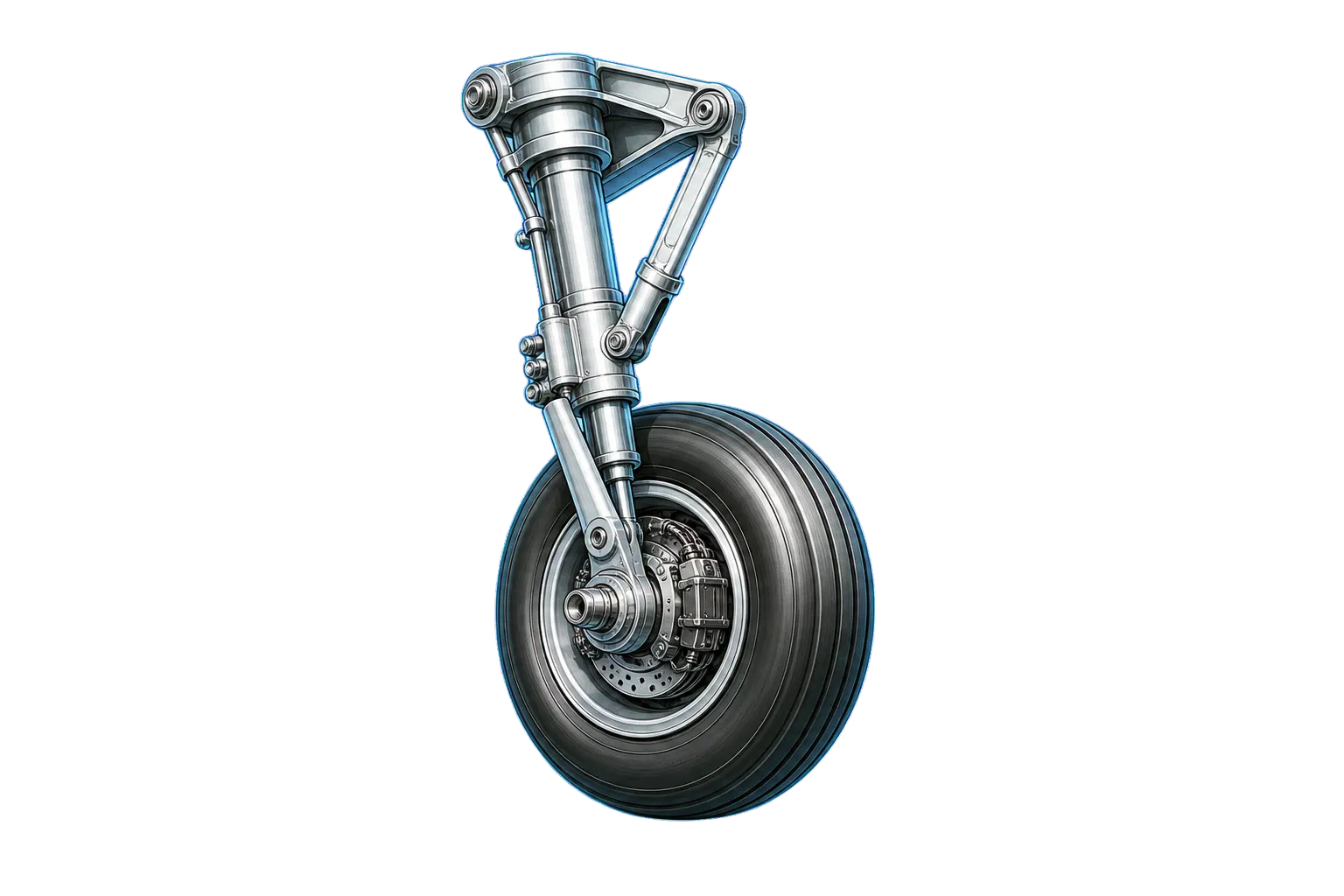
Reports indicate that two outer cylinders of the main landing gear (MLG) were found fractured in the weld area, which could result in a fracture of the outer cylinder and lead to collapse of the MLG during landing.
AI-generated summary from the source AD text. Verify against the official source before acting.
Required Actions
Inspect the outer cylinder of the MLG to determine the serial number. Perform an ultrasonic inspection of the outer cylinder for cracks if necessary. Take applicable specified and corrective actions if necessary.
AI-generated summary from the source AD text. Verify against the official source before acting.
Compliance Time
Within 6 years of the effective date of the AD.
AI-generated summary from the source AD text. Verify against the official source before acting.
Affected Aircraft
All Boeing Model 777-200 and -300 series airplanes.
AI-generated summary from the source AD text. Verify against the official source before acting.
Federal Register Abstract
The FAA is adopting a new airworthiness directive (AD) for all Boeing Model 777-200 and -300 series airplanes. This AD requires inspection of the outer cylinder of the main landing gear (MLG) to determine the serial number; an ultrasonic inspection of the outer cylinder of the MLG for cracks if necessary; and applicable specified and corrective actions if necessary. This AD is prompted by reports indicating that two outer cylinders were found fractured in the weld area. We are issuing this AD to detect and correct cracks or defects that could result in a fracture of the outer cylinder of the MLG, which could lead to collapse of the MLG during landing.
Document Text
Show stored source text (verify against official source)
[Federal Register Volume 70, Number 60 (Wednesday, March 30, 2005)]
[Rules and Regulations]
[Pages 16101-16104]
From the Federal Register Online via the Government Publishing Office [<a href="http://www.gpo.gov">www.gpo.gov</a>]
[FR Doc No: 05-6110]


-----------------------------------------------------------------------

DEPARTMENT OF TRANSPORTATION

Federal Aviation Administration

14 CFR Part 39

[Docket No. FAA-2004-19525; Directorate Identifier 2004-NM-18-AD;
Amendment 39-14026; AD 2005-07-02]
RIN 2120-AA64


Airworthiness Directives; Boeing Model 777-200 and -300 Series
Airplanes

AGENCY: Federal Aviation Administration (FAA), Department of
Transportation (DOT).

ACTION: Final rule.

-----------------------------------------------------------------------

SUMMARY: The FAA is adopting a new airworthiness directive (AD) for all
Boeing Model 777-200 and -300 series airplanes. This AD requires
inspection of the outer cylinder of the main landing gear (MLG) to
determine the serial number; an ultrasonic inspection of the outer
cylinder of the MLG for cracks if necessary; and applicable specified
and corrective actions if necessary. This AD is prompted by reports
indicating that two outer cylinders were found fractured in the weld
area. We are issuing this AD to detect and correct cracks or defects
that could result in a fracture of the outer cylinder of the MLG, which
could lead to collapse of the MLG during landing.

DATES: This AD becomes effective May 4, 2005.
    The incorporation by reference of a certain publication listed in
the AD is approved by the Director of the Federal Register as of May 4,
2005.

ADDRESSES: For service information identified in this AD, contact
Boeing Commercial Airplanes, P.O. Box 3707, Seattle, Washington 98124-
2207.
    Docket: The AD docket contains the proposed AD, comments, and any
final disposition. You can examine the AD docket on the Internet at
<a href="http://dms.dot.gov">http://dms.dot.gov</a>, or in person at the Docket Management Facility
office between 9 a.m. and 5 p.m., Monday through Friday, except Federal
holidays. The Docket Management Facility office (telephone (800) 647-
5227) is located on the plaza level of the Nassif Building at the U.S.
Department of Transportation, 400 Seventh Street SW., room PL-401,
Washington, DC. This docket number is FAA-2004-19525; the directorate
identifier for this docket is 2004-NM-18-AD.

FOR FURTHER INFORMATION CONTACT: Gary Oltman, Aerospace Engineer,
Airframe Branch, ANM-120S, FAA, Seattle Aircraft Certification Office,
1601 Lind Avenue, SW., Renton, Washington 98055-4056; telephone (425)
917-6443; fax (425) 917-6590.

SUPPLEMENTARY INFORMATION: The FAA proposed to amend 14 CFR Part 39
with an AD for all Boeing Model 777-200, -200ER, and -300 series
airplanes. That action, published in the Federal Register on November
4, 2004 (69 FR 64263), proposed to require inspection of the outer
cylinder of the main landing gear (MLG) to determine the serial number;
an ultrasonic inspection of the outer cylinder of the MLG for cracks if
necessary; and applicable specified and corrective actions if
necessary.

Comments

    We provided the public the opportunity to participate in the
development of this AD. We have considered the comments that have been
submitted on the proposed AD.

Request for Alternate Inspection or Extension of Compliance Time

    One commenter asks that an ``on-aircraft'' inspection be allowed as
an alternate means of accomplishing the inspection for cracking of the
main landing gear (MLG) in order to avoid unnecessary removal and
disassembly of the MLG. Additionally, the removal and disassembly costs
would be saved if an on-wing (on-aircraft) inspection were available.
The commenter also asks that, if an ``on-aircraft'' inspection is not
possible, the compliance time for accomplishing the inspection of the
outer cylinder of the MLG be extended until removal of the MLG can be
done at a normal maintenance time for overhaul. The commenter states
that it has airplanes that have been in-service for 4 years without any
problems, and notes that the cracking of the MLG was found before it
was installed on the airplane. The FAA would allow 6 years for
compliance, as specified in the proposed AD. The commenter adds that
the manufacturer states that 6 years is the time allowed for overhaul,
but the overhaul limit is actually 10 years.
    We do not agree with the commenter's request for an ``on-aircraft''
inspection in place of the inspection of the outer cylinder of the MLG.
There are no procedures for accomplishing an ``on-aircraft'' inspection
specified in the referenced service information. Nor do we agree to
extend the compliance time for accomplishing the inspection of the
outer cylinder of the MLG until the removal of the MLG can be done at a
normal maintenance time for overhaul. In developing an appropriate
compliance time for this action, we considered the recommendation of
the manufacturer, the urgency associated with the subject unsafe
condition, and the practical aspect of accomplishing the required
inspection within a period of time that corresponds to normal scheduled
maintenance for most affected operators. The compliance time specified
in this final rule represents an acceptable interval of time wherein
affected airplanes may be allowed to operate without jeopardizing
safety. In addition, no technical justification was provided to
substantiate this request. Paragraph (k)(1) of this AD provides
affected operators the opportunity to apply for an alternative method
of compliance (AMOC) and to present data to justify the adjustment of
the compliance time. We have made no change to the final rule in this
regard.

Request for Part Number or Serial Number Identification on Affected
Parts

    One commenter asks that part number (P/N) or serial number (S/N)
re-identification be done after accomplishing the required inspection.
The commenter states that the referenced service bulletin does not
require P/N or S/N re-identification of affected parts after
accomplishing the inspection: the procedures only specify engraving the
service bulletin number on the part. The commenter adds that the outer
cylinder of the MLG is a life-limited part that must be tracked for the
life of the part; therefore, P/N or S/N re-identification is necessary
to track incorporation of the referenced service bulletin and the
proposed AD. The

[[Page 16102]]

commenter notes that life-limited parts are tracked for the life of the
part, and operators must know on which airplanes the S/N identified in
the referenced service bulletin is installed.
    We do not agree with the commenter. The referenced service bulletin
specifies vibro-engraving or electro-chemically etching the service
bulletin number next to the existing P/N on the outer cylinder
assembly. We have determined that this action sufficiently
differentiates between pre- and post-modification of the part and
allows tracking for the life of the part. We have made no change to the
final rule in this regard.

Requests To Change Applicability or Allow Alternate Method for
Confirming the Serial Numbers

    One commenter asks that the applicability specified in the proposed
AD be changed to an appliance AD, which would be applicable only to
airplanes with parts having the P/N and S/N identified in the
referenced service bulletin, not all Model 777-200, -200ER, and -300
series airplanes. The commenter does not provide a reason for this
request.
    We do not agree with the commenter. Our general policy, when an
unsafe condition results from an appliance or other item that is, or
could be, installed on multiple airplane models, is that the AD is
issued so that it is applicable to those airplane models, rather than
to the item. The reason for this is simple: Making the AD applicable to
the airplane models on which the appliance or other item is installed
ensures that operators of those airplanes will be notified directly of
the unsafe condition and the action required to correct it. While it is
assumed that an operator will know the models of airplanes that it
operates, there is a potential that the operator will not know or be
aware of specific items that are installed on its airplanes. Therefore,
calling out the airplane model as the subject of the AD prevents
``unknowing non-compliance'' on the part of the operator. We have made
no change to the final rule in this regard.
    Another commenter asks that the applicability specified in the
proposed AD be changed to match the effectivity identified in the
referenced service bulletin, which applies to Model 777-200 series
airplanes only. If the applicability is not changed, the commenter asks
that an alternate method of confirming the S/N of the outer cylinder of
the MLG be allowed. The commenter notes that one method is using
digital records provided by the manufacturer. The commenter does not
provide a reason for this request.
    We partially agree with the commenter. We agree to change the
applicability specified in the proposed AD somewhat. As specified in
the ``Differences'' section of the proposed AD, Model 777-300 series
airplanes are included in the applicability since we determined that,
because of the potential for the affected outer cylinders to be
installed on Model 777-300 series airplanes, the proposed actions must
be done on those airplanes. As discussed below in ``Explanation of
Changes to Proposed AD,'' we inadvertently included Model 777-200ER
series airplanes; we have removed that model from the applicability
specified in this final rule.
    We agree to allow the use of digital records provided by the
manufacturer for confirming the serial number of the outer cylinder of
the MLG, provided that precise tracking of which outer cylinder serial
number is on which airplane since delivery can be determined from the
airplane maintenance records. The final rule already provides for this
by the maintenance records review specified in paragraph (h) of this
AD. We have made no change to the final rule in this regard.

Request for Preliminary Inspection

    One commenter asks that the requirements specified in paragraph
(h)(2) of the proposed AD be changed to allow for a preliminary
inspection of serial numbers to determine which airplanes are affected
by the proposed AD. The commenter also asks to be allowed to accomplish
any necessary inspections and corrective action at a later time, as
long as those actions are accomplished within the compliance time
required by paragraph (g) of the proposed AD. The commenter states that
paragraph (h)(2) of the proposed AD specifies that if any serial number
identified in the referenced service bulletin is installed, the
ultrasonic inspection must be accomplished before further flight, in
addition to accomplishing all applicable specified actions and any
corrective action.
    We agree that a preliminary inspection to determine the serial
numbers of affected airplanes may be accomplished before accomplishing
the requirements specified in paragraph (h)(2) of this AD. Operators
are always permitted to perform actions earlier than the compliance
time specified in an AD. In this case, it is at the operator's
discretion to accomplish a preliminary inspection of the serial numbers
to determine which airplanes are affected by the AD at any time before
the required compliance time, if that time more closely fits the
operator's maintenance schedule. We also agree that the inspection for
cracking and any applicable specified actions, as required by paragraph
(h)(2), may be accomplished at a later time as long as the inspection
for cracking is done within the compliance time required by paragraph
(g) of this AD. Paragraph (h)(2) of this AD has been changed
accordingly.
    We do not agree that any applicable corrective action resulting
from inspection findings may be accomplished at a later time; the
corrective action must always be accomplished before further flight
after accomplishing the required inspection to maintain safety of
flight. We have made no change to the final rule in this regard.

Explanation of Changes to Proposed AD

    The applicability in the proposed AD addresses ``All Boeing Model
777-200, -200ER, and -300 series airplanes.'' We inadvertently included
Model 777-200ER series airplanes, which are not specified on the type
certificate data sheet and are encompassed within the Model 777-200
series. Our intent is that the AD apply to all Model 777-200 and -300
series airplanes; therefore, we have changed the applicability in this
final rule accordingly.
    Boeing has received a Delegation Option Authorization (DOA). We
have revised this final rule to delegate the authority to approve an
AMOC for any repair required by this AD to the Authorized
Representative for the Boeing DOA Organization rather than the
Designated Engineering Representative.

Conclusion

    We have carefully reviewed the available data, including the
comments that have been submitted, and determined that air safety and
the public interest require adopting the AD with the changes described
previously. These changes will neither increase the economic burden on
any operator nor increase the scope of the AD.

Costs of Compliance

    This AD affects about 463 Model 777 series airplanes worldwide. The
following table provides the estimated costs for U.S. operators to
comply with this AD.

[[Page 16103]]


                                                                     Estimated Costs
--------------------------------------------------------------------------------------------------------------------------------------------------------
                                                           Average                                           Number of U.S.-
              Action                    Work hours        labor rate       Parts       Cost per airplane        registered             Fleet cost
                                                           per hour                                             airplanes
--------------------------------------------------------------------------------------------------------------------------------------------------------
Part Number Inspection...........  1 to 229 (depending           $65  None..........  $65 to $14,885.....  133................  $8,645 to $1,979,705
                                    on which inspection
                                    method is used).
Ultrasonic Inspection (if          6...................          $65  None..........  $390 per outer       unknown, but there   $10,140
 necessary).                                                                           cylinder, $780 for   may be up to 26
                                                                                       both outer           affected outer
                                                                                       cylinders on the     cylinders in fleet.
                                                                                       airplane.
--------------------------------------------------------------------------------------------------------------------------------------------------------

Authority for This Rulemaking

    Title 49 of the United States Code specifies the FAA's authority to
issue rules on aviation safety. Subtitle I, Section 106, describes the
authority of the FAA Administrator. Subtitle VII, Aviation Programs,
describes in more detail the scope of the Agency's authority.
    We are issuing this rulemaking under the authority described in
Subtitle VII, Part A, Subpart III, Section 44701, ``General
requirements.'' Under that section, Congress charges the FAA with
promoting safe flight of civil aircraft in air commerce by prescribing
regulations for practices, methods, and procedures the Administrator
finds necessary for safety in air commerce. This regulation is within
the scope of that authority because it addresses an unsafe condition
that is likely to exist or develop on products identified in this
rulemaking action.

Regulatory Findings

    We have determined that this AD will not have federalism
implications under Executive Order 13132. This AD will not have a
substantial direct effect on the States, on the relationship between
the national government and the States, or on the distribution of power
and responsibilities among the various levels of government.
    For the reasons discussed above, I certify that this AD:
    (1) Is not a ``significant regulatory action'' under Executive
Order 12866;
    (2) Is not a ``significant rule'' under DOT Regulatory Policies and
Procedures (44 FR 11034, February 26, 1979); and
    (3) Will not have a significant economic impact, positive or
negative, on a substantial number of small entities under the criteria
of the Regulatory Flexibility Act.
    We prepared a regulatory evaluation of the estimated costs to
comply with this AD. See the ADDRESSES section for a location to
examine the regulatory evaluation.

List of Subjects in 14 CFR Part 39

    Air transportation, Aircraft, Aviation safety, Incorporation by
Reference, Safety.

Adoption of the Amendment

0
Accordingly, under the authority delegated to me by the Administrator,
the FAA amends 14 CFR part 39 as follows:

PART 39--AIRWORTHINESS DIRECTIVES

0
1. The authority citation for part 39 continues to read as follows:

    Authority: 49 U.S.C. 106(g), 40113, 44701.


Sec.  39.13  [Amended]

0
2. The FAA amends Sec.  39.13 by adding the following new airworthiness
directive (AD):

2005-07-02 Boeing: Amendment 39-14026. Docket No. FAA-2004-19525;
Directorate Identifier 2004-NM-18-AD.

Effective Date

    (a) This AD becomes effective May 4, 2005.

Affected ADs

    (b) None.

Applicability

    (c) This AD applies to all Boeing Model 777-200 and -300 series
airplanes; certificated in any category.

Unsafe Condition

    (d) This AD was prompted by reports that two outer cylinders of
the main landing gear (MLG) were found fractured in the weld area.
We are issuing this AD to detect and correct cracks or defects that
could result in a fracture of the outer cylinder of the MLG, which
could lead to collapse of the MLG during landing.

Compliance

    (e) You are responsible for having the actions required by this
AD performed within the compliance times specified, unless the
actions have already been done.

Service Bulletin References

    (f) The term ``the service bulletin,'' as used in this AD, means
the Accomplishment Instructions of Boeing Alert Service Bulletin
777-32A0038, Revision 1, dated February 19, 2004.

Compliance Time

    (g) Perform the applicable actions specified in paragraph (h) of
this AD at the later of the times specified in paragraphs (g)(1) and
(g)(2) of this AD.
    (1) Within 4,000 flight cycles or 750 days after the effective
date of this AD, whichever occurs first; or
    (2) Before accumulation of 8,000 total flight cycles on the
outer cylinder or 72 months on the outer cylinder since new,
whichever occurs first.

Part Identification Inspection, Ultrasonic Inspection, and Corrective
Action

    (h) Inspect the outer cylinder of the MLG to determine whether
an outer cylinder having a serial number (S/N) listed in paragraph
1.D., ``Description,'' of the service bulletin is installed. Instead
of an inspection of the outer cylinder of the MLG, a review of
airplane maintenance records is acceptable if the S/N of the outer
cylinder can be positively determined from that review.
    (1) If no S/N identified in the service bulletin is installed,
no further action is required by this paragraph.
    (2) If any S/N identified in the service bulletin is installed,
at the applicable compliance time specified in paragraph (g) of this
AD, do an ultrasonic inspection of the outer cylinder of the MLG for
cracks, and do all applicable specified and corrective actions per
the service bulletin. Do any applicable corrective action before
further flight.

Reporting a Crack

    (i) Submit a report of any crack that is found during the
inspection required by paragraph (h)(2) of this AD to the Manager,
Seattle Aircraft Certification Office (ACO), FAA, 1601 Lind Avenue,
SW., Renton, Washington, at the applicable time specified in
paragraph (i)(1) or (i)(2) of this AD. The report must include the
inspection results, a description of any discrepancies found, the
outer cylinder serial number and part number, and the number of
landings and flight hours on the outer cylinder. Under the
provisions of the Paperwork Reduction Act of 1980 (44 U.S.C. 3501 et
seq.), the Office of Management and Budget (OMB) has approved the
information collection requirements contained in this AD and has
assigned OMB Control Number 2120-0056.

[[Page 16104]]

    (1) If the inspection was done after the effective date of this
AD: Submit the report within 10 days after the inspection.
    (2) If the inspection was accomplished prior to the effective
date of this AD: Submit the report within 10 days after the
effective date of this AD.

Parts Installation

    (j) As of the effective date of this AD, no person may install
an outer cylinder having a S/N listed in paragraph 1.D.,
``Description,'' of the service bulletin on any airplane unless it
has been inspected and all specified and corrective actions are
accomplished in accordance with paragraph (h)(2) of this AD.

Alternative Methods of Compliance (AMOCs)

    (k)(1) The Manager, Seattle ACO, has the authority to approve
AMOCs for this AD, if requested in accordance with the procedures
found in 14 CFR 39.19.
    (2) An AMOC that provides an acceptable level of safety may be
used for any repair required by this AD, if it is approved by an
Authorized Representative for the Boeing Delegation Option
Authorization Organization who has been authorized by the Manager,
Seattle ACO, to make those findings.

Material Incorporated by Reference

    (l) You must use Boeing Alert Service Bulletin 777-32A0038,
Revision 1, dated February 19, 2004, to perform the actions that are
required by this AD, unless the AD specifies otherwise. The Director
of the Federal Register approves the incorporation by reference of
this document in accordance with 5 U.S.C. 552(a) and 1 CFR part 51.
For copies of the service information, contact Boeing Commercial
Airplanes, P.O. Box 3707, Seattle, Washington 98124-2207. For
information on the availability of this material at the National
Archives and Records Administration (NARA), call (202) 741-6030, or
go to <a href="http://www.archives.gov/federal_register/code_of_federal_regulations/ibr_locations.html">http://www.archives.gov/federal_register/code_of_federal_regulations/ibr_locations.html</a>. You may view the AD docket at the
Docket Management Facility, U.S. Department of Transportation, 400
Seventh Street SW., room PL-401, Nassif Building, Washington, DC.

    Issued in Renton, Washington, on March 21, 2005.
Ali Bahrami,
Manager, Transport Airplane Directorate, Aircraft Certification
Service.
[FR Doc. 05-6110 Filed 3-29-05; 8:45 am]
BILLING CODE 4910-13-P
Source: Official FAA Source ↗
Retrieved: Apr 4, 2026
Rights: U.S. Government Public Domain
This site is not affiliated with or endorsed by the FAA. Always verify with official sources.
Related Airworthiness Directives
2025-21-02
final ruleAirworthiness Directives; The Boeing Company Airplanes
Unsafe Condition: high electrical resistance in both transorb modules, which can result in two actuator control electronics (ACEs) being exposed to damaging lightning transient voltages in excess of the qualificatio...

2025-15-09 Recurring
final ruleAirworthiness Directives; The Boeing Company Airplanes
Unsafe Condition: uncommanded fore and aft movement of the Captain's and First Officer's seats which, during a critical part of a flight such as takeoff or landing, could cause a flight control obstruction or uninte...
2025-05-10
final ruleAirworthiness Directives; The Boeing Company Airplanes
Unsafe Condition: fatigue cracking of various principal structural elements
2025-06-12
final ruleAirworthiness Directives; The Boeing Company Airplanes
Unsafe Condition: a glideslope (G/S) beam anomaly during an instrument landing system (ILS) approach, which resulted in a higher-than-expected descent rate during the final segment of an ILS approach, and misleading...