AD 2001-09-18
Applicability
| Type | Manufacturer | Model | Details |
|---|---|---|---|
| aircraft | The Boeing Company | DC-9-81 (MD-81) | Airworthiness Directives; McDonnell Douglas Model DC-9-80 Series Airplanes and Model MD-88 Airplanes |
| aircraft | The Boeing Company | DC-9-82 (MD-82) | Airworthiness Directives; McDonnell Douglas Model DC-9-80 Series Airplanes and Model MD-88 Airplanes |
| aircraft | The Boeing Company | DC-9-83 (MD-83) | Airworthiness Directives; McDonnell Douglas Model DC-9-80 Series Airplanes and Model MD-88 Airplanes |
| aircraft | The Boeing Company | DC-9-87 (MD-87) | Airworthiness Directives; McDonnell Douglas Model DC-9-80 Series Airplanes and Model MD-88 Airplanes |
| aircraft | The Boeing Company | MD-88 | Airworthiness Directives; McDonnell Douglas Model DC-9-80 Series Airplanes and Model MD-88 Airplanes |
Unsafe Condition
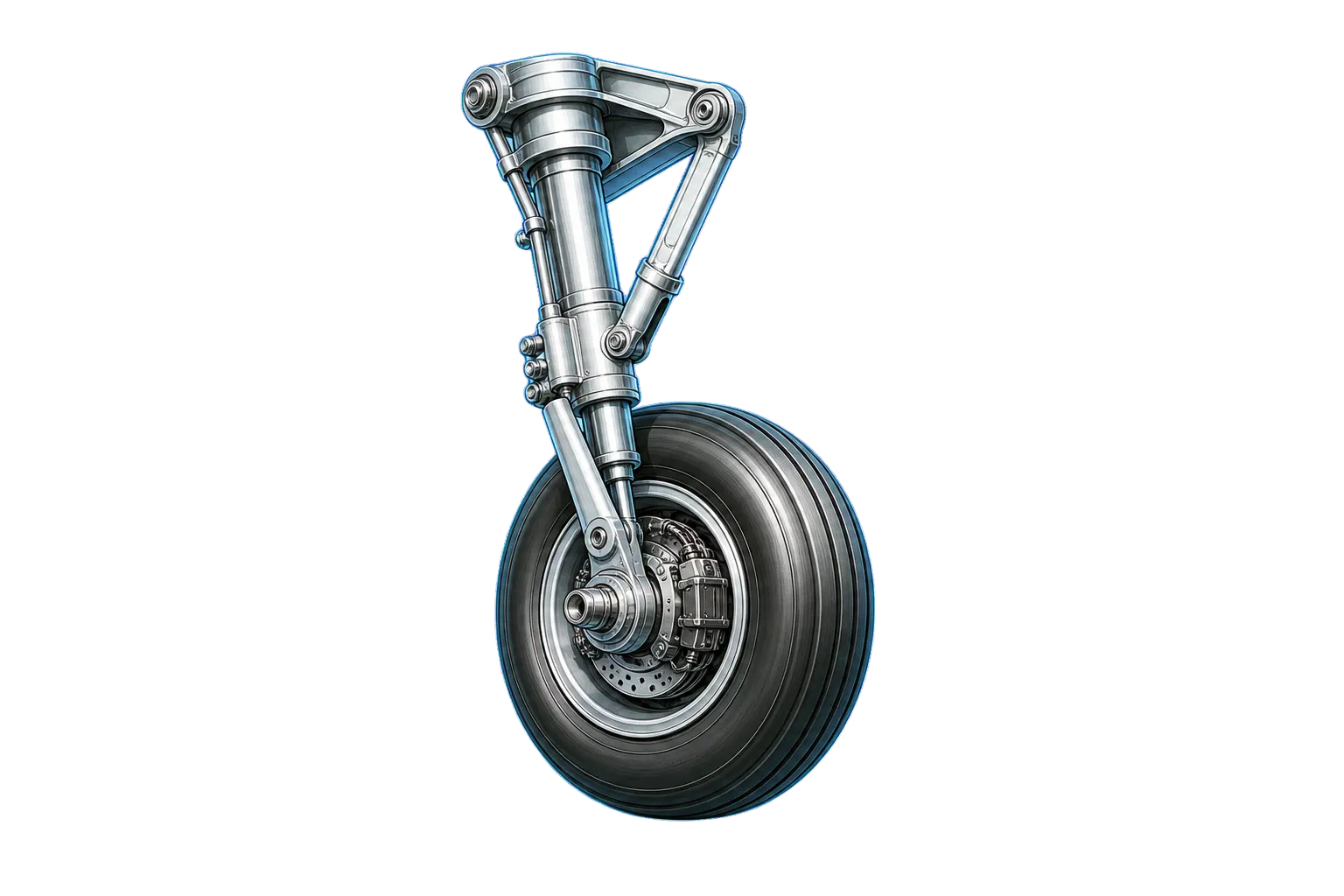
Fatigue cracking of the main landing gear (MLG) pistons, which could result in failure of the pistons and subsequent damage to the airplane structure or injury to airplane occupants.
AI-generated summary from the source AD text. Verify against the official source before acting.
Required Actions
Repetitive dye penetrant and magnetic particle inspections to detect cracks of the MLG pistons; repair and replacement of discrepant parts; installation of a preventative modification; and an optional terminating action for certain MLG pistons.
AI-generated summary from the source AD text. Verify against the official source before acting.
Compliance Time
Within 1,500 landings or 12 months after the effective date of this AD for MLG pistons that have not been inspected.
AI-generated summary from the source AD text. Verify against the official source before acting.
Affected Aircraft
McDonnell Douglas Model DC-9-80 Series Airplanes and Model MD-88 Airplanes.
AI-generated summary from the source AD text. Verify against the official source before acting.
Federal Register Abstract
This amendment supersedes an existing airworthiness directive (AD), applicable to certain McDonnell Douglas Model DC-9-80 series airplanes and Model MD-88 airplanes, that currently requires a one-time inspection to detect cracking of the main landing gear (MLG) pistons, and repair or replacement of the pistons with new or serviceable parts, if necessary. This amendment requires, among other actions, repetitive dye penetrant and magnetic particle inspections to detect cracks of the MLG pistons; repair and replacement of discrepant parts; and installation of a preventative modification; as applicable. This amendment also provides for an optional terminating action for certain MLG pistons. This amendment is prompted by additional reports of failure of the MLG pistons during towing of the airplanes. The actions specified by this AD are intended to prevent fatigue cracking of the MLG pistons, which could result in failure of the pistons and subsequent damage to the airplane structure or injury to airplane occupants.
Document Text
Show stored source text (verify against official source)
[Federal Register Volume 66, Number 91 (Thursday, May 10, 2001)]
[Rules and Regulations]
[Pages 23840-23845]
From the Federal Register Online via the Government Publishing Office [<a href="http://www.gpo.gov">www.gpo.gov</a>]
[FR Doc No: 01-11674]


-----------------------------------------------------------------------

DEPARTMENT OF TRANSPORTATION

Federal Aviation Administration

14 CFR Part 39

[Docket No. 99-NM-164-AD; Amendment 39-12225; AD 2001-09-18]
RIN 2120-AA64


Airworthiness Directives; McDonnell Douglas Model DC-9-80 Series
Airplanes and Model MD-88 Airplanes

AGENCY: Federal Aviation Administration, DOT.

ACTION: Final rule.

-----------------------------------------------------------------------

SUMMARY: This amendment supersedes an existing airworthiness directive
(AD), applicable to certain McDonnell Douglas Model DC-9-80 series
airplanes and Model MD-88 airplanes, that currently requires a one-time
inspection to detect cracking of the main landing gear (MLG) pistons,
and repair or replacement of the pistons with new or serviceable parts,
if necessary. This amendment requires, among other actions, repetitive
dye penetrant and magnetic particle inspections to detect cracks of the
MLG pistons; repair and replacement of discrepant parts; and
installation of a preventative modification; as applicable. This
amendment also provides for an optional terminating action for certain
MLG pistons. This amendment is prompted by additional reports of
failure of the MLG pistons during towing of the airplanes. The actions
specified by this AD are intended to prevent fatigue cracking of the
MLG pistons, which could result in

[[Page 23841]]

failure of the pistons and subsequent damage to the airplane structure
or injury to airplane occupants.

DATES: Effective June 14, 2001.
    The incorporation by reference of certain publications listed in
the regulations is approved by the Director of the Federal Register as
of June 14, 2001.

ADDRESSES: The service information referenced in this AD may be
obtained from Boeing Commercial Aircraft Group, Long Beach Division,
3855 Lakewood Boulevard, Long Beach, California 90846, Attention: Data
and Service Management, Dept. C1-L5A (D800-0024). This information may
be examined at the Federal Aviation Administration (FAA), Transport
Airplane Directorate, Rules Docket, 1601 Lind Avenue, SW., Renton,
Washington; or at the FAA, Los Angeles Aircraft Certification Office,
3960 Paramount Boulevard, Lakewood, California; or at the Office of the
Federal Register, 800 North Capitol Street, NW., suite 700, Washington,
DC.

FOR FURTHER INFORMATION CONTACT: Brent Bandley, Aerospace Engineer,
Airframe Branch, ANM-120L, FAA, Los Angeles Aircraft Certification
Office, 3960 Paramount Boulevard, Lakewood, California 90712; telephone
(310) 627-5237; fax (310) 627-5210.

SUPPLEMENTARY INFORMATION: A proposal to amend part 39 of the Federal
Aviation Regulations (14 CFR part 39) by superseding AD 96-19-09,
amendment 39-9756 (61 FR 48617, September 16, 1996), which is
applicable to certain McDonnell Douglas Model DC-9-80 series airplanes
and Model MD-88 airplanes series airplanes, was published in the
Federal Register on October 4, 2000 (65 FR 59146). The action proposed
to require, among other actions, repetitive dye penetrant and magnetic
particle inspections to detect cracks of the main landing gear (MLG)
pistons; repair and replacement of discrepant parts; and installation
of a preventative modification; as applicable. The action also proposed
an optional terminating action for certain MLG pistons.

Comments Received

    Interested persons have been afforded an opportunity to participate
in the making of this amendment. Due consideration has been given to
the comments received.

Request To Revise Note 1 of the Proposed AD

    One commenter request that the following sentence be added to Note
1 of the proposed AD: ``Modification per previous revisions of the
referenced service bulletin or dispositions from the manufacturer that
occurred prior to the effective date of the AD comply with the AD.''
    The FAA partially agrees. We do not agree to include the sentence
suggested by the commenter. However, as discussed below, we have
included new notes in the final rule to give operators credit for
accomplishing the preventative modification before the effective date
of this AD.

Request To Give Credit for Preventative Modifications Accomplished
Previously

    One commenter requests that operators be given credit for
accomplishing the preventative modification per the original version,
or Revisions 01 through 03 of McDonnell Douglas Service Bulletin MD80-
32-277, or procedures developed and analyzed by Boeing and approved by
the FAA before the effective date of the AD. The commenter notes that
Revision 04 of Service Bulletin MD80-32-277 (referenced as the
appropriate source of service information for the requirements of this
AD) contains procedures for wet grinding and flap shot peening, which
were not recommended in the previous revisions of the service bulletin.
    Two other commenters request that the applicability of paragraph
(e)(2)(i) of the proposed AD include any MLG piston modified before the
effective date of the AD per the original version, or Revisions 01
through 03 of McDonnell Douglas Service Bulletin MD80-32-277, or
Service Rework Drawing SR08320081.
    One of the commenters notes that one of the paragraphs in the
Discussion section of the proposed AD states ``Operators should note
that, although the service bulletin specifies that the manufacturer may
be contacted for disposition of certain repair conditions, this
proposal would require the repair of those conditions to be
accomplished per a method approved by the FAA. The commenter requests
that it be revised to ``* * * certain repair conditions, for all
repairs performed after the effective date of this AD, this proposed AD
* * * .''
    The FAA partially agrees. We find that modification of any MLG
piston or replacement with a modified MLG per the original version, and
Revisions 1 through 4 of the referenced service bulletin, Service
Rework Drawing SR08320081, or any FAA-approved preventative
modification to MLG pistons, before the effective date of this AD, is
considered acceptable for compliance with the preventative modification
requirements of paragraphs (a)(3), (b)(1)(iii), (b)(2), and (c)(1) of
this AD, and with the replacement requirements of paragraphs (c)(2) and
(d)(1) of this AD. Therefore, we have included new notes in the final
rule to clarify this point. With the inclusion of these new notes, we
find that the applicability of paragraph (e)(2)(i) of the final rule
does not need to be changed. We also find that a revision to the
Discussion section, as suggested by the commenter, is not necessary
because that section does not reappear in the final rule.

Request To Include Reidentified Part Number

    Two commenters request that paragraph (e) of the proposed AD also
reference the part number (P/N) for MLG pistons that were modified and
reidentified as P/N SR09320081-3 through SR09320081-13 inclusive,
depending on its corresponding original identity. One of the commenters
states that it tracks the MLG pistons by the applicable ``SR'' part
number, which are listed in McDonnell Douglas Service Bulletin MD80-32-
277, Revisions 01 through 04.
    The FAA agrees that the affected MLG piston, P/N 5935347-1 through
5935347-509 inclusive, identified in paragraph (e) of the AD, have been
modified and reidentified as P/N SR09320081-3 through SR09320081-13
inclusive. We have revised paragraph (e) of the final rule to clarify
this point.

Request For Clarification of Applicability of Paragraph (e)(2)(ii) of
the Proposed AD

    The applicability of paragraph (e)(2)(ii) of the proposed AD reads
``For any MLG piston that has been modified prior to the effective date
of this AD.'' One commenter interprets this to mean pistons modified
prior to December 7, 1999 (the issuance date of Revision 04 of
McDonnell Douglas Service Bulletin MD80-32-277). The commenter states
that it is reasonable to assume that some pistons may have been
modified by Revision 04 of the referenced service bulletin since its
issuance in December 1999.
    From this comment, the FAA infers that the commenter is requesting
that the applicability of paragraph (e)(2)(ii) of the proposed AD be
clarified. We agree that clarification is necessary. The commenter is
incorrect in its interpretation that the applicability of paragraph
(e)(2)(ii) of the AD refers to MLG pistons modified per Revision 04 of
McDonnell Douglas Service Bulletin MD80-32-277 prior to December 7,
1999. Our intent was that paragraph (e)(2)(ii) of the AD be applicable
to ``For any MLG piston that has been modified

[[Page 23842]]

per service information other than Revision 04 of McDonnell Douglas
Service Bulletin MD80-32-277 and not inspected per Revision 04 of the
service bulletin prior to the effective date of this AD.'' We have
revised paragraph (e)(2)(ii) of the final rule accordingly to clarify
this point.

Requests To Give Credit for Repetitive Inspections Since Modification

    Several commenters request that the FAA give credit to operators
that are doing repetitive inspections every 2,500 landings since
modification of the MLG pistons per McDonnell Douglas Service Bulletin
MD80-32-277, Revision 04, dated December 7, 1999, for the initial
inspections required by paragraph (e)(2)(ii) of the proposed AD and the
repetitive inspections required by paragraph (f) of the proposed AD.
Two commenters also state that paragraph (h)(2) of the proposed AD has
a similar requirement and request that paragraph (h)(2) of the proposed
AD also be revised.
    Another commenter states that, based on its service history, any
MLG piston that has been inspected every 2,500 landings provides an
equivalent level of safety. The commenter has no objection to the
proposed initial compliance time of within 1,500 landings or 12 months
after the effective date of this AD for MLG pistons that have not been
inspected.
    The FAA does not consider that a change, as requested by the
commenters, to the final rule is necessary. Operators are given credit
for work previously performed by means of the phrase in the
``Compliance'' section of the AD that states, ``Required as indicated,
unless accomplished previously.'' Therefore, in the case of paragraphs
(f) and (h)(2) of this AD, if the required inspection has been
accomplished prior to the effective date of this AD, this AD does not
require that it be repeated. However, this AD does require that
repetitive inspections be conducted thereafter at intervals not to
exceed 2,500 landings (if no cracking is detected, as specified in
paragraphs (f) and (i) of the final rule), and that other follow-on
actions be accomplished when indicated.

Request To Revise A Certain Compliance Time in Paragraph (f) of the
Proposed AD

    Several commenters request that the compliance time of ``prior to
the accumulation of 30,000 or more total landings on the MLG piston''
specified in paragraph (f) of the proposed AD be changed to ``within
30,000 landings since modification of the MLG.'' One of the commenters
states that the subject compliance time of paragraph (f) of the
proposed AD conflicts with paragraph (a)(3) of the proposed AD, which
requires the preventative modification of certain MLG pistons (non-
modified) that have accumulated 30,000 or more total landings to be
done ``within 2 years or 5,000 landings on the MLG piston after the
effective date of this AD.'' In this scenario, the commenter contends
that a non-modified piston has an extended service allowance and
modified pistons have been penalized.
    Another commenter states that the proposed compliance time
conflicts with the requirements of paragraphs (b)(1)(iii) and (e)(2) of
the proposed AD. Paragraph (b)(1)(iii) of the proposed AD requires the
preventative modification ``prior to the accumulation of 30,000 or more
total landings on the MLG piston.'' Paragraph (e)(2) of the proposed AD
requires dye penetrant and magnetic particle inspections for any MLG
piston that has accumulated less than 30,000 landings since
accomplishment of the modification.
    It was the FAA's intent that the replacement required by paragraph
(f) of the proposed AD be accomplished within 30,000 landing since
modification of the MLG. Therefore, we agree with the commenters to
revise the compliance time of paragraph (f) of the final rule from
``prior to the accumulation of 30,000 or more total landings on the MLG
piston'' to ``within 30,000 landings since modification of the MLG''
and have revised the final rule accordingly.

Request To Revise Phrase ``Since Date of Manufacture''

    One commenter requests that the phrase ``since date of
manufacture'' be revised to ``since date of installation'' in
paragraphs (h)(1), (h)(2), and (h)(3) of the proposed AD. The commenter
states that industry's standard for tracking safe-life landing gear
components is total landings accumulated from the date of installation,
not the date of manufacture.
    The FAA does not agree. Because MLG pistons can be taken off
airplanes and sold to other operators, there potentially could be
multiple installations. Operators may misinterpret ``date of
installation'' to mean that every time a MLG piston is installed, the
number of landings returns to zero. Therefore, we find ``date of
manufacture'' (i.e., since new) to be the correct phrase.

Request To Reference Correct Service Bulletin for Optional Terminating
Action

    Several commenters request that paragraph (l) of the proposed AD be
revised to reference McDonnell Douglas Service Bulletin MD80-32-309,
which was issued by Boeing on January 31, 2000, instead of McDonnell
Douglas Service Bulletin MD80-32-277, Revision 04, dated December 7,
1999. One commenter states that Service Bulletin MD80-32-277 does not
reference any configuration beyond part number (P/N) 5935347-511 for
replacement of prior configurations. The commenter also states that
Service Bulletin MD80-32-309 specifies that MLG piston, P/N 5935347-
517, is an approved configuration for closing action, and that it is an
FAA-approved alternative method of compliance for both AD's 96-19-09
and 99-13-07.
    The FAA agrees. We have reviewed McDonnell Douglas Service Bulletin
MD80-32-277, Revision 04, dated December 7, 1999, and acknowledge that
it does not describe procedures for replacement of any MLG piston with
a MLG piston, P/N 5935347-517. The correct service information for
accomplishing the replacement specified in paragraph (l) of this AD is
McDonnell Douglas Service Bulletin MD80-32-309, dated January 31, 2000.
We have revised paragraph (l) of the final rule accordingly.
    Operators should note that Service Bulletin MD80-32-309 also
describes procedures for replacement of the MLG piston due to cracking
near the radius of the jackball fitting. However, this proposed AD does
not address the actions associated with the jackball fitting. We may
consider issuing a separate rulemaking action to supersede AD 99-13-07.

Request To Include Inspection of Jackball Fitting

    One commenter requests that the proposed AD require an inspection/
rework of the aft torque link lug and inspection of the jackball
fitting. The commenter provided no explanation for its request. The FAA
does not agree. As discussed above, the FAA may issue a separate
rulemaking action to address any identified unsafe condition associated
with the jackball fitting.

Question About How To Determine the Inspection Interval and Imposed
Life Limit

    One commenter asks how to determine the inspection interval and the
imposed life limit for MLG pistons that were previously modified per

[[Page 23843]]

McDonnell Douglas Service Bulletin MD80-32-277, when it cannot
determine the times and cycles accumulated at the time of modification.
    The FAA finds that, if the cycle count of the MLG piston cannot be
determined at the time of modification, operators should work with an
appropriate FAA Principal Maintenance Inspector (PMI), the Manager of
the Los Angeles Aircraft Certification Office (ACO), and the airplane
manufacturer to resolve the issue.

Conclusion

    After careful review of the available data, including the comments
noted above, the FAA has determined that air safety and the public
interest require the adoption of the rule with the changes previously
described. The FAA has determined that these changes will neither
increase the economic burden on any operator nor increase the scope of
the AD.

Cost Impact

    There are approximately 1,200 Model DC-9-80 series airplanes and
Model MD-88 airplanes of the affected design in the worldwide fleet.
The FAA estimates that 700 airplanes of U.S. registry will be affected
by this AD.
    Should an operator be required to do the dye penetrant and magnetic
particle inspections, it will take approximately 2 work hours per MLG
piston to accomplish the inspections, at an average labor rate of $60
per work hour. Based on these figures, the cost impact of these
inspections required by this AD on U.S. operators is estimated to be
$120 per MLG piston.
    Should an operator be required to do the preventative modification,
it will take approximately 6 work hours per MLG piston to accomplish
the inspections, at an average labor rate of $60 per work hour. Based
on these figures, the cost impact of these inspections required by this
AD on U.S. operators is estimated to be $360 per MLG piston.
    The cost impact figures discussed above are based on assumptions
that no operator has yet accomplished any of the requirements of this
AD action, and that no operator would accomplish those actions in the
future if this AD were not adopted. The cost impact figures discussed
in AD rulemaking actions represent only the time necessary to perform
the specific actions actually required by the AD. These figures
typically do not include incidental costs, such as the time required to
gain access and close up, planning time, or time necessitated by other
administrative actions.
    Should an operator elect to accomplish the optional terminating
action that is provided by this AD action, it would take approximately
31 work hours per MLG piston to accomplish it, at an average labor rate
of $60 per work hour. The cost of required parts would be approximately
$107,070 per MLG piston. Based on these figures, the cost impact of the
optional terminating action would be $108,930 per MLG piston.

Regulatory Impact

    The regulations adopted herein will not have a substantial direct
effect on the States, on the relationship between the national
Government and the States, or on the distribution of power and
responsibilities among the various levels of government. Therefore, it
is determined that this final rule does not have federalism
implications under Executive Order 13132.
    For the reasons discussed above, I certify that this action (1) is
not a ``significant regulatory action'' under Executive Order 12866;
(2) is not a ``significant rule'' under DOT Regulatory Policies and
Procedures (44 FR 11034, February 26, 1979); and (3) will not have a
significant economic impact, positive or negative, on a substantial
number of small entities under the criteria of the Regulatory
Flexibility Act. A final evaluation has been prepared for this action
and it is contained in the Rules Docket. A copy of it may be obtained
from the Rules Docket at the location provided under the caption
ADDRESSES.

List of Subjects in 14 CFR Part 39

    Air transportation, Aircraft, Aviation safety, Incorporation by
reference, Safety.

Adoption of the Amendment

    Accordingly, pursuant to the authority delegated to me by the
Administrator, the Federal Aviation Administration amends part 39 of
the Federal Aviation Regulations (14 CFR part 39) as follows:

PART 39--AIRWORTHINESS DIRECTIVES

    1. The authority citation for part 39 continues to read as follows:

    Authority: 49 U.S.C. 106(g), 40113, 44701.


Sec. 39.13  [Amended]

    2. Section 39.13 is amended by removing amendment 39-9756 (61 FR
48617, September 16, 1996), and by adding a new airworthiness directive
(AD), amendment 39-12225, to read as follows:

2001-09-18  McDonnell Douglas: Amendment 39-12225. Docket 99-NM-164-
AD. Supersedes AD 96-19-09, Amendment 39-9756.

    Applicability: Model DC-9-81 (MD-81), DC-9-82 (MD-82), DC-9-83
(MD-83), and DC-9-87 (MD-87) series airplanes; and Model MD-88
airplanes; as listed in McDonnell Douglas Service Bulletin MD80-32-
277, Revision 04, dated December 7, 1999; certificated in any
category.

    Note 1: This AD applies to each airplane identified in the
preceding applicability provision, regardless of whether it has been
modified, altered, or repaired in the area subject to the
requirements of this AD. For airplanes that have been modified,
altered, or repaired so that the performance of the requirements of
this AD is affected, the owner/operator must request approval for an
alternative method of compliance in accordance with paragraph (m)(1)
of this AD. The request should include an assessment of the effect
of the modification, alteration, or repair on the unsafe condition
addressed by this AD; and, if the unsafe condition has not been
eliminated, the request should include specific proposed actions to
address it.

    Compliance: Required as indicated, unless accomplished
previously.
    To prevent fatigue cracking of the main landing gear (MLG)
pistons, which could result in failure of the pistons and subsequent
damage to the airplane structure or injury to airplane occupants,
accomplish the following:

For Airplanes on Which Certain Pistons Have Not Been Modified:
Inspections

    (a) For airplanes on which any MLG piston, part number (P/N)
5935347-1 through 5935347-509 inclusive, has NOT been modified: Do
the actions specified in paragraph (a)(1), (a)(2), or (a)(3) of this
AD, as applicable, per the Accomplishment Instructions of McDonnell
Douglas Service Bulletin MD80-32-277, Revision 04, dated December 7,
1999.
    (1) For any MLG piston that has accumulated less than 5,000
total landings since date of manufacture: Prior to the accumulation
of 5,000 total landings on the MLG piston, or within 12 months after
the effective date of this AD, whichever occurs later, do dye
penetrant and magnetic particle inspections to detect cracks of the
MLG pistons.
    (2) For any MLG piston that has accumulated 5,000 or more total
landings since date of manufacture, but less than 30,000 total
landings since date of manufacture: Within 1,500 landings on the MLG
piston or 12 months after the effective date of this AD, whichever
occurs later, do dye penetrant and magnetic particle inspections to
detect cracks of the MLG pistons.
    (3) For any MLG piston that has accumulated 30,000 or more total
landings since date of manufacture: Within 2 years or 5,000 landings
on the MLG piston after the effective date of this AD, whichever
occurs first, do the preventative modification (including
inspections; corrective actions, if necessary; wet grind rework
area; flap shot peen rework area; and reidentify the MLG

[[Page 23844]]

pistons); except as required by paragraph (k) of this AD. Following
accomplishment of the preventative modification, do the actions
specified in paragraph (e) at the time indicated in that paragraph.

    Note 2: Modification of the MLG piston per the original version,
and Revisions 01 through 04 of McDonnell Douglas Service Bulletin
MD80-32-277, Service Rework Drawing SR08320081, or any FAA-approved
preventative modification to MLG pistons before the effective date
of this AD, is considered acceptable for compliance with the
preventative modification requirements of paragraphs (a)(3),
(b)(1)(iii), (b)(2), and (c)(1) of this AD.

For Airplanes on Which Certain Pistons Have Not Been Modified:
Condition 1 (No Crack)

    (b) If no crack is found during any inspection required by
either paragraph (a)(1) or (a)(2) of this AD, do the actions
specified in either paragraph (b)(1) or (b)(2) of this AD.
    (1) Condition 1, Option 1. Do the actions specified in either
paragraph (b)(1)(i) or (b)(1)(ii) of this AD, and in paragraph
(b)(1)(iii) of this AD.
    (i) Repeat the inspections required by either paragraph (a)(1)
or (a)(2) of this AD thereafter at intervals not to exceed 1,500
landings until the permanent modification required by paragraph
(b)(1)(iii) of this AD has been done.
    (ii) Before further flight, do the flap shot peening per
McDonnell Douglas Service Bulletin MD80-32-277, Revision 04, dated
December 7, 1999. Repeat the inspections required by either
paragraph (a)(1) or (a)(2) of this AD thereafter at intervals not to
exceed 2,500 landings until the permanent modification required by
paragraph (b)(1)(iii) of this AD has been done.
    (iii) Prior to the accumulation of 30,000 or more total landings
on the MLG piston, do the preventative modification (including
inspections; corrective actions, if necessary; wet grind rework
area; flap shot peen rework area; and reidentify the MLG pistons),
per the Accomplishment Instructions of McDonnell Douglas Service
Bulletin MD80-32-277, Revision 04, dated December 7, 1999; except as
required by paragraph (k) of this AD. Accomplishment of the
permanent modification stops the repetitive inspection requirements
of paragraphs (b)(1)(i) and (b)(1)(ii) of this AD. Following
accomplishment of the preventative modification, do the actions
specified in paragraph (e) at the time indicated in that paragraph.
    (2) Condition 1, Option 2. Before further flight, do the
preventative modification (including inspections; corrective
actions, if necessary; wet grind rework area; flap shot peen rework
area; and reidentify the MLG pistons) per Condition 1, Option 2, of
the Accomplishment Instructions of McDonnell Douglas Service
Bulletin MD80-32-277, Revision 04, dated December 7, 1999; except as
required by paragraph (k) of this AD. Following accomplishment of
the preventative modification, do the actions specified in paragraph
(e) at the time indicated in that paragraph.

For Airplanes on Which Certain Pistons Have Not Been Modified:
Condition 2 (Any Crack Within Limits)

    (c) If any crack is found during any inspection required by
either paragraph (a)(1) or (a)(2) of this AD, and that crack is
within the limits specified in McDonnell Douglas Service Bulletin
MD80-32-277, Revision 04, dated December 7, 1999, before further
flight, do the action(s) specified in either paragraph (c)(1) or
(c)(2) of this AD.
    (1) Do the preventative modification (including inspections;
corrective actions, if necessary; wet grind rework area; flap shot
peen rework area; and reidentify the MLG pistons) per the
Accomplishment Instructions of the service bulletin; except as
required by paragraph (k) of this AD. Following accomplishment of
the preventative modification, do the actions specified in paragraph
(e) or (h) of this AD, as applicable, at the time indicated in that
paragraph.
    (2) Replace the MLG piston with a new or serviceable MLG piston
per the service bulletin. Following accomplishment of the
replacement, do the actions specified in paragraph (a), (e), or (h)
of this AD, as applicable, at the time indicated in that paragraph.

    Note 3: Replacement of the MLG piston with a modified MLG per
the original version, and Revisions 01 through 04 of McDonnell
Douglas Service Bulletin MD80-32-277, Service Rework Drawing
SR08320081, or any FAA-approved preventative modification to MLG
pistons before the effective date of this AD, is considered
acceptable for compliance with the replacement requirements of
paragraphs (c)(2) and (d)(1) of this AD.

For Airplanes on Which Certain Pistons Have Not Been Modified:
Condition 3 (Any Crack Outside Limits)

    (d) If any crack is found during any inspection required by
either paragraph (a)(1) or (a)(2) of this AD that is outside the
limits specified in McDonnell Douglas Service Bulletin MD80-32-277,
Revision 04, dated December 7, 1999, before further flight, do the
action(s) specified in paragraph (d)(1) or (d)(2) of this AD.
    (1) Condition 3, Option 1. Replace the MLG piston with a new or
serviceable MLG piston per the service bulletin. Following
accomplishment of the replacement, do the actions specified in
paragraph (a), (e), or (h) of this AD, as applicable, at the time
indicated in that paragraph.
    (2) Condition 3, Option 2. Repair per a method approved by the
Manager, Los Angeles Aircraft Certification Office (ACO), FAA.

For Airplanes on Which Certain Pistons Have Been Modified: Replacement
or Inspections and Corrective Actions, If Necessary

    (e) For airplanes on which any MLG piston, part number (P/N)
5935347-1 through 5935347-509 inclusive, has been modified and
reidentified as P/N SR09320081-3 through SR09320081-13 inclusive:
    (1) For any MLG piston that has accumulated 30,000 or more
landings since accomplishment of the modification: Within 6 months
after the effective date of this AD, replace the MLG piston with a
new or serviceable MLG piston per the service bulletin. Following
accomplishment of the replacement, do the actions specified in
paragraph (a), (e), or (h) of this AD, as applicable, at the time
indicated in that paragraph.
    (2) For any MLG piston that has accumulated less than 30,000
landings since accomplishment of the modification: Do dye penetrant
and magnetic particle inspections to detect cracks of the MLG
pistons, per the Accomplishment Instructions of McDonnell Douglas
Service Bulletin MD80-32-277, Revision 04, dated December 7, 1999;
at the applicable time(s) specified in paragraph (e)(2)(i) or
(e)(2)(ii) of this AD.
    (i) For any MLG piston that has been modified per paragraph
(a)(3), (b)(1)(iii), (b)(2), or (c)(1) of this AD, or that has been
replaced with a modified MLG piston per paragraph (c)(2) or (d)(1)
of this AD: Inspect within 2,500 landings following accomplishment
of the modification or replacement with a modified MLG piston.
    (ii) For any MLG piston that has been modified per service
information other than Revision 04 of McDonnell Douglas Service
Bulletin MD80-32-277 and not inspected per Revision 04 of the
service bulletin prior to the effective date of this AD: Inspect
within 1,500 landings or 12 months after the effective date of this
AD, whichever occurs later.
    (f) If no crack is found during any inspection required by
paragraph (e)(2) of this AD, repeat the dye penetrant and magnetic
particle inspections required by paragraph (e)(2) of this AD
thereafter at intervals not to exceed 2,500 landings. Within 30,000
landings since modification of the MLG piston, replace the MLG
piston with a new or serviceable MLG piston per the Accomplishment
Instructions of McDonnell Douglas Service Bulletin MD80-32-277,
Revision 04, dated December 7, 1999. Following accomplishment of the
replacement, do the actions specified in paragraph (a), (e), or (h)
of this AD, as applicable, at the time indicated in that paragraph.
    (g) If any crack is found during any inspection required by
paragraph (e)(2) of this AD, before further flight, do the action(s)
specified in either paragraph (d)(1) or (d)(2) of this AD.

For Airplanes on Which A Certain Piston Has Been Installed:

    (h) For airplanes on which any MLG piston, P/N 5935347-511, has
been installed: Do the actions specified in paragraph (h)(1),
(h)(2), or (h)(3) of this AD, as applicable, per the Accomplishment
Instructions of McDonnell Douglas Service Bulletin MD80-32-277,
Revision 04, dated December 7, 1999.
    (1) For any MLG piston that has accumulated less than 5,000
total landings since date of manufacture: Prior to the accumulation
of 5,000 total landings on the MLG piston, or within 12 months after
the effective date of this AD, whichever occurs later, do dye
penetrant and magnetic particle

[[Page 23845]]

inspections to detect cracks of the MLG pistons.
    (2) For any MLG piston that has accumulated 5,000 or more total
landings since date of manufacture, but less than 30,000 total
landings since date of manufacture: Within 1,500 landings on the MLG
piston or 12 months after the effective date of this AD, whichever
occurs later, do dye penetrant and magnetic particle inspections to
detect cracks of the MLG pistons.
    (3) For any MLG piston that has accumulated 30,000 or more total
landings since date of manufacture: Within 6 months after the
effective date of this AD, replace the MLG piston with a new or
serviceable MLG piston per the service bulletin. Following
accomplishment of the replacement, do the actions specified in
paragraph (a), (e), or (h) of this AD, as applicable, at the time
indicated in that paragraph.
    (i) If no crack is found during any inspection required by
either paragraph (h)(1) or (h)(2) of this AD, repeat the dye
penetrant and magnetic particle inspections required by either
paragraph (h)(1) or (h)(2) of this AD thereafter at intervals not to
exceed 2,500 landings. Prior to the accumulation of 30,000 or more
total landings on the MLG piston, do the actions specified in
paragraph (d)(1) of this AD.
    (j) If any crack is found during any inspection required by
either paragraph (h)(1) or (h)(2) of this AD, before further flight,
do the action(s) specified in either paragraph (d)(1) or (d)(2) of
this AD.

Exception to Actions Referenced in Service Bulletin

    (k) If any discrepancy is found during any inspection while
accomplishing the preventative modification required by this AD,
prior to further flight, do applicable corrective action(s) per
McDonnell Douglas Service Bulletin MD80-32-277, Revision 04, dated
December 7, 1999. If the service bulletin specifies to contact the
manufacturer for appropriate action: Prior to further flight, repair
in accordance with a method approved by the Manager, Los Angeles
ACO. For a repair method to be approved by the Manager, Los Angeles
ACO, as required by this paragraph, the Manager's approval letter
must specifically reference this AD.

Optional Terminating Action

    (l) Replacement of any MLG piston with a new MLG piston, P/N
5935347-517, per McDonnell Douglas Service Bulletin MD80-32-309,
dated January 31, 2000, constitutes terminating action for the
requirements of this AD for that MLG piston.

Alternative Methods of Compliance

    (m)(1) An alternative method of compliance or adjustment of the
compliance time that provides an acceptable level of safety may be
used if approved by the Manager, Los Angeles ACO. Operators shall
submit their requests through an appropriate FAA Principal
Maintenance Inspector, who may add comments and then send it to the
Manager, Los Angeles ACO.

    Note 4: Information concerning the existence of approved
alternative methods of compliance with this AD, if any, may be
obtained from the Los Angeles ACO.

    (2) Alternative methods of compliance, approved previously in
accordance with AD 96-19-09, amendment 39-9756, are approved as
alternative methods of compliance with this AD.

Special Flight Permits

    (n) Special flight permits may be issued in accordance with
sections 21.197 and 21.199 of the Federal Aviation Regulations (14
CFR 21.197 and 21.199) to operate the airplane to a location where
the requirements of this AD can be accomplished.

Incorporation by Reference

    (o) Except as provided by paragraphs (d)(2), (k), and (l) of
this AD, the actions shall be done in accordance with McDonnell
Douglas Service Bulletin MD80-32-277, Revision 04, dated December 7,
1999. This incorporation by reference was approved by the Director
of the Federal Register in accordance with 5 U.S.C. 552(a) and 1 CFR
part 51. Copies may be obtained from Boeing Commercial Aircraft
Group, Long Beach Division, 3855 Lakewood Boulevard, Long Beach,
California 90846, Attention: Data and Service Management, Dept. C1-
L5A (D800-0024). Copies may be inspected at the FAA, Transport
Airplane Directorate, 1601 Lind Avenue, SW., Renton, Washington; or
at the FAA, Los Angeles Aircraft Certification Office, 3960
Paramount Boulevard, Lakewood, California; or at the Office of the
Federal Register, 800 North Capitol Street, NW., suite 700,
Washington, DC.

Effective Date

    (p) This amendment becomes effective on June 14, 2001.

    Issued in Renton, Washington, on May 3, 2001.
Lirio Liu Nelson,
Acting Manager, Transport Airplane Directorate, Aircraft Certification
Service.
[FR Doc. 01-11674 Filed 5-9-01; 8:45 am]
BILLING CODE 4910-13-P
Source: Official FAA Source ↗
Retrieved: Apr 6, 2026
Rights: U.S. Government Public Domain
This site is not affiliated with or endorsed by the FAA. Always verify with official sources.
Related Airworthiness Directives
2025-09-11
final ruleAirworthiness Directives; The Boeing Company Airplanes
Unsafe Condition: The discovery of jammed elevators during takeoff could result in the inability of the airplane to rotate at rotation speed V<NF>R<INF>, and lead to a rejected takeoff and high-speed runway excursion.
2023-12-15
final ruleAirworthiness Directives; The Boeing Company Airplanes
Unsafe Condition: 5G C-Band interference can cause radio altimeters to not perform their intended function, resulting in increased flightcrew workload while on approach with the flight director, autothrottle, or aut...
2023-10-02
final ruleAirworthiness Directives; Transport and Commuter Category Airplanes
Unsafe Condition: Radio altimeter anomalies that are undetected by the automation or pilot, particularly close to the ground (e.g., landing flare), could lead to loss of continued safe flight and landing. Additional...
2023-02-09 Recurring
final ruleAirworthiness Directives; The Boeing Company Airplanes
Unsafe Condition: Cracks in the upper and lower aft skin panels and rear spar upper caps of the horizontal stabilizer, which, if not corrected, could lead to the loss of overall structural integrity of the horizonta...