AD 2000-08-08
Applicability
| Type | Manufacturer | Model | Details |
|---|---|---|---|
| aircraft | The Boeing Company | 737-600 Series | Airworthiness Directives; Boeing Model 737-600, -700, and -800 Series Airplanes |
| aircraft | The Boeing Company | 737-700 Series | Airworthiness Directives; Boeing Model 737-600, -700, and -800 Series Airplanes |
| aircraft | The Boeing Company | 737-800 Series | Airworthiness Directives; Boeing Model 737-600, -700, and -800 Series Airplanes |
Unsafe Condition
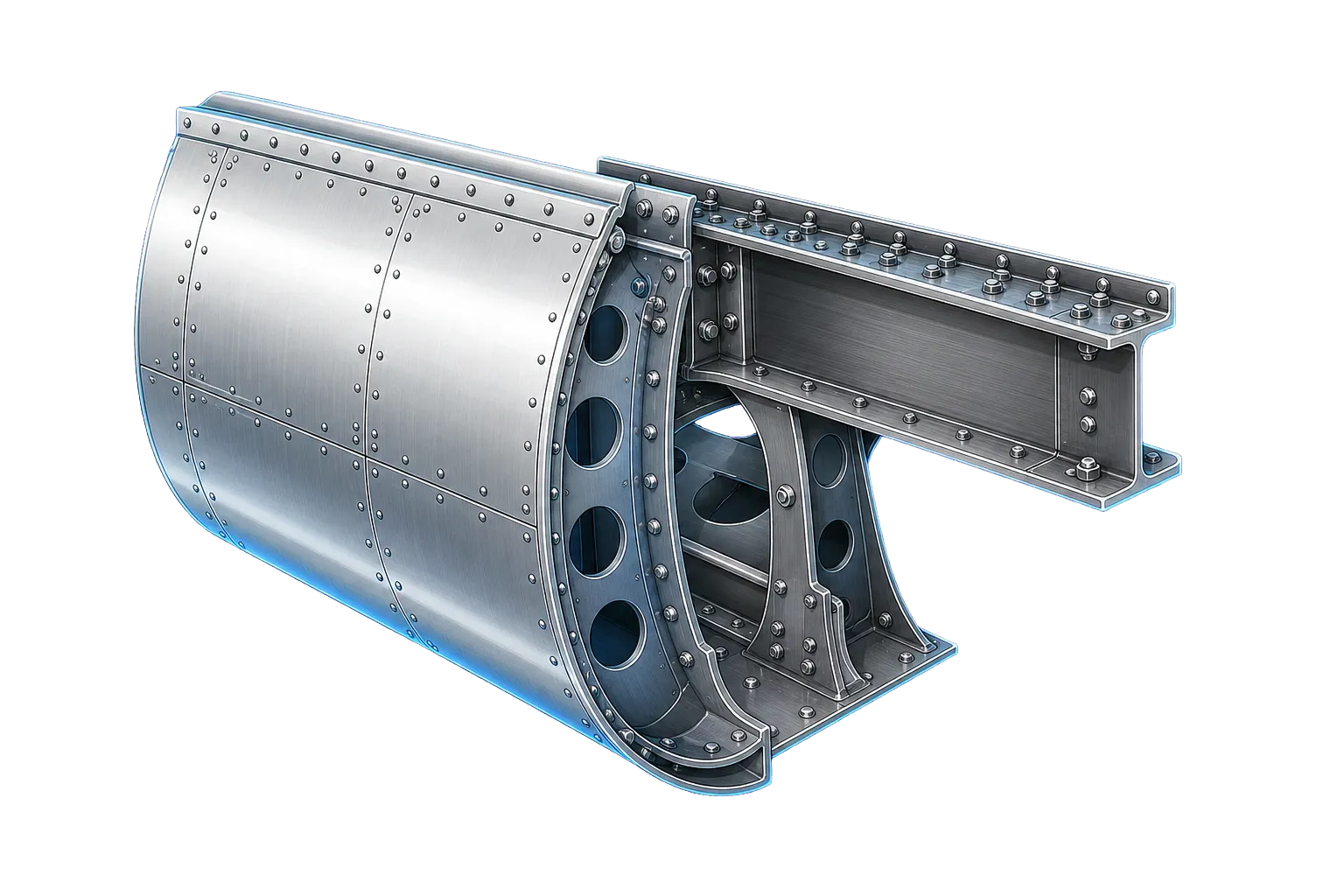
Cracking of the rear spar stiffeners in the wing center section, initiated at fastener holes below the lower chord of the rear spar, which could lead to failure of the keel beam structure.
AI-generated summary from the source AD text. Verify against the official source before acting.
Required Actions
Perform a one-time high-frequency eddy current inspection to detect cracking of the rear spar stiffeners at the left and right buttock lines 6.15. For crack-free stiffeners, install nested angles as a preventive modification. For cracked stiffeners, repair them using a method approved by the FAA or a Boeing Company Designated Engineering Representative.
AI-generated summary from the source AD text. Verify against the official source before acting.
Compliance Time
Within 60 days after the effective date of this AD or prior to the accumulation of the total number of flight cycles specified in Table 1 of Boeing Service Bulletin 737-57-1253, whichever occurs later.
AI-generated summary from the source AD text. Verify against the official source before acting.
Affected Aircraft
Boeing Model 737-600, -700, and -800 series airplanes, certificated in any category, line numbers 1 through 321 inclusive.
AI-generated summary from the source AD text. Verify against the official source before acting.
Federal Register Abstract
This amendment adopts a new airworthiness directive (AD) that is applicable to certain Boeing Model 737-600, -700, and -800 series airplanes. This action requires a one-time inspection to detect cracking of the rear spar stiffeners in the wing center section; and modification of crack-free stiffeners, or repair of cracked stiffeners. This amendment is prompted by a report of severed rear spar stiffeners of the center wing, which resulted in cracking in the adjacent keel beam structure. The actions specified in this AD are intended to prevent failure of the keel beam structure.
Document Text
Show stored source text (verify against official source)
[Federal Register Volume 65, Number 79 (Monday, April 24, 2000)]
[Rules and Regulations]
[Pages 21633-21634]
From the Federal Register Online via the Government Publishing Office [<a href="http://www.gpo.gov">www.gpo.gov</a>]
[FR Doc No: 00-9895]


========================================================================
Rules and Regulations
                                                Federal Register
________________________________________________________________________

This section of the FEDERAL REGISTER contains regulatory documents
having general applicability and legal effect, most of which are keyed
to and codified in the Code of Federal Regulations, which is published
under 50 titles pursuant to 44 U.S.C. 1510.

The Code of Federal Regulations is sold by the Superintendent of Documents.
Prices of new books are listed in the first FEDERAL REGISTER issue of each
week.

========================================================================


Federal Register / Vol. 65, No. 79 / Monday, April 24, 2000 / Rules
and Regulations

[[Page 21633]]


DEPARTMENT OF TRANSPORTATION

Federal Aviation Administration

14 CFR Part 39

[Docket No. 2000-NM-88-AD; Amendment 39-11694; AD 2000-08-08]
RIN 2120-AA64


Airworthiness Directives; Boeing Model 737-600, -700, and -800
Series Airplanes

AGENCY: Federal Aviation Administration, DOT.

ACTION: Final rule; request for comments.

-----------------------------------------------------------------------

SUMMARY: This amendment adopts a new airworthiness directive (AD) that
is applicable to certain Boeing Model 737-600, -700, and -800 series
airplanes. This action requires a one-time inspection to detect
cracking of the rear spar stiffeners in the wing center section; and
modification of crack-free stiffeners, or repair of cracked stiffeners.
This amendment is prompted by a report of severed rear spar stiffeners
of the center wing, which resulted in cracking in the adjacent keel
beam structure. The actions specified in this AD are intended to
prevent failure of the keel beam structure.

DATES: Effective May 9, 2000.
    The incorporation by reference of certain publications listed in
the regulations is approved by the Director of the Federal Register as
of May 9, 2000.
    Comments for inclusion in the Rules Docket must be received on or
before June 23, 2000.

ADDRESSES: Submit comments in triplicate to the Federal Aviation
Administration (FAA), Transport Airplane Directorate, ANM-114,
Attention: Rules Docket No. 2000-NM-88-AD, 1601 Lind Avenue, SW.,
Renton, Washington 98055-4056.
    The service information referenced in this AD may be obtained from
Boeing Commercial Airplane Group, P.O. Box 3707, Seattle, Washington
98124-2207. This information may be examined at the FAA, Transport
Airplane Directorate, 1601 Lind Avenue, SW., Renton, Washington; or at
the Office of the Federal Register, 800 North Capitol Street, NW.,
suite 700, Washington, DC.

FOR FURTHER INFORMATION CONTACT: Nenita Odesa, Aerospace Engineer,
Airframe Branch, ANM-120S, FAA, Transport Airplane Directorate, 1601
Lind Avenue, SW., Renton, Washington 98055-4056; telephone (425) 227-
2557; fax (425) 227-1181.

SUPPLEMENTARY INFORMATION: The FAA has received a report of severed
rear spar stiffeners of the center wing, which were found during
fatigue testing of the Model 737-800 series airplane. The cracks were
located in the stiffeners at the left and right buttock lines 6.15, and
initiated at fastener holes below the lower chord of the rear spar. The
broken stiffeners were caused by actual stresses being higher than
those used for design of the structure. Failure of the stiffeners
caused cracking in the adjacent keel beam structure. This condition, if
not corrected, could result in failure of the keel beam structure.
    Model 737-600 and -700 series airplanes have a similar structural
design and are therefore also subject to the identified unsafe
condition.

Explanation of Relevant Service Information

    The FAA has reviewed and approved Boeing Service Bulletin 737-57-
1253, dated December 16, 1999, which describes procedures for a one-
time high-frequency eddy current inspection to detect cracking in the
rear spar stiffeners at the fastener holes below the lower rear spar
chord of the wing center section. For crack-free stiffeners, the
service bulletin recommends a preventive modification, which involves
installing nested angles at the stiffeners at the left and right
buttock lines 6.15. For any cracked stiffener, the service bulletin
recommends, among other things, replacement of that stiffener.
Accomplishment of the actions specified in the service bulletin is
intended to adequately address the identified unsafe condition.

Explanation of the Requirements of the Rule

    Since an unsafe condition has been identified that is likely to
exist or develop on other airplanes of the same type design, this AD is
being issued to prevent failure of the keel beam structure. This AD
requires accomplishment of the actions specified in the service
bulletin described previously, except as discussed below.

Differences Between the Rule and Relevant Service Information

    The service bulletin recommends that cracked stiffeners be replaced
and that further repair be accomplished in accordance with instructions
from Boeing. However, this AD requires that repair of any cracked
stiffener be accomplished in accordance with a method approved by the
FAA.

Determination of Rule's Effective Date

    Since a situation exists that requires the immediate adoption of
this regulation, it is found that notice and opportunity for prior
public comment hereon are impracticable, and that good cause exists for
making this amendment effective in less than 30 days.

Comments Invited

    Although this action is in the form of a final rule that involves
requirements affecting flight safety and, thus, was not preceded by
notice and an opportunity for public comment, comments are invited on
this rule. Interested persons are invited to comment on this rule by
submitting such written data, views, or arguments as they may desire.
Communications shall identify the Rules Docket number and be submitted
in triplicate to the address specified under the caption ADDRESSES. All
communications received on or before the closing date for comments will
be considered, and this rule may be amended in light of the comments
received. Factual information that supports the commenter's ideas and
suggestions is extremely helpful in evaluating the effectiveness of the
AD action and determining whether additional rulemaking action would be
needed.
    Comments are specifically invited on the overall regulatory,
economic, environmental, and energy aspects of the rule that might
suggest a need to modify the rule. All comments

[[Page 21634]]

submitted will be available, both before and after the closing date for
comments, in the Rules Docket for examination by interested persons. A
report that summarizes each FAA-public contact concerned with the
substance of this AD will be filed in the Rules Docket.
    Commenters wishing the FAA to acknowledge receipt of their comments
submitted in response to this rule must submit a self-addressed,
stamped postcard on which the following statement is made: ``Comments
to Docket Number 2000-NM-88-AD.'' The postcard will be date stamped and
returned to the commenter.

Regulatory Impact

    The regulations adopted herein will not have a substantial direct
effect on the States, on the relationship between the national
Government and the States, or on the distribution of power and
responsibilities among the various levels of government. Therefore, it
is determined that this final rule does not have federalism
implications under Executive Order 13132.
    The FAA has determined that this regulation is an emergency
regulation that must be issued immediately to correct an unsafe
condition in aircraft, and that it is not a ``significant regulatory
action'' under Executive Order 12866. It has been determined further
that this action involves an emergency regulation under DOT Regulatory
Policies and Procedures (44 FR 11034, February 26, 1979). If it is
determined that this emergency regulation otherwise would be
significant under DOT Regulatory Policies and Procedures, a final
regulatory evaluation will be prepared and placed in the Rules Docket.
A copy of it, if filed, may be obtained from the Rules Docket at the
location provided under the caption ADDRESSES.

List of Subjects in 14 CFR Part 39

    Air transportation, Aircraft, Aviation safety, Incorporation by
reference, Safety.

Adoption of the Amendment

    Accordingly, pursuant to the authority delegated to me by the
Administrator, the Federal Aviation Administration amends part 39 of
the Federal Aviation Regulations (14 CFR part 39) as follows:

PART 39--AIRWORTHINESS DIRECTIVES

    1. The authority citation for part 39 continues to read as follows:

    Authority: 49 U.S.C. 106(g), 40113, 44701.


Sec. 39.13  [Amended]

    2. Section 39.13 is amended by adding the following new
airworthiness directive:

2000-08-08  Boeing: Amendment 39-11694. Docket 2000-NM-88-AD.

    Applicability: Model 737-600, -700, and -800 series airplanes;
certificated in any category; line numbers 1 through 321 inclusive.

    Note 1: This AD applies to each airplane identified in the
preceding applicability provision, regardless of whether it has been
modified, altered, or repaired in the area subject to the
requirements of this AD. For airplanes that have been modified,
altered, or repaired so that the performance of the requirements of
this AD is affected, the owner/operator must request approval for an
alternative method of compliance in accordance with paragraph (b) of
this AD. The request should include an assessment of the effect of
the modification, alteration, or repair on the unsafe condition
addressed by this AD; and, if the unsafe condition has not been
eliminated, the request should include specific proposed actions to
address it.

    Compliance: Required as indicated, unless accomplished
previously.
    To prevent failure of the keel beam structure, accomplish the
following:

Inspection

    (a) Prior to the accumulation of the total number of flight
cycles specified by Table 1, ``Compliance Thresholds,'' as
applicable, of Boeing Service Bulletin 737-57-1253, dated December
16, 1999; or within 60 days after the effective date of this AD,
whichever occurs later: Perform a one-time high-frequency eddy
current inspection to detect cracking of the rear spar stiffeners
that are located at the left and right buttock lines 6.15 of the
wing center section, in accordance with the service bulletin.
    (1) If no cracking is detected in either stiffener: Prior to
further flight, install the preventive modification on that
stiffener, in accordance with the service bulletin.
    (2) If any cracking is found in either stiffener, prior to
further flight, repair that stiffener in accordance with a method
approved by the Manager, Seattle Aircraft Certification Office
(ACO), FAA, Transport Airplane Directorate; or in accordance with
data meeting the type certification of the airplane approved by a
Boeing Company Designated Engineering Representative (DER) who has
been authorized by the Manager, Seattle ACO, to make such findings.
For a repair method to be approved by the Manager, Seattle ACO, as
required by this paragraph, the Manager's approval letter must
specifically reference this AD.

Alternative Methods of Compliance

    (b) An alternative method of compliance or adjustment of the
compliance time that provides an acceptable level of safety may be
used if approved by the Manager, Seattle ACO. Operators shall submit
their requests through an appropriate FAA Principal Maintenance
Inspector, who may add comments and then send it to the Manager,
Seattle ACO.

    Note 2: Information concerning the existence of approved
alternative methods of compliance with this AD, if any, may be
obtained from the Seattle ACO.

Special Flight Permits

    (c) Special flight permits may be issued in accordance with
sections 21.197 and 21.199 of the Federal Aviation Regulations (14
CFR 21.197 and 21.199) to operate the airplane to a location where
the requirements of this AD can be accomplished.

Incorporation by Reference

    (d) Except as required by paragraph (a)(2) of this AD, the
actions shall be done in accordance with Boeing Service Bulletin
737-57-1253, dated December 16, 1999. This incorporation by
reference was approved by the Director of the Federal Register in
accordance with 5 U.S.C. 552(a) and 1 CFR part 51. Copies may be
obtained from Boeing Commercial Airplane Group, P.O. Box 3707,
Seattle, Washington 98124-2207. Copies may be inspected at the FAA,
Transport Airplane Directorate, 1601 Lind Avenue, SW., Renton,
Washington; or at the Office of the Federal Register, 800 North
Capitol Street, NW., suite 700, Washington, DC.
    (e) This amendment becomes effective on May 9, 2000.

    Issued in Renton, Washington, on April 14, 2000.
Charles D. Huber,
Acting Manager, Transport Airplane Directorate, Aircraft Certification
Service.
[FR Doc. 00-9895 Filed 4-21-00; 8:45 am]
BILLING CODE 4910-13-P
Source: Official FAA Source ↗
Retrieved: Apr 6, 2026
Rights: U.S. Government Public Domain
This site is not affiliated with or endorsed by the FAA. Always verify with official sources.
Related Airworthiness Directives
2025-25-04
final ruleAirworthiness Directives; The Boeing Company Airplanes
Unsafe Condition: inflation of the escape slide while it is in the escape slide compartment, which could result in injury to passengers and crew during normal operation, or impede an emergency evacuation by renderin...
2025-19-12
final ruleAirworthiness Directives; The Boeing Company Airplanes
Unsafe Condition: Improper grinding of the inner diameter of the main landing gear (MLG) outer cylinders, resulting in possible heat damage to the outer cylinders. This could cause failure of a principal structural ...
2025-15-01 Recurring
final ruleAirworthiness Directives; The Boeing Company Airplanes
Unsafe Condition: A frame web crack at a certain fuselage station (STA) between certain stringers common to the frame web notch.
2025-07-03 Recurring
final ruleAirworthiness Directives; The Boeing Company Airplanes
Unsafe Condition: cracking in the station (STA) 663.75 frame fitting outboard chords and failsafe straps adjacent to the stringer S-18A straps, which could result in failure of a principal structural element (PSE) t...