AD 2000-04-14
Applicability
| Type | Manufacturer | Model | Details |
|---|---|---|---|
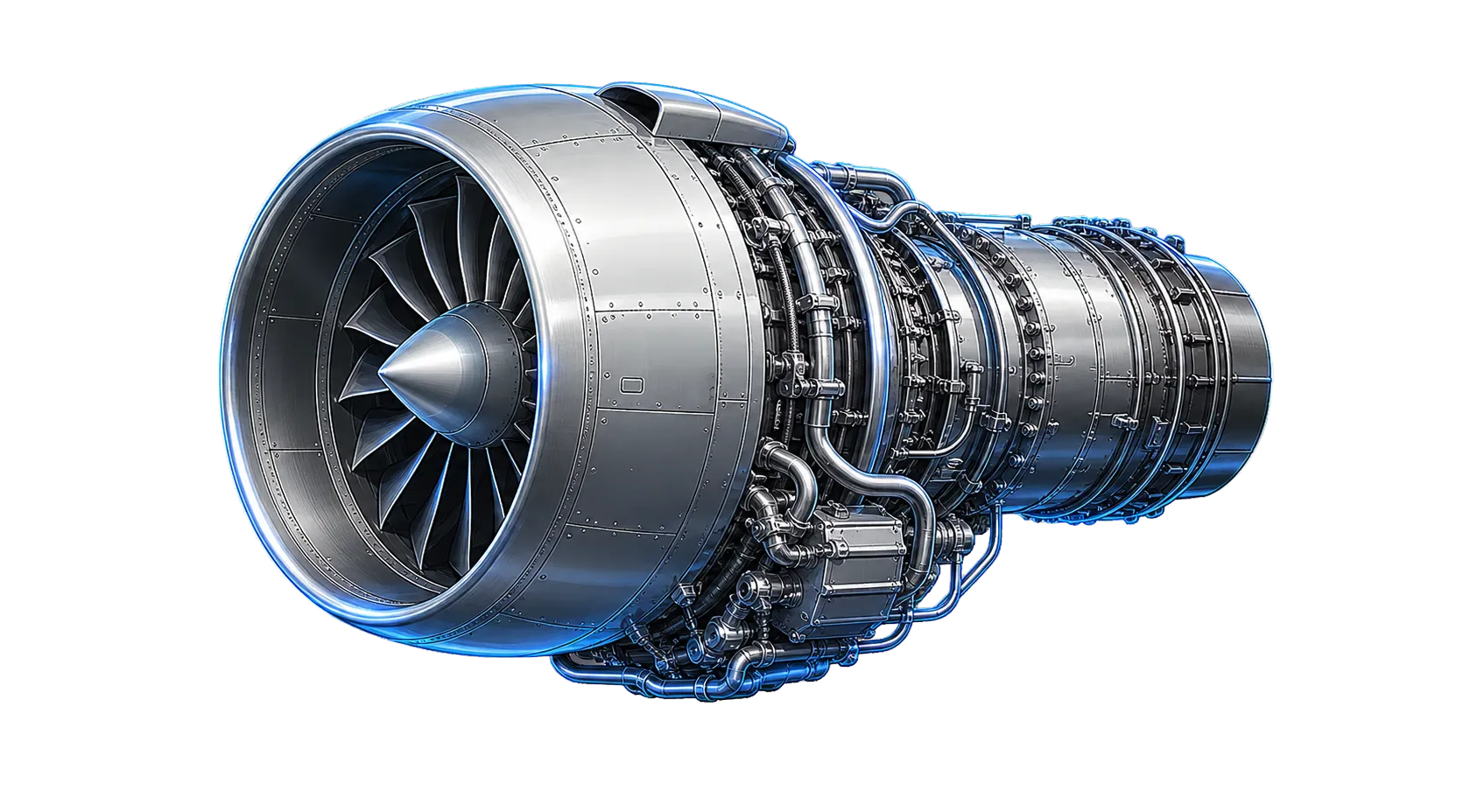
| engine | General Electric | Company CF6-80C2 Series | Airworthiness Directives; General Electric Company CF6-80C2 Series Turbofan Engines |
Unsafe Condition
High-pressure fuel leaks caused by improper seating of fuel tube flanges, which could result in an engine fire and damage to the airplane.
AI-generated summary from the source AD text. Verify against the official source before acting.
Required Actions
Replace the fuel tube connecting the flowmeter to the Integrated Drive Generator (IDG) and the fuel tube(s) connecting the Main Engine Control (MEC) or Hydromechanical (HMU) to the flowmeter with improved fuel tubes. This must be done during on-wing maintenance when the fuel tubes are disconnected or at the next shop visit.
AI-generated summary from the source AD text. Verify against the official source before acting.
Compliance Time
At the next opportunity when the fuel tubes are disconnected for on-wing maintenance or at the next shop visit.
AI-generated summary from the source AD text. Verify against the official source before acting.
Affected Aircraft
General Electric Company CF6-80C2 series turbofan engines, including models A1, A2, A3, A5, A8, A5F, B1, B2, B4, B6, B1F, B2F, B4F, B6F, B7F, and D1F, installed on but not limited to Airbus A300-600/600R, A310-200Adv/300, Boeing 747-200/300/400, 767-200ER/300/300ER/400ER, and McDonnell Douglas MD-11 series airplanes.
AI-generated summary from the source AD text. Verify against the official source before acting.
Federal Register Abstract
This amendment adopts a new airworthiness directive (AD), applicable to General Electric Company (GE) CF6-80C2 series turbofan engines, that requires replacement of the fuel tube connecting the flowmeter to the Integrated Drive Generator (IDG) and the fuel tube(s) connecting the Main Engine Control (MEC) or Hydromechanical (HMU) to the flowmeter with improved fuel tubes. This amendment is prompted by reports of fuel leaking in the core cowl cavity under high pressure that can be ignited by the hot engine case temperatures. The actions specified by this AD are intended to prevent high-pressure fuel leaks caused by improper seating of fuel tube flanges, which could result in an engine fire and damage to the airplane.
Document Text
Show stored source text (verify against official source)
[Federal Register Volume 65, Number 40 (Tuesday, February 29, 2000)]
[Rules and Regulations]
[Pages 10698-10700]
From the Federal Register Online via the Government Publishing Office [<a href="http://www.gpo.gov">www.gpo.gov</a>]
[FR Doc No: 00-4433]


-----------------------------------------------------------------------

DEPARTMENT OF TRANSPORTATION

Federal Aviation Administration

14 CFR Part 39

[Docket No. 99-NE-24-AD; Amendment 39-11597; AD 2000-04-14]
RIN 2120-AA64


Airworthiness Directives; General Electric Company CF6-80C2
Series Turbofan Engines

AGENCY: Federal Aviation Administration, DOT.

ACTION: Final rule.

-----------------------------------------------------------------------

SUMMARY: This amendment adopts a new airworthiness directive (AD),
applicable to General Electric Company (GE) CF6-80C2 series turbofan
engines, that requires replacement of the fuel tube connecting the
flowmeter to the Integrated Drive Generator (IDG) and the fuel tube(s)
connecting the Main Engine Control (MEC) or Hydromechanical (HMU) to
the flowmeter with improved fuel tubes. This amendment is prompted by
reports of fuel leaking in the core cowl cavity under high pressure
that can be ignited by the hot engine case temperatures. The actions
specified by this AD are intended to prevent high-pressure fuel leaks
caused by improper seating of fuel tube flanges, which could result in
an engine fire and damage to the airplane.

DATES: Effective May 1, 2000.
    The incorporation by reference of certain publications listed in
the regulations is approved by the Director of the Federal Register as
of May 1, 2000.

ADDRESSES: The service information referenced in this AD may be
obtained from General Electric Aircraft Engines, c/o Commercial
Technical Publications, 1 Neumann Way, Room 230, Cincinnati, OH 45215-
1988; telephone 513-552-2005, fax 513-552-2816. This information may be
examined at the Federal Aviation Administration (FAA), New England
Region, Office of the Regional Counsel, 12 New England Executive Park,
Burlington, MA; or at the Office of the Federal Register, 800 North
Capitol Street, NW, suite 700, Washington, DC.

FOR FURTHER INFORMATION CONTACT: Ian Dargin, Aerospace Engineer,
Certification Office, FAA, Engine and Propeller Directorate, 12 New
England Executive Park, Burlington, MA 01803-5299; telephone 781-238-
7178, fax 781-238-7199.

SUPPLEMENTARY INFORMATION: A proposal to amend part 39 of the Federal
Aviation Regulations (14 CFR part 39) to include an airworthiness
directive (AD) that is applicable to General Electric Company (GE) CF6-
80C2 series turbofan engines was published in the Federal Register on
September 8, 1999 (64 FR 48721). That action proposed to require
replacement of the fuel tube connecting the flowmeter to the Integrated
Drive Generator (IDG) and the fuel tube(s) connecting the Main Engine
Control (MEC) or Hydromechanical (HMU) to the flowmeter with improved
fuel tubes. That action was prompted by reports of fuel leaking in the
core cowl cavity under high pressure that can be ignited by the hot
engine case temperatures. That condition, if not corrected, could
result in high-pressure fuel leaks caused by improper seating of fuel
tube flanges, which could result in an engine fire and damage to the
airplane.

Comments Received

    Interested persons have been afforded an opportunity to participate
in the making of this amendment. Due consideration has been given to
the comments received.

Compliance Time for Fuel Tube Replacement

    Four commenters state that the compliance time should be the next
shop visit only, not at the next time the fuel tubes are disconnected
for on-wing maintenance.
    One commenter believes that requiring compliance the next time the
fuel tubes are disconnected for on-wing maintenance would call for
stocking parts in many locations and would prevent possible non-
compliance of this AD should an unscheduled on-wing maintenance
activity occur.
    One commenter believes that line maintenance personnel would
require a system that tells them which fuel tubes need to be replaced
and therefore performing the proposed requirements at a shop visit
would be preferable.
    Two commenters believe that tracking the accomplishment of this AD
would be a burden and proposes that replacement of the fuel tubes after
a fixed number of hours or at the next shop visit would be preferable.

FAA Response

    The FAA does not concur. While parts availability and tracking of
on wing maintenance can be a burden, the risk associated with any
additional maintenance action only increases the chance of improper
installation and a high-pressure fuel leak unless these old fuel tubes
are replaced with the new design fuel tubes at the first opportunity.
The new design fuel tubes will prevent hang-up of the flange on the
fuel tube, allowing proper seating and preventing fuel leaks. Although
there may be situations where a fuel tube is unavailable, the
commenters provide no additional data or information that would support
their changes that still show an acceptable mitigation of risk of a
fuel tube leak and fire.
    One commenter provided useful information as to which fuel tubes
the line maintenance personnel should replace for on wing maintenance.
The FAA requires only those fuel tubes that are disconnected to be
replaced during on-wing maintenance and has added a clarifying
statement to this final rule.
    Similarly, one commenter provided a definition of ``disconnected''
and the FAA has added a clarifying statement to this final rule to
indicate that disconnecting at ``either end'' triggers this AD for on
wing maintenance.

[[Page 10699]]

Recommendation for On-Wing Maintenance or Attaching a Label to the
Fuel Tubes

    One commenter suggests recommending fuel tube replacement rather
than mandating it. The commenter also suggests attaching a label to the
fuel tube. The commenter is concerned that in the event of unplanned
maintenance trouble shooting, the AD may not be complied with. The FAA
does not concur. Although the idea of a label might be useful, the FAA
does not believe that the use of labels should be mandated. AD
compliance should be managed under the individual operator's
maintenance system. Furthermore, the FAA believes that it is necessary
to have the fuel tube replacement accomplished at the earlier of on-
wing maintenance or a shop visit, and that making the on-wing
maintenance only a recommendation would not achieve the desired level
of safety. The FAA has determined that continued use of the old fuel
tubes constitutes an unacceptable risk and that this AD is necessary to
achieve a substantial mitigation of that risk through the mandated
replacement of the old fuel tubes with fuel tubes of an improved
design. As previously stated, any additional maintenance action only
increases the chance of improper installation and a high-pressure fuel
leak unless these old fuel tubes are replaced with the new design fuel
tubes at the first opportunity.

Hard Time or Calendar Date Removal

    One commenter states that the proposal should mandate fuel tube
replacement at a hard time or calendar date, and that the fuel tube
replacement would best be accomplished at a shop visit. The commenter
states that line maintenance actions would be more difficult to record
than during a shop visit. The commenter also suggests that a trial
period would be necessary to review the procedure. The FAA does not
concur. While replacement on a fixed date would accomplish the required
objective, replacement of fuel tubes, it would also result in requiring
operators to disconnect tubes that have been on-wing and have not had
an indication of a leak. Initiating action on a system that is
functioning properly may result in potentially more risk and is
therefore not desirable. The FAA believes that any training that may be
necessary should be controlled by the operator under its individual
maintenance system.

Concurrence

    One commenter concurs with the rule as proposed.

Conclusion

    After careful review of the available data, including the comments
noted above, the FAA has determined that air safety and the public
interest require the adoption of the rule with the changes described
previously.

Economic Analysis

    There are approximately 2,693 engines of the affected design in the
worldwide fleet. The FAA estimates that 581 engines installed on
airplanes of U.S. registry will be affected by this proposed AD, that
it will take approximately 0.5 work hours per engine to accomplish the
required actions, and that the average labor rate is $60 per work hour.
Of the 581 engines, some have already complied with the GE Alert
Service Bulletins (ASBs). There is no cost impact to the domestic fleet
for parts complying with ASB 73-A224 since all domestic engines are now
in compliance. To comply with ASB 73-A0231, required parts would cost
$2,858 per engine for the remaining 128 domestic FADEC engines, and
$1,229 per engine for the remaining 138 domestic Power Management
Control (PMC) engines. Based on these figures, the total cost impact of
the AD on US operators is estimated to be $535,426.

Regulatory Impact

    The regulations adopted herein will not have a substantial direct
effect on the States, on the relationship between the national
Government and the States, or on the distribution of power and
responsibilities among the various levels of government. Therefore, it
is determined that this final rule does not have federalism
implications under Executive Order (EO) No. 13132.
    For the reasons discussed above, I certify that this action (1) is
not a ``significant regulatory action'' under EO No. 12866; (2) is not
a ``significant rule'' under DOT Regulatory Policies and Procedures (44
FR 11034, February 26, 1979); and (3) will not have a significant
economic impact, positive or negative, on a substantial number of small
entities under the criteria of the Regulatory Flexibility Act. A final
evaluation has been prepared for this action and it is contained in the
Rules Docket. A copy of it may be obtained from the Rules Docket at the
location provided under the caption ADDRESSES.

List of Subjects in 14 CFR Part 39

    Air transportation, Aircraft, Aviation safety, Incorporation by
reference, Safety.

Adoption of the Amendment

    Accordingly, pursuant to the authority delegated to me by the
Administrator, the Federal Aviation Administration amends part 39 of
the Federal Aviation Regulations (14 CFR part 39) as follows:

PART 39--AIRWORTHINESS DIRECTIVES

    1. The authority citation for part 39 continues to read as follows:

    Authority: 49 U.S.C. 106(g), 40113, 44701.


Sec. 39.13  [Amended]

    2. Section 39.13 is amended by adding the following new
airworthiness directive:

2000-04-14  General Electric Company: Amendment 39-11597. Docket 99-
NE-24-AD.

    Applicability: General Electric Company (GE) CF6-80C2 A1/ A2/
A3/ A5/ A8/ A5F/ B1/ B2/ B4/ B6/ B1F/ B2F/ B4F/ B6F/ B7F/ D1F
turbofan engines, installed on but not limited to Airbus Industrie
A300-600/ 600R series and A310-200Adv/ 300 series, and Boeing 747-
200/ 300/ 400 series and 767-200ER/ 300/ 300ER/ 400ER and McDonnell
Douglas MD-11 series airplanes.

    Note 1: This airworthiness directive (AD) applies to each engine
identified in the preceding applicability provision, regardless of
whether it has been modified, altered, or repaired in the area
subject to the requirements of this AD. For engines that have been
modified, altered, or repaired so that the performance of the
requirements of this AD is affected, the owner/operator must request
approval for an alternative method of compliance in accordance with
paragraph (d) of this AD. The request should include an assessment
of the effect of the modification, alteration, or repair on the
unsafe condition addressed by this AD; and, if the unsafe condition
has not been eliminated, the request should include specific
proposed actions to address it.

    Compliance: Required as indicated, unless accomplished
previously.
    To prevent improper fuel tube flange seating, resulting in high
pressure fuel leaks, which could result in an engine fire and damage
to the airplane, accomplish the following:

Replacement

    (a) At the next time the fuel tubes are disconnected at either
end for on-wing maintenance, or the next shop visit after the
effective date of this AD, whichever occurs first, replace the old
configuration fuel tubes with the improved tubes. For on-wing
maintenance, replace only the fuel tube(s) that have been
disconnected. Perform the actions as follows:

[[Page 10700]]

    (1) Replace the fuel flowmeter to Integrated Drive Generator
(IDG) cooler fuel tube, part number (P/N) 1321M42G01, with a
serviceable part in accordance with paragraph 2 of GE Alert Service
Bulletin (ASB) No. 73-A224, Revision 2, July 9, 1997, and perform a
leak check after accomplishing the replacement.

Power Management Controls

    (2) For engines with Power Management Controls, replace the Main
Engine Control (MEC) to fuel flowmeter fuel tube, P/N 1334M88G01,
and bolts, P/N MS9557-12, with serviceable parts, in accordance with
paragraph 3A of GE ASB 73-A0231, Revision 1, dated May 3, 1999 and
perform a leak check after accomplishing the replacement.

Full Authority Digital Electronic Controls

    (3) For engines with Full Authority Digital Electronic Controls
replace the Hydromechanical Unit (HMU) to fuel flowmeter fuel tubes,
P/Ns 1383M12G01 and 1374M30G01 with serviceable parts, in accordance
with paragraph 3B of GE ASB 73-A0231, Revision 1, dated May 3, 1999
and perform a leak check after accomplishing the replacement.

    Note 2: Information on performing the leak check can be found in
the Aircraft Maintenance Manual, 71-00-00.

Definitions

    (b) For the purpose of this AD, a shop visit is defined as any
time an engine is removed from service and returned to the shop for
any maintenance.
    (c) For the purpose of this AD, a serviceable part is defined as
any part other than tube, P/N 1321M42G01, for the fuel flowmeter to
IDG cooler; tube; P/N 1334M88G01, and bolt, P/N MS9557-12, for the
MEC to fuel flowmeter tube; and tubes, P/Ns 1383M12G01 and
1374M30G01, for the HMU to fuel flowmeter fuel tubes.

Alternative Methods of Compliance

    (d) An alternative method of compliance or adjustment of the
compliance time that provides an acceptable level of safety may be
used if approved by the Manager, Engine Certification Office.
Operators shall submit their requests through an appropriate FAA
Principal Maintenance Inspector, who may add comments and then send
it to the Manager, Engine Certification Office.

    Note 3: Information concerning the existence of approved
alternative methods of compliance with this airworthiness directive,
if any, may be obtained from the Engine Certification Office.

Ferry Flights

    (e) Special flight permits may be issued in accordance with
sections 21.197 and 21.199 of the Federal Aviation Regulations (14
CFR 21.197 and 21.199) to operate the aircraft to a location where
the requirements of this AD can be accomplished.

Incorporation by Reference

    (f) The actions required by this AD shall be done in accordance
with the following GE ASBs: 73-A224, Revision 2, July 9, 1997, and
73-A0231, Revision 1, May 3, 1999. This incorporation by reference
was approved by the Director of the Federal Register in accordance
with 5 U.S.C. 552(a) and 1 CFR part 51. Copies may be obtained from
General Electric Aircraft Engines, c/o Commercial Technical
Publications, 1 Neumann Way, Room 230, Cincinnati, OH 45215-1988;
telephone 513-552-2005, fax 513-552-2816. Copies may be inspected at
the FAA, New England Region, Office of the Regional Counsel, 12 New
England Executive Park, Burlington, MA; or at the Office of the
Federal Register, 800 North Capitol Street, NW, suite 700,
Washington, DC.
    (g) This amendment becomes effective on May 1, 2000.

    Issued in Burlington, Massachusetts, on February 17, 2000.
Ronald A. Vavruska,
Acting Manager, Engine and Propeller Directorate, Aircraft
Certification Service.
[FR Doc. 00-4433 Filed 2-28-00; 8:45 am]
BILLING CODE 4910-13-U
Source: Official FAA Source ↗
Retrieved: Apr 6, 2026
Rights: U.S. Government Public Domain
This site is not affiliated with or endorsed by the FAA. Always verify with official sources.